Terror on the Football Pitch: Adamawa Community Recount ISWAP Attack
In April, ISWAP opened fire on a full football pitch in Guyaka, a rural community in northeastern Nigeria. At least 33 residents were killed, and seven others sustained injuries and are currently receiving treatment. The attack, the first on the community in over a decade, has forced many residents to flee, and those left behind are living in fear.
Listen to this story

11 May 2026
The referee blew the whistle a few minutes before 5 p.m., on April 26, to kick off the second half of a football game. The players re-emerged on the field, and the spectators once again gathered to witness the second round of the Guyaku Local Championship Football League in the Sabon Gari area of Guyaku, a small community in the Gombi Local Government Area (LGA) of Adamawa State, northeastern Nigeria.
Just minutes into the match, another sound pierced the air across the football pitch, but it wasn’t the referee’s whistle this time. It was sporadic gunshots that alerted the players and the spectators that something terrible was about to unfold.
The gunshots continued from different directions, their sound drawing closer. As the confused crowd tried to make sense of the situation, some armed men arrived at the football field on motorcycles. They opened fire on the crowd, and in that instant, people scrambled for safety, while others fell dead on the pitch.
Within minutes, Istifanus Hassan, an eyewitness who narrowly survived the attack, said that everywhere was thrown into chaos as screams and smoke filled the air.
“We ran into the bushes, but they [terrorists] followed people with their motorcycles and were shooting them in the bush,” he recalled. Although he survived, Istifanus said what he witnessed while hiding in a nearby bush that evening may haunt him forever.
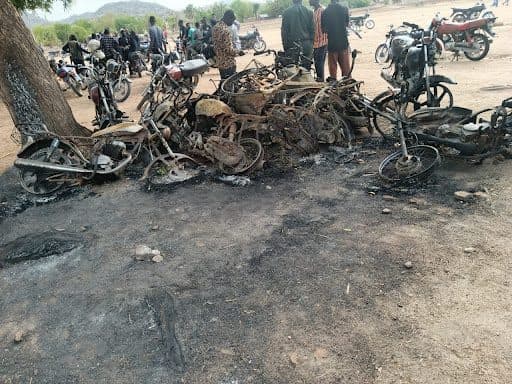
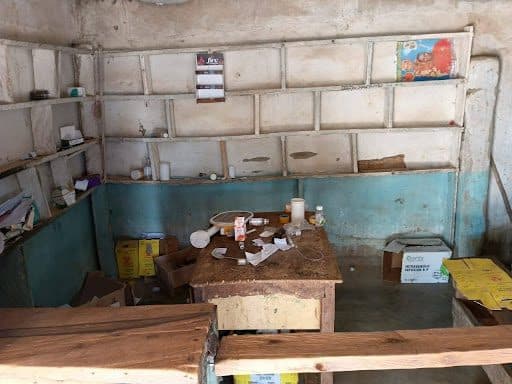
The terrorists burnt down houses, motorcycles, shops, and a church. They also looted at least three grocery shops and a chemist. “They used motorcycles to pack the items after killing the shop owners. They packed all the items and burnt the shops down,” he said, adding that they made away with medicines as well.
“I watched my community members and relatives fall dead to the ground. The men were targeted and shot in the head, and the women were spared,” Istifanus said.
But not every woman survived the attack. Other residents told HumAngle that all the women captured by the terrorists were left unharmed, but two women lost their lives in the incident. Their deaths were attributed to stray bullets.
One of the deceased was 28-year-old Sintiki Dimas, who went to the football pitch to sell snacks to spectators. As a petty trader, Sintiki relied on selling local snacks like kuli-kuli to support herself and her younger siblings.
Her mother, Bata Dimas, said Sintiki was killed while trying to flee, adding that her daughter’s trade was a great source of support to her eight younger siblings and the rest of the family.
The other woman, who also lost her life in the attack, was fleeing with her toddler strapped to her back when a bullet hit and killed her. “The baby was also shot on his leg, but he’s currently receiving treatment,” an eyewitness, who asked not to be named, told HumAngle.
The attack continued for hours.
By the following day, the Islamic State West African Province (ISWAP), a Boko Haram breakaway, had claimed responsibility for the assault. The attack, which killed at least 33 residents and injured seven others, happened barely two months after ISWAP attacked a military base in Hong, a nearby local government area.
Residents say it exposed longstanding security gaps in the border community, triggered fresh displacement, and revived fears of a return to the deadly years of insurgent violence that have devastated the region.
The first attack in a decade
It is not the first time terrorists have invaded Guyaku, but it is the first time since 2015, when the Boko Haram insurgency was at its peak in Adamawa. Then, “they burnt almost the entire village to the ground that year, but luckily, we all fled, and no one was harmed,” said Hamman Basmani, the Wakili (community leader) of Guyaku.
By 2016, most residents who had fled the area had returned and resumed their usual activities.
Guyaku is an agrarian community, and residents – over a thousand of them, according to Hamman – mainly rely on farming for survival. Since the 2015 attack, he said, the residents had lived peacefully until the recent incident.
While other residents returned to Guyaku after the 2015 incident, Barnabas Benaiah was among those who did not. He relocated to Hong with his nuclear family, while his extended family remained in Guyaku.
“I’m not currently staying in Guyaku, but I’m always there,” he said, meaning that he visits regularly. He added that he feels attached to his hometown, which is why he stayed in a neighbouring town.
When ISWAP attacked Guyaku in April, Barnabas lost three family members. Two were his brothers, and the other was his niece. “They [his brothers] all had families and had left behind pregnant wives,” he told HumAngle.
Barnabas noted that the attack in Guyaku was tactical.
“They were after men,” he said, echoing testimonies from other residents. “Mostly young men, so they targeted spots where these men could be found, such as the football pitch, local joints, and front yards. They shot the men in the head, and when they encountered women, they told them to walk away because they had nothing to do with them. The women who died were hit by flying bullets.”
A recent academic study on gendercide in the Lake Chad insurgency found that such patterns have appeared in previous ISWAP and Boko Haram attacks, where adult men are often perceived as potential fighters, vigilantes, informants, or collaborators with the state.
Residents say the terrorists pursued residents who ran towards neighbouring communities and killed them, while also looting valuables, such as motorcycles. “They went to a commercial charging store and packed all the phones from there. They were still looting shops when soldiers from Garkida town arrived, so they abandoned some of the items and ran,” Barnabas said.
Tela Bala, Kwari, Kwana, and other communities within Guyaku were also affected. “[Several] people from these communities have now fled to urban centres,” he added.
Istifanus remained in the bush until the gunshots ceased. He came out and joined other residents in recovering dead bodies. Most of the corpses were found at the football pitch, while some were recovered in front of houses and across the street.
“The corpses I saw and counted that day were up to 28, but I couldn’t stay to continue identifying the bodies,” he recounted. “I became emotional and left.”
Hamman, the community leader, told HumAngle that other bodies were recovered in the bushes and roads leading to other villages days afterwards. He said that 33 bodies were found; 30 of them were men, and most were young.
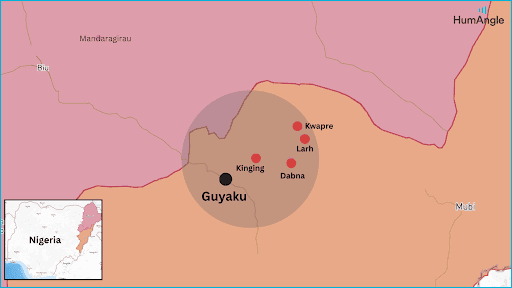
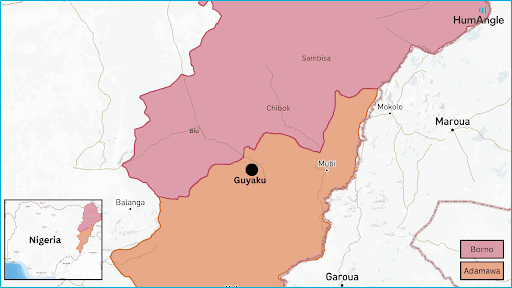
Guyaku sits in Adamawa’s northwestern region. It is about 20 km from the border with Borno State and less than 15 kilometres from Kwapre, Banga, Larh, and Dabnz Kinging communities, each of which has been abandoned due to Boko Haram attacks over the years.
Guyaku, along with these border communities, falls within known terror hotspots, including forests like Alagarno and towns like Mandaragairu, where terrorists often operate and move through to attack surrounding hinterland communities along the southern Borno-Adamawa border.
In April, HumAngle reported how these abandoned agrarian communities fall within the direct line of influence of terror groups from major enclaves like Sambisa Forest and the other forests connecting local bushes in Adamawa State to those across the border in Borno, allowing them to remain geographically threatened by these groups.
Tale of terror
For residents in these communities, nowhere is safe anymore. During the April 26 attack, 39-year-old Alheri Gabriel was sitting outside his house, playing cards with his friends, when the terrorists rode towards them on motorcycles.
“At first, I was confused, and I thought they were trying to catch a thief because someone was running in front of them. I thought he was a thief, and had I tried to help them catch him, but I noticed they had guns,” Alheri recounted.
Suddenly, the terrorists ordered him to come forward, but he hesitated, and when they pointed a gun at him, he immediately started running as fast as his legs could carry him.
“While I was running, they shot me in the left shoulder, but I didn’t stop. I continued running, and they pursued me with their motorcycles, but I fled into a house and hid there until they lost track of me,” he told HumAngle.
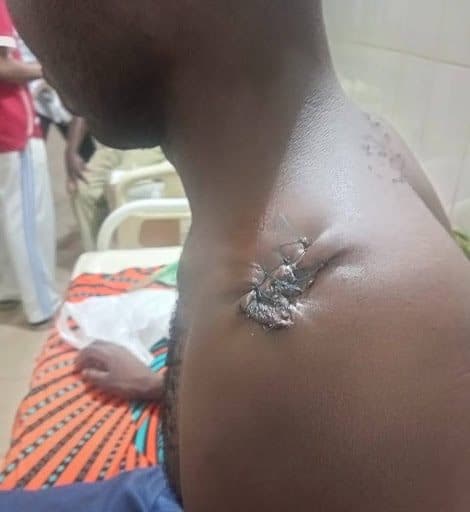
He remained hidden while blood continued to gush from his injured shoulder. When the shooting ceased, he staggered into the street and was assisted by other residents. Alheri was first rushed to a hospital in Gombi town, along with other injured people, before being transferred to the Modibbo Adama University Teaching Hospital in Yola, the Adamawa State capital, for further treatment.
Later, he learnt the men he had been playing cards with were all shot and their bodies set ablaze by the terrorists in the front yard.
He underwent surgery on May 1 and is still recovering, but he fears his life will never be the same. “I have a wife and young children. I’m a skilled photographer and a barber, and I don’t think I’ll be able to recover soon or resume work,” he said.
With a family to feed, Alheri hopes to recover soon so he can return to his business. However, something has changed. “I don’t think I’ll return to Guyaku,” he said.
His wife and children have fled to another town, where they are living with relatives.
Empty streets
More than a week after the ISWAP attack, residents – especially women and children – have continued to flee Guyaku despite assurances from the Adamawa State government that security would be strengthened in the area and that justice would be served.
“Only the men are left here, and we are not more than 20,” Hamman said, adding that residents are worried about the security gaps that exist in the area.
During an assessment visit two days after the attack, Ahmadu Fintiri, the Governor of Adamawa State, said, “We are intensifying security operations immediately to restore peace and ensure every resident feels safe in their home again. We will rebuild, and we will remain resilient.”
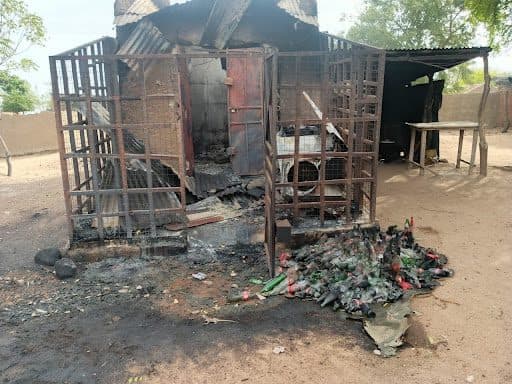
Despite those assurances, residents say the security presence in the community has remained inadequate. Although a group of soldiers, local vigilantes, and hunters were stationed there in the early days after the attack, the military officers have since withdrawn.
“The local security team goes round the community, but there is no security post or unit we can report to during emergencies,” Hamman said.
For many residents, however, the absence of formal security is not new. Guyaku has long relied on the local vigilante group for security, but they are poorly equipped to repel major terror attacks. The nearest police stations are in Gombi and Garkida, about a 30- to 40-minute drive away.
The lingering insecurity has also disrupted efforts to bury some of the victims. Barnabas said some of the corpses are yet to be buried as their family members have since fled the area. “A mass burial was scheduled, but no agreement was reached, so individuals began burying their dead, and those whose relatives fled were paired with other victims,” he said. “At the cemetery, we got a call that the terrorists had just been spotted, and that was how the burial rites were abandoned. Everyone fled,” he stated.
Hamman, who continues to lead the community during the crisis, said residents are pleading with the government to deploy more security personnel to the area.
“[They should] send soldiers to join hands with the vigilantes and protect us. If people see security personnel patrolling the area, they will want to come home. But if there are no security personnel, even if the people want to come back home, they will be discouraged.”
Support Our Journalism
There are millions of ordinary people affected by conflict in Africa whose stories are missing in the mainstream media. HumAngle is determined to tell those challenging and under-reported stories, hoping that the people impacted by these conflicts will find the safety and security they deserve.
To ensure that we continue to provide public service coverage, we have a small favour to ask you. We want you to be part of our journalistic endeavour by contributing a token to us.
Your donation will further promote a robust, free, and independent media.
Comments
0 comments
No comments yet.
Sign in to join the discussion.
Of course, we want our exclusive stories to reach as many people as possible and would appreciate it if you republish them. We only ask that you properly attribute to HumAngle, generally including the author's name, a link to the publication and a line of acknowledgement.