Inside the Nigerian Military’s Quiet Gains Against a Fragmented War
From Sambisa to Zamfara, the Niger Delta creeks to the volatile South-East, Nigeria’s military has delivered real, hard-fought gains against diverse threats. However, weak governance continues to erode these gains. The state cannot hold ground it never governed properly. The result is a cycle where progress is made, then steadily undone.

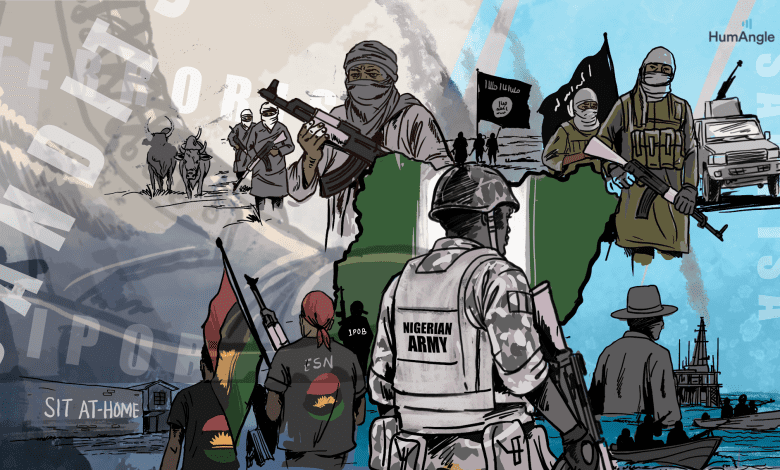
In Nigeria’s North East, the Boko Haram insurgent group once carved out territory and declared a caliphate. In the North West, terrorist groups operate as fluid, profit-driven networks, embedding themselves in local economies. In the Middle Belt, communal violence reflects deeper contests over land, identity, and survival. In the South East, separatist agitation by the Indigenous People of Biafra (IPOB) has fused with armed enforcement and criminal opportunism. Along the southern waterways, oil theft and piracy threaten economic lifelines.
Across all these theatres, one institution has remained consistently engaged: the Nigerian military, often as the default responder in the absence of effective civilian governance. Public perception often frames this engagement as a failure as attacks continue and civilians remain vulnerable. A closer, evidence-based reading tells a more complex story, however, though available data remains incomplete and, at times, contested.
The Nigerian military appears to have adapted under pressure and recalibrated aspects of its doctrine, and, in key moments, helped reverse trajectories that once pointed toward state collapse. It has delivered tangible gains, some strategic, others tactical, many costly. Still, those gains sit on unstable ground because governance gaps, political interference, corruption, and weak institutional follow-through have repeatedly blunted them. Communities liberated from one threat find themselves exposed to another.
The North East war: reversing a collapse
By early 2015, Nigeria was on the brink of losing control in the North East. Boko Haram had evolved from an insurgent group into a territorial force controlling large swathes of Borno State and parts of Yobe and Adamawa. It administered territory, collected taxes, and imposed its authority over local populations. Gwoza was declared the headquarters of a so-called caliphate. Entire communities were displaced, and military formations overrun.
The turning point came with a shift in military posture, in which command structures were reconfigured, and the operational headquarters was relocated to Maiduguri, the Borno State capital, bringing leadership closer to the frontline. Coordination with regional forces under the Multinational Joint Task Force (MJTF) also intensified as air and ground operations were synchronised.
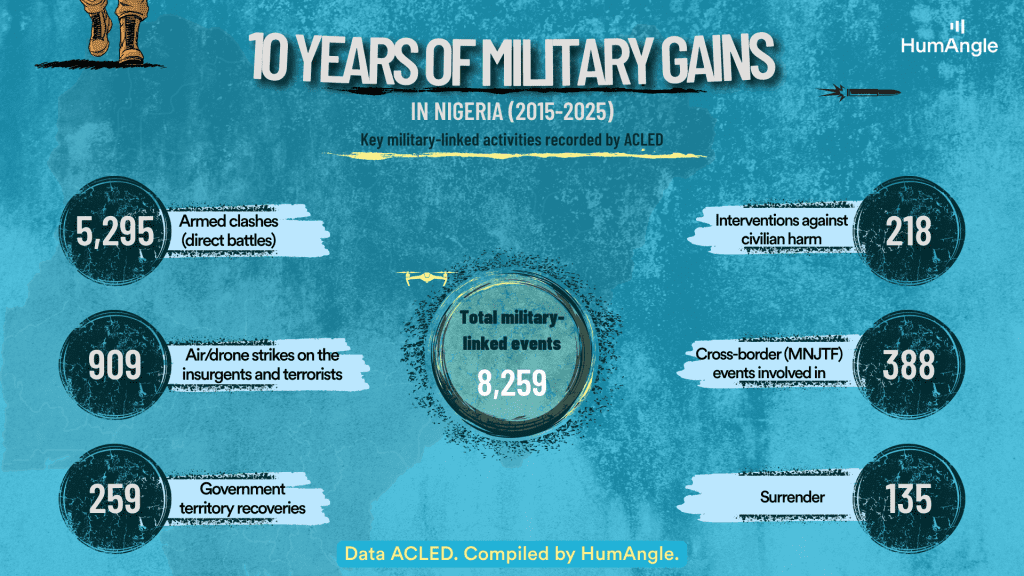
The results were immediate and significant, though the durability of these gains has varied across locations. Key towns like Monguno, Bama, Dikwa, and even Gwoza, the symbolic heart of Boko Haram’s territorial claim, fell back under government control in rapid succession. Data from ACLED shows that between 2015 and 2025, the military recovered at least 259 territories.
With this territorial success, supply routes were disrupted, and fighters were killed in large numbers. Civilians began to return to these areas, in some cases under fragile security conditions.
It marked the collapse of Boko Haram’s experiment with territorial governance, and the battle for Sambisa Forest reinforced this shift.
For years, Sambisa had functioned as a strategic sanctuary where fighters trained, hostages were held, and leadership structures operated with relative security. It also carried psychological weight. As long as Sambisa remained intact, Boko Haram retained a sense of permanence.
The military’s assault on the forest required sustained effort involving navigating difficult terrain, dealing with improvised explosive devices, and confronting entrenched fighters. Airstrikes softened targets while ground troops advanced in phases, enabling special forces units to penetrate deeper into the forest.
The symbolic impact was significant, though not decisive in ending insurgent capacity. Boko Haram could no longer claim a fixed territorial base for as long as was once the case. Its command structure was disrupted, and its image of invincibility weakened.
And so Boko Haram fragmented into factions. The Islamic State West Africa Province (ISWAP) emerged as a more structured and strategic actor while the Shekau-led faction became more erratic, marked by extreme violence and unpredictability.
The military adjusted again.
Operations shifted from territory holding to mobility and disruption. Intelligence-led raids targeted leadership and logistics. Airpower became central to deep strikes in difficult terrain. Operation Lafiya Dole, the codename for the counter-insurgency operation, transitioned into Operation Hadin Kai, reflecting a recalibrated effort.
Today, the insurgency remains active, particularly in remote areas and along the Lake Chad basin. But the scale and nature of the threat have changed.
The North West: fighting a war without frontlines
The North West posed a different challenge. Armed groups here are diffuse. It lacks a central command and is driven by economic incentives rather than ideology, so groups form, splinter, and realign quickly. Local grievances and criminal enterprise also intersect here.
Estimates suggest tens of thousands of terrorists operate across this region, covering multiple states including Zamfara, Katsina, Kebbi, Sokoto, and Kaduna. This fragmentation complicates the military response, as frontlines, headquarters, and leadership structures (the usual strategic targets) are not clear. The military has responded by leaning heavily on airpower and targeted ground operations. This has not gone without major problems, such as the repeated “accidental bombing” of civilian populations, which have drawn criticism from rights groups and affected communities.
Still, airstrikes have been used to hit camps deep within forested areas that are difficult for ground troops to access. Intelligence plays a critical role in identifying targets. Data shows that the sustained air campaign has yielded at least 909 strikes and 10,237 fatalities in 10 years. ACLED data shows that about 560 of these fatalities were civilians.
Ground forces usually conduct follow-up operations to recover weapons and temporarily secure areas.
Large numbers of kidnapped victims have been rescued during coordinated operations. Livestock, often a key economic asset for communities, has been retrieved. Such attacks have also killed some high-profile terrorist leaders, but they have also led to the loss of officers.
In some areas, these operations appear to have had a temporary stabilising effect, though violence frequently resurges. Communities report periods of reduced attacks, farming activities have resumed in limited corridors, and confidence in security presence has improved, though often temporarily.
Still, armed violence regenerates as the effects of weak governance in the North East are the same in the North West: new leaders emerge, and fighters disperse and regroup. Economic incentives remain strong.
The Middle Belt: stabilising a political conflict
Violence in the Middle Belt is often described as a farmer-herder conflict, but the region’s violence reflects a complex mix of land disputes, ethnic tensions, and environmental stress. Armed militias operate alongside opportunistic criminal actors, while cycles of reprisal deepen mistrust between communities.
There are too many dynamics in play here to reduce the crisis to a “military versus any specific group” conflict. Most of the time, softer kinetic actions, such as arrest and deterrence, are used.
In certain corridors, the presence of military forces has reduced the frequency of mass casualty events. But the limits are clear. Several parts of the region still depend on self-help vigilante groups, who are often outgunned during terror attacks.
There is also a growing distrust between communities and security operatives, who are sometimes accused of slow response and complicity. In April, residents of Gashish, a rural community in Barkin Ladi Local Government Area of Plateau State, staged a protest over continued attacks in the community despite military presence. A checkpoint manned by troops of Operation Enduring Peace was destroyed during the demonstration.
The military has denied such accusations, but independent verification remains limited.
However, in other areas, the visibility of armed forces has also had a deterrent effect on opportunistic attacks.
At its core, the conflict in the region is driven by political and environmental factors. It revolves around identity and access to land and water. While military deployments can suppress violence temporarily, they cannot resolve competing claims or rebuild trust between communities. Without political solutions, stability remains provisional.
The South East: managing a hybrid threat
The South East presents a hybrid security challenge. Separatist agitation, particularly linked to IPOB, has evolved into a mix of political mobilisation and armed enforcement. The group has enforced sit-at-home orders through violence and intimidation while the Eastern Security Network (ESN) operates in forested areas.
The military’s response has been presented as targeted and intelligence-driven. Operations focus on dismantling camps, intercepting arms, and arresting key figures. Urban centres are secured to prevent escalation into wider insurgency.
Yet the approach carries risks.
Heavy-handed operations have generated grievances. Allegations of abuses have eroded trust in some communities. This complicates intelligence gathering, which is critical in a conflict where fighters blend into civilian populations.
The Niger Delta and maritime domain: securing economic lifelines
In the South South and along Nigeria’s maritime corridors, the military, particularly the navy, has delivered some of its most visible successes. A decade ago, the Gulf of Guinea was a global hotspot for piracy. Sustained operations, including improved surveillance, increased naval patrols, and collaboration with international partners, have changed that landscape. These have led to the destruction of illegal refining sites and to arrests that disrupt networks involved in oil theft.
These gains have helped to protect revenue streams, stabilise energy production, and reinforce Nigeria’s position in regional maritime security, although illegal activities have not been fully eradicated.
“The Nigerian military is overstretched”
According to World Bank data collected from development indicators in 2020, Nigeria has roughly 223,000 active personnel across the army, navy, and air force. The army, which carries out most internal operations, has about 140,000 to 150,000 troops.
In the battlespace, there are simultaneous operations in at least six theatres. That constitutes multi-domain internal security warfare. Nigeria has about 0.1 per cent of its population under arms. When compared to countries facing sustained internal conflict, which often exceed 0.3 to 0.5 per cent, the country is operating below the threshold needed to dominate territory.
On the geography front, Nigeria is over 923,000 square kilometres, with vast forests, porous borders, and ungoverned rural space. It is impossible to hold ground everywhere with the limited available personnel. So troops are cycled, which then leads to fatigue because units stay deployed for long periods with limited rest.
Retired Lt. Gen. Tukur Buratai, the country’s former Chief of Army Staff, recently said, “The military is overstretched, defence budgets are diverted to routine policing duties, and the Armed Forces’ preparedness for conventional threats is reduced.”
However, there are also welfare issues and equipment gaps, especially at the tactical level in remote theatres. The result is predictable: Tactical wins, like killing terror commanders or rescuing hostages are visible, but strategic stagnation remains because you cannot sustain presence everywhere.
The structural constraint: why gains do not hold
Despite these efforts, Nigeria’s security situation remains volatile.
In many areas, once the military has cleared armed actors, there is limited follow-through by civil authorities, as local administration is weak. So, communities do not experience the full return of the state, allowing armed groups to exploit this gap to re-enter or reorganise.
Economic conditions sustain conflict. Studies have shown that high levels of poverty and unemployment, particularly among young people, create a pool of potential recruits when armed groups offer income, however precarious.
Trust deficits also weaken intelligence because communities that distrust state actors are less likely to share information. This limits the effectiveness of intelligence-led operations and increases reliance on force.
Finally, strategy remains fragmented. Nigeria faces different types of violence that require tailored responses. Yet policy often treats them through a similar lens. Counterterrorism approaches are applied to terrorist attacks, while military solutions are prioritised in conflicts that require political negotiation.
The Nigerian military has played a significant role in preventing state collapse in multiple regions.
At the height of Boko Haram’s expansion, the possibility of sustained territorial loss was real. That threat has been largely reversed. In the North West, despite persistent violence, terrorist groups have not been allowed to consolidate into a territorial authority. In the South East, tensions have been contained below the threshold of full insurgency. In the maritime domain, economic lifelines have been secured.
However, good governance remains the only real pathway out of a cycle of violence.
Yet the reality remains harsh. Lives are still lost daily. Families continue to sell everything they own to pay ransoms. The military has contributed to pushing back elements of the threat with measurable, though uneven, success, but it has not eliminated them.
Additional data provided by Mansir Muhammed.
The Nigerian military has been a critical player in addressing security threats across various regions. In the North East, where Boko Haram had gained control, military operations successfully reclaimed territories and disrupted the insurgents' governance structure.
In the North West, where groups motivated by economic gains operate, the military utilizes airpower and intelligence to combat diffuse threats, though this sometimes leads to civilian casualties. Additionally, in the Middle Belt, violence driven by land and ethnic conflicts persists, with military presence providing temporary respite.
In the South East, separatist activities linked to IPOB pose a unique challenge, necessitating targeted military operations to dismantle infrastructure and forestall escalation. Meanwhile, in the South, enhanced naval operations have mitigated piracy and protected maritime interests. However, the military remains overstretched, operating with limited personnel and resources over vast areas. Despite tactical victories, strategic gains are often negated by inadequate governance and economic conditions that perpetuate conflict. For sustainable peace, Nigeria requires robust governance and political solutions tailored to each regional conflict.
Support Our Journalism
There are millions of ordinary people affected by conflict in Africa whose stories are missing in the mainstream media. HumAngle is determined to tell those challenging and under-reported stories, hoping that the people impacted by these conflicts will find the safety and security they deserve.
To ensure that we continue to provide public service coverage, we have a small favour to ask you. We want you to be part of our journalistic endeavour by contributing a token to us.
Your donation will further promote a robust, free, and independent media.
Donate HereStay Closer To The Stories That Matter