What’s Left of Benue State’s Deserted Communities?
Years after armed attacks forced thousands in Benue State, Nigeria’s North Central, to flee, many remain trapped in camps, waiting for the promise of return. Through satellite imagery, HumAngle reveals what has become of their villages.
Listen to this story

30 Oct 2025
The paths that lead home are now silent.
But it wasn’t always like that. Years ago, weekdays in Tse Torkula followed a familiar rhythm for Lydia Nyiev and other residents. She began with morning prayers, helped her daughters-in-law and grandchildren prepare breakfast, and then set out for the farms, several of which she managed, growing yams, millet, rice, and other crops.
“It took me three months to harvest all the farms, including my husband’s and three sons’,” she recounted. Each season earned her close to a million naira.
By midday, she would be back from the farm, preparing pounded yams with vegetables gotten from her garden. “That was our typical lunch.” Once she had eaten and rested, Lydia always had another activity lined up for the evening, either choir practice at church, a women’s meeting, a visitation, or tending to her backyard garden.
Then came 2014. The rhythm of life broke.
One night, armed men attacked her hometown, Tse Torkula, a farming community in Guma Local Government Area, Benue State, in North Central Nigeria. They killed residents, burned homes and barns, and sent others fleeing.
Lydia fled with her family of twelve, comprising her daughter-in-laws and grandchildren. She had already lost her husband and three sons and now bore the burden of being the sole breadwinner.
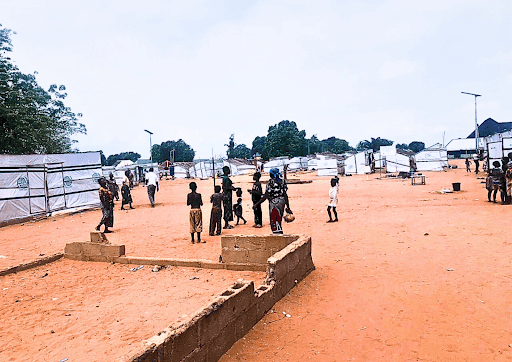
She was 49 years old when they arrived at the John Mark II displacement camp in Daudu, a roadside town in Guma, about an hour from her home.
“We were one of the first people who got here; there was no shelter like today. We used our wrappers to lie on the floor in the classrooms,” she recalled.
Lydia is 60 years old now. One of her grandchildren was just three years old when they arrived; he is now 14. They survive on menial jobs, aid, and occasional gifts. “Someone recently gave me boiled yams, and I was excited. It’s been so long since I tasted one,” she said with a laugh of disbelief.
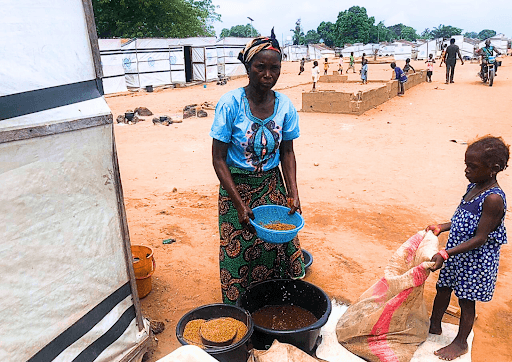
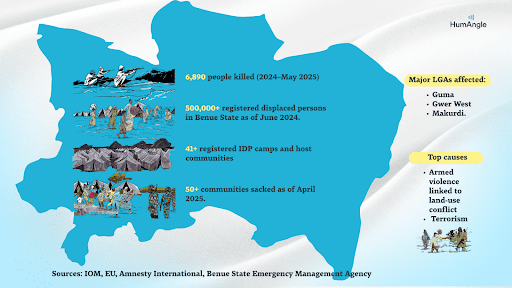
She has not returned home since they fled. Lydia is one of more than half a million registered displaced persons in Benue, one of Nigeria’s worst-affected states outside the North East, who now live in over 41 government-run and other makeshift camps sheltering people from multiple communities.
But the home she longs for no longer exists as she remembers it. Bushes have swallowed the footprints, the trees lean closer, and the sound of life–children shouting, hoes striking soil, the chatter of markets–has faded into the wind.
“You risk your life once you move past just seven kilometres to the northeast axis of the camp,” Cosmas Iorzool, the Coordinator at John Mark II Camp, said.
Barely a week before HumAngle’s interview with Cosmas, a resident of the camp was almost killed when he went to fetch firewood a few kilometres away from the camp. “He quickly hid when he saw the men approaching where he was around Uikpam-Umenger road in Guma,” he said.
Not everyone escapes. In July, two young men were killed along the same road, an incident locals said is typical but rarely reported.
For many, those homes are little more than memories. Only a few of the displaced return to their ancestral villages for funerals, risking their lives for the sake of tradition — to lay loved ones in the soil that marks identity and lineage. Even those journeys are very brief and require security escorts due to the fear of attacks.
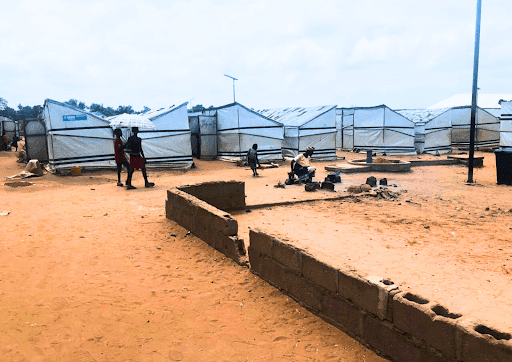
“People want to go home and leave behind this hand-to-mouth lifestyle at the camps, but there is fear,” Cosmas said.
The roots of Benue’s violence
Benue’s displacement crisis traces back to years of deadly clashes between farming communities and nomadic herders, often linked to land use, migration, and access to water. The violence deepened after the state’s 2017 anti-open grazing law, which was meant to regulate livestock movement but instead heightened tensions and triggered reprisal attacks.
Since then, waves of violence have emptied entire villages, particularly across Guma, Gwer West, Makurdi, and Logo LGAs.
Locals and community leaders who spoke to HumAngle insist that the violence can no longer be described as mere farmer-herder clashes, as it is often unprovoked.
“It is some form of terrorism,” said Hyacinth Alia, the Benue State Governor. “Daily, we receive this intel… it is beyond just conflict or ethnic clashes.”
Amnesty International estimates that more than 6,890 people have been killed in such attacks across Benue between 2024 and May 2025, while the Benue State Emergency Management Agency said at least 50 communities have been sacked as of April.
The ghost communities
Since these deserted communities are too dangerous to access, HumAngle turned to satellite analysis to see what remains. Using multi-year, high-resolution imagery from Google Earth and Sentinel data, over 15 communities were analysed for signs of life, habitation, and land use.
“There is strong evidence of abandonment,” said Mansir Muhammed, HumAngle’s Senior Specialist for GIS, OSINT, and Emerging Tech, who conducted the analysis.
Across Guma and Gwer West, the satellite imagery tells the same story — roofs caved in, fields overgrown, and settlements fading into the bush.
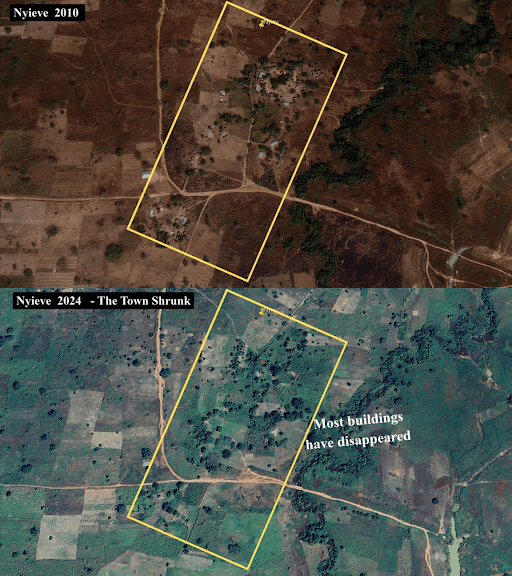
Until 2016, Tse Torkula was a vibrant settlement, as Lydia described, but it has steadily deteriorated. As of October 2025, the imagery captured a large rectangular building complex, likely a school or clinic, at its centre, surrounded by compact homes and cultivated plots. Now, the complex lies in ruins; the reflective roofs are gone, and the huts around it have collapsed. “The ruin of central public infrastructure is a major indicator of community collapse,” Mansir observed.
Beyond Tse Torkula, the silence stretches. Hamlets around Uikpam, a nearby settlement where the two men were recently killed, also show a consistent pattern of destruction. In 2021, the communities were active with multiple compounds, traditional huts, and metal-roofed structures. The area was also well cultivated. However, as of October 2025, the hamlets are in ruins.
The environment appears arid; circular hut outlines are visible among collapsed structures, while the surrounding fields lie fallow.
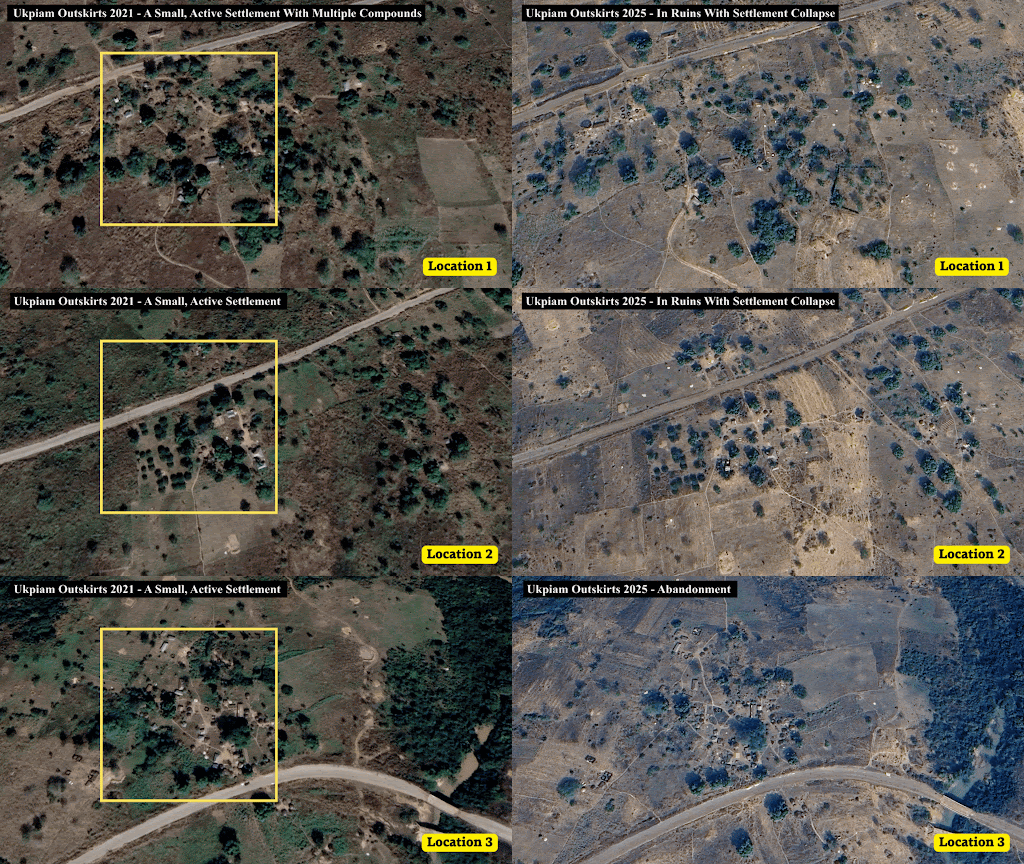
Although locals inhabit some communities near Uikpam, they continue to face attacks. In August, a community in the area was attacked, and three people were killed.
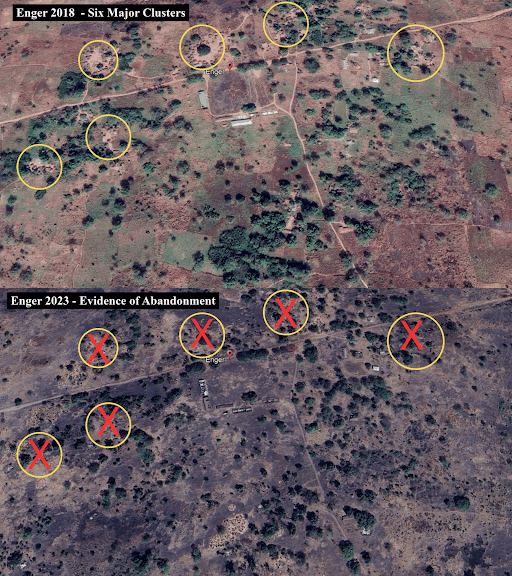
In Tse Enger, Gwer West, where at least ten villagers were shot dead in 2018, roofs have fallen, paths have blurred, and cultivated fields have turned to bush. In 2018, the imagery showed clear boundaries in the area; huts with intact roofs, neat footpaths, and tidy plots of farmland. By 2025, those lines had blurred.
“When you experience your relatives killed in their sleep, others while on the run, you will not want to return home if there is no strong assurance of security,” said Cosmas.
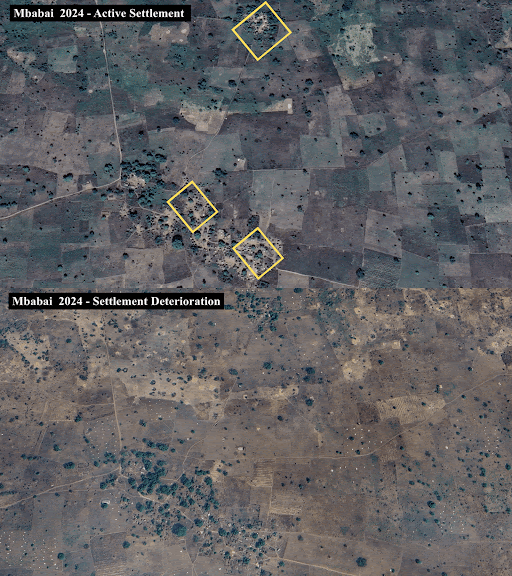
Further down to Mbabai, another village in Guma, there is almost nothing left to read. The huts have crumbled; no farming remains. The village started deteriorating in 2017.
Mike Utsaha, a prominent Nigerian legal scholar and civil society official, hails from Mbabai. When he died in 2023 and was to be buried at home, it took the “deployment of well-armed soldiers along the route and in surrounding bushes” to convey his remains.
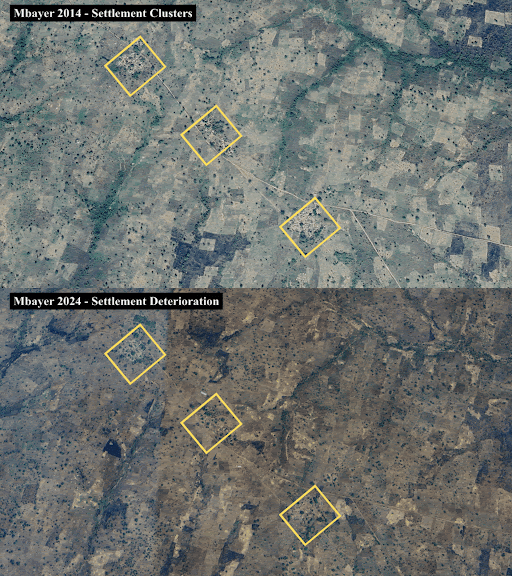
Still in Guma, if you had visited Mbayer in 2014, you would have seen at least three distinct settlements. A decade later, they are all gone. It is not only roof collapse, but also the loss of settlement outlines and farming patterns. “This looks like destruction or long-term clearing that removed settlement traces,” Mansir noted.
At least 17 people were killed in April 2021 when armed men attacked Mbayer, not the first time the community had come under attack. Previous raids had already forced families to flee, leaving behind burned homes and farmlands.
Among them was Cyprian Chiver, who had left Mbayer earlier in 2011, at 26, with his mother and two younger siblings. They settled in Daudu and have lived there since. In 2023, Cyprian tried to return home but fled again after another wave of violence.
“We are just here doing work on people’s farms. Sometimes, I go as far as Nasarawa to look for work,” he told HumAngle. It was during one of those trips that he met and eventually married his wife. The 40-year-old is now a father of twins, who were born in April last year. He continues to provide for his family through menial jobs.
“It is rough,” he added, “going from someone with large farms, raising a lot of money during harvest, to earning little or nothing. It’s heartbreaking.”
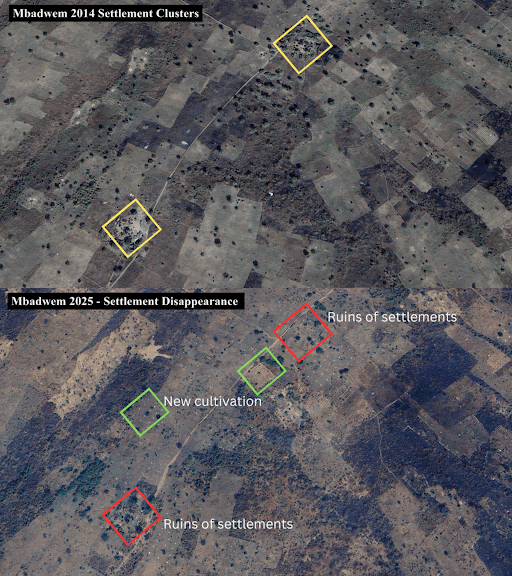
That heartbreak echoes from one abandoned community to another. In 2014, there were at least two visible settlements in Mbadwem, including one with a distinctive blue-roofed house. By October 2025, all traces were gone.
When Mbadwem was still occupied by locals, it suffered repeated night raids. In April 2022, eight people were killed in a single overnight attack.
Like Mbadwem, several other communities show the same pattern of collapse and erasure. In Gwer West, the encroaching vegetation in Tse Ubiam speaks of slow abandonment — roofs caving in, courtyards swallowed by green, faint traces of paths where children once ran. Satellite imagery shows occasional human movement, likely herders or travellers passing through, but no sign of resettlement.
Even the hamlets still occupied within Tse Ubiam have not been spared. They continue to face attacks, including an incident in May 2025 when armed men stormed the area and killed several residents.
Such recurring violence, experts say, reflects the absence of effective state control in these rural areas.
“The absence of this control has weakened coordination for resettlement and has allowed armed groups to move freely,” Dominic Aondowase, a doctoral researcher in defence and strategic studies at the Nigerian Defence Academy in Kaduna, told HumAngle. “The void has also allowed non-state actors, such as vigilante groups and local militias, to fill the gap in maintaining order. Although these groups provide temporary security, their activities sometimes escalate tensions and contribute to cycles of reprisal attacks, making long-term resettlement efforts unstable.”
That void has forced survivors to remain in camps rather than risk returning home.
The fragile question of return
However, they continue to wrestle with uncertainty about their return. The Benue State government has announced resettlement plans, but survivors say the process is painfully slow and, more crucially, unsafe.
Adding to their confusion, the state government recently opened a ‘mega’ displacement camp to house more persons. For many, it signals that their homecoming may not be soon.
That is not all. In June, residents and displaced persons sheltering at Yelwata, a roadside community along the Benue–Nasarawa–Abuja federal highway, just minutes from John Mark II displacement camp, were attacked. More than 150 people were killed and over 6,500 displaced, including pregnant women and children.
The attack drew national and global attention. President Bola Tinubu visited the state, alongside senior security officials such as the Chief of Defence Staff and the Inspector General of Police. Yet, their visits and the arrest of 23 suspects did little to allay fear among the displaced and other residents.
The fear is not unfounded. In Nigeria’s North East, government-led resettlement efforts have faltered because people were moved back before their safety was secured. In Borno State, some families who had returned to rebuild their homes under official programmes later fled again after renewed insurgent assaults that claimed the lives of people.
Benue’s displaced fear the same fate.
“If the government is going to resettle us, we need assurance of security; otherwise, it will only be a cycle of death and fleeing again,” said Saa-Aondo Shinku, a native of Yelwata who escaped death that night but lost several of his relatives in the massacre.
Beyond the uncertainty of return, life in the camps has become a struggle for survival. Like Lydia and Cyprian, many of those displaced were once large-scale farmers; now, they rely on irregular food distributions or beg to feed their families.
“We used to feed others; now we depend on charity,” said Saa-Aondo.
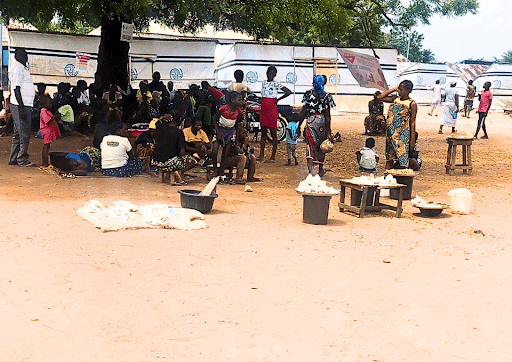
After being displaced from Yelewata, Saa-Aondo lived briefly at one of the government-run camps. “There is so much hunger there. People don’t even have firewood to boil water to bathe in the morning,” he added.
The collapse of agriculture has worsened food insecurity in a state once known as Nigeria’s ‘food basket’.
HumAngle learnt that additional security operatives have been stationed in the markets and more developed areas in some of these communities, allowing some farmers to cautiously return to farmlands close to town, but not beyond.
The social fabric of these rural communities has also unravelled. This has left many children out of school and families without access to basic social services.
For Lydia, sitting idle and thinking about the past decade only deepens the pain. She finds solace instead in singing with the choir of a nearby church. Some missionaries who once visited the camp gave her an MP3 player loaded with hymns and Bible verses — her small comfort amid long days of waiting.
“Singing just takes my mind off things,” she said, her voice growing livelier as she spoke. “I pray I’ll be alive to see us return home one day.”
Satellite image analysis and illustrations by Mansir Muhammed
Support Our Journalism
There are millions of ordinary people affected by conflict in Africa whose stories are missing in the mainstream media. HumAngle is determined to tell those challenging and under-reported stories, hoping that the people impacted by these conflicts will find the safety and security they deserve.
To ensure that we continue to provide public service coverage, we have a small favour to ask you. We want you to be part of our journalistic endeavour by contributing a token to us.
Your donation will further promote a robust, free, and independent media.
Comments
0 comments
No comments yet.
Sign in to join the discussion.
Of course, we want our exclusive stories to reach as many people as possible and would appreciate it if you republish them. We only ask that you properly attribute to HumAngle, generally including the author's name, a link to the publication and a line of acknowledgement.