The HumAngle Newsroom Shutdown for a Month. What Was the Cost?
In December last year, HumAngle announced an anti-burnout policy that allows the newsroom to go on a total break in April, August, and December. While journalists would still receive their complete pay, they would not be working during those months.

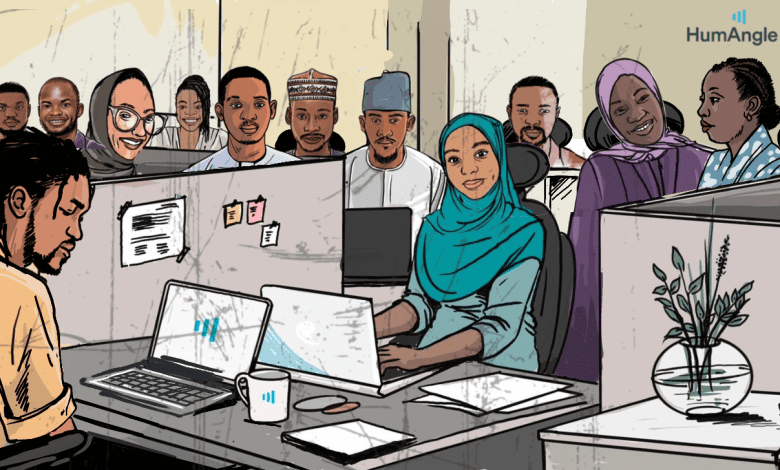
We should start by clarifying that it wasn’t entirely a shutdown. Reports still appeared on the website and on our social media pages regularly in April, but we were not working. They were produced in March and scheduled for April.
In December last year, HumAngle announced an anti-burnout policy that allows the newsroom to go on a total break in April, August, and December. While journalists would still receive their complete pay, they would not be working during those months. It was an unprecedented and radical move that we felt was necessary to preserve the mental and physical health of the journalists who work unimaginably hard every day to bring hard truths about conflict to the fore.
The truth is that the work we do as journalists is life-saving. Information must go out. People must know what is happening around them if they are to live safely and make informed decisions about their lives and futures. Information can quite literally be the distance between life and death, especially in an increasingly violent country. The news cycle does not stop because the human experience is a continuum. It can’t be boxed into Monday to Friday, and 9 a.m. to 4 p.m. Things just… happen. And this is where the complication lies.
Living like that has such a searing mental health toll, and because it is not physical, it often goes unnoticed and therefore untreated. Stressors are seen as ‘just part of the job’. The chaos is necessary to sustain the profession.
We realised that flipping that script on its head would make all the difference. Well-being is necessary to sustain the profession. It is necessary not just for the people who do the work, but even for the work itself. This idea is based on the simple assumption that humans are more likely to perform at their best when they feel their best. And yet, the news cycle demands that you keep working, even when deep down you know you have very little left to give.
And so one of the questions we needed to ask ourselves as the policy came together was this: What would we do if a major conflict news demanded coverage during one of these rest months? The answer that we arrived at was simple yet profound: Nothing. The first lesson we learned this April, as we tried to put that answer into practice for the first time since the policy was announced, was that ‘nothing’ can sometimes be a very difficult thing to do.
Reader, all hell seemed to break loose in April. Nearly all, if not all, states in Nigeria experienced some form of major insecurity event. Multiple airstrikes killed hundreds of people in Borno and Yobe. There were violent attacks in places like Erena in Niger State, as well as many abductions in Sokoto, Plateau, Cross River, Zamfara, Kebbi, Katsina, and Benue.
At some point, inaction began to feel more difficult than the action we were trying to take a break from.
What did reporters spend their rest month doing?
Two journalists said one of their best accomplishments was reading more. One said they read three books to completion and were on their fourth. The other said they read seven poetry books, three novels, and one non-fiction book.
Someone else took a culinary class and learned to make new cuisines. They also went clubbing for the first time.
Another said they went off the grid for a whole week and did not have to worry about missing any major news. Others travelled, explored their interests and passions, and engaged in other money-making activities. One person shared that they spent an entire night helping an older woman in their neighbourhood to smoke and fry some fish for sale. They worked from 10 p.m. to 2 a.m. With the following morning being a Monday, they would not have done so if not for the break. The experience made them realise that the smoked fish business was exhausting. “I no go dey price fish anyhow again,” they joked.
Another person said they enjoyed stepping out of their home to the salon or gym without worrying about taking their laptop in case a work thing came up.
Someone else said they authored two articles for a peer-reviewed journal, to which another person responded: “You are too serious about life.”
Someone else said they spent days indoors just watching movies, only taking breaks to eat. Another person tried to enter the real estate market and was swindled for their efforts (but not before successfully selling a plot of land).
Someone else went into a goat-rearing and selling business. “Imagine on a Monday morning, when you’re supposed to be having an editorial meeting (where the managing editor is saying, “can you please use the pitching template I sent in the group?”) but you’re cruising from one remote village in Gwagwalada, buying goats to resell them for some pennies. If not for [the] anti-burnout policy, I no fit try am,” they joked.
The larger picture
Studies have shown that journalism is one of the professions characterised by poor work-life balance, and these responses from our journalists have driven that point home more than anything else. Many of the things they spent time doing are ordinary daily activities that make life worth living, or sometimes even enjoyable. Yet, they were not entirely possible during the work season. It puts things in perspective. Burnout exists among journalists because there is no clear start and stop point in the profession, which can make personal and enjoyable activities difficult to accomplish.
As the newsroom fully resumes next week, we will continue to do what we do best: tell important stories while still prioritising our wellbeing. In the next few weeks, you can expect to read deep dives about the conflicts that happened last month. We might be late to the gathering, but it was for a good reason.
HumAngle implemented an anti-burnout policy allowing its journalists to take complete breaks in April, August, and December while still receiving full pay. The aim was to preserve mental and physical health amidst the incessant demands of journalism in a conflict environment. Despite a hectic news cycle in April, staff adhered to the break, finding "doing nothing" challenging yet necessary for their well-being.
During the break, journalists engaged in activities such as reading, traveling, learning new skills, and exploring different interests, highlighting a positive work-life balance shift. The policy underscores the importance of well-being for sustaining the profession, addressing burnout issues caused by the lack of distinct work boundaries. As operations resume, the newsroom remains committed to telling important stories while prioritizing mental health.
Support Our Journalism
There are millions of ordinary people affected by conflict in Africa whose stories are missing in the mainstream media. HumAngle is determined to tell those challenging and under-reported stories, hoping that the people impacted by these conflicts will find the safety and security they deserve.
To ensure that we continue to provide public service coverage, we have a small favour to ask you. We want you to be part of our journalistic endeavour by contributing a token to us.
Your donation will further promote a robust, free, and independent media.
Donate HereStay Closer To The Stories That Matter

It’s interesting to see how a month can impact a newsroom. What do you think the biggest challenge was during that time?
Not reporting on important matters was challenging, as journalists usually feel some guilt about that. But after the first week, we found a way to cope with the feeling by seeing the rest period as not just good but necessary.
Good plan. Reporters welfare is essential.
This is nice. It will be interesting to observe how the August break evolves now that staff have experienced it. Will it lean more towards rest and recharge like April, or take on a more structured format with planned engagements, learning sessions, or team-based activities? Either way, it’s a positive step, and I look forward to how it continues to develop.
My interest is the connection between insurgency and and foreign intelligence.. Like we have seen how CIA created and developed Boko Haram and other territories groups..
Further more how journalists can assist governments in dealing with them?