Ideology, Blood, and War: Rethinking the Origins of Boko Haram
Mohammed Yusuf was killed; Abubakar Shekau died by suicide to evade capture. Habib and Abba, Yusuf’s own sons, walked into explosions of their own making. Yet, the network they built stubbornly endures. Here’s how.
Listen to this story

23 Apr 2026
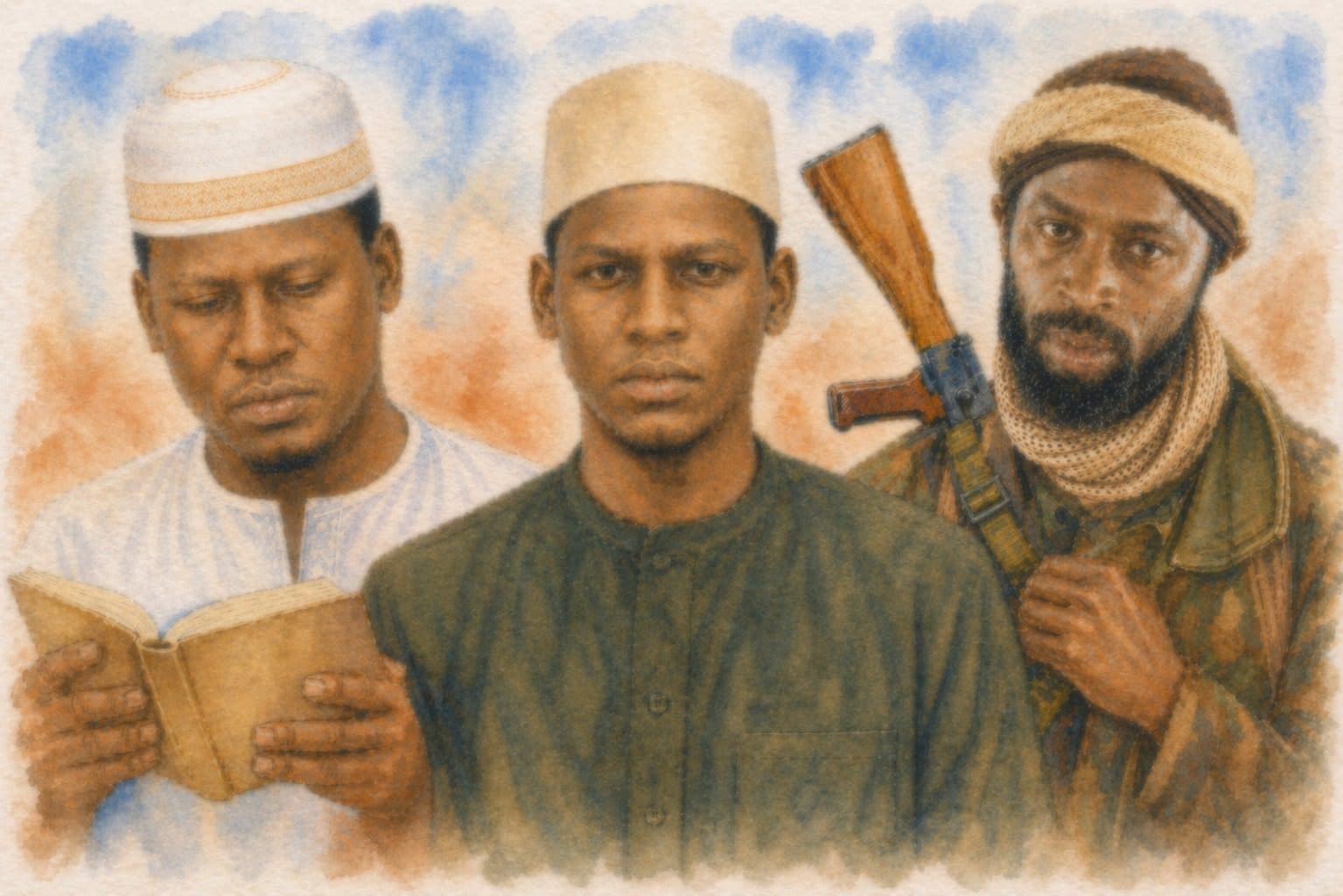
Before he became a fugitive preacher, during which time security officials learned to mutter his name with a foreboding weight, culminating ultimately in his killing, filmed and circulated across local and international news platforms, Mohammed Yusuf was a boy seated before his father, learning the Qur’an. This is where this story begins.
Not in 2002 or in July 2009, which are often cited as the landmark years. The beginning lay far away from prying eyes, in the ordinary intimacy of religious learning, in a world of fathers and sons, mallams and pupils, recitation and repetition.
Those who knew Yusuf’s early life describe a child shaped in his father’s image. According to one of his sisters, who does not wish to be named, “He learned to recite the Qur’an under Baba. He was our father’s student before he became anyone else’s.” He imbibed that discipline, the rigour and rhythm of recitation, correction, and memorisation.
He went on to study under Goni Bulama, who was reportedly knowledgeable in fiqh (the human interpretation and application of Sharia law). Later, he travelled to Potiskum in Yobe State to continue learning under his uncle, Goni Madu. He stayed there for two or three years, “then he returned home and continued seeking knowledge in several places” as part of the Almajiranci system, his sister recalled.
Among the clerics repeatedly named by people who followed that part of his life is Goni Modu in Lamisula, a suburb in Maiduguri. He occasionally took lessons from the late Sheikh Abba Aji, a well-respected Mufassir (Qur’anic exegete )in Maiduguri. “Yusuf did not emerge from the bubble; he was shaped through the interplay of ideologies,” said Kyari Mustafa, a researcher and one of Yusuf’s former students. One of his childhood friends, who is now a moderate cleric in Maiduguri, described Yusuf as a very curious child, adding that he thinks “that was what made him learn faster than all his peers”.
According to many who encountered Yusuf, he was many things, some of them deeply dangerous, but he was not a man who wandered by accident into religious influence. He read, listened, argued, absorbed, and faltered like many clerics before him and after him. He later recast those ideas into a corrosive, doctrinal political weapon, with devastating consequences that plunged more than five countries bordering Lake Chad into violence, killing and maiming tens of thousands, and uprooting millions from their communities.
Long before he created a movement the world would come to know as Boko Haram, he moved through circles of da’awah and doctrinal activism that were themselves products of a wider shift in Muslim politics. At one stage, he was linked to the Muslim Brothers, a movement of mostly students active in the 1980s and 1990s that promoted political Islam and reform. Some accounts also linked him to circles associated with Sheikh Ibrahim El Zakzaky, the Shia cleric and leader of the Islamic Movement in Nigeria. Those familiar with that era said Yusuf pulled away immediately from what he regarded as Shi’a framing by key figures in the movement, since he was inclined toward Sunni religious beliefs. However, Yusuf was not separated from their struggle; instead, he was separated over the terms, over authority, aqeedah, and over who would define the path ahead.
The claim that Yusuf was a disciple of the late Kano-based Salafi scholar Sheikh Ja’afar Mahmud and his circle does not hold under closer scrutiny. However, those who observed the stint at Muhammad Indimi’s mosque in Maiduguri and the eventual split describe a sharper divergence. “Ja’afar argued that Muslims should engage formal schools and institutions, then reform them from within. Yusuf rejected that path, calling for a boycott. He pushed for parallel systems built on Islamic guidance with zero secular influence,” said Mustafa.
From the beginning, there were overlaps between Yusuf and dozens of clerics in broad questions about jihad and Sharia. Still, Yusuf pushed toward establishing a totalitarian Sharia system on terms others did not share, or not yet. Across the Sahel, a broad clerical ecosystem continues to propagate hardline doctrinal interpretations reminiscent of those once advanced by Mohammed Yusuf. Many remain obscure, not for lack of ideological alignment, but because they have not transitioned into open confrontation with the state. Unlike Yusuf, whose influence escalated when he mobilised disaffected youth into armed resistance, these figures operate below the threshold of insurgency and restrict themselves to preaching.
There was also an organisational history that has been largely buried beneath the violence that came later. “Yusuf was once part of a movement in 1997/1998 identified as ‘Jamatul Tajdid Islami’, which was first created in Kano and headquartered there,” said Malam Mohammad, Yusuf’s former associate now based in Kano. By early 2000, he was back in Maiduguri, beginning or deepening preaching activities across several mosques. He was pushed out from Mohammed Indimi’s Mosque, moved to Al’amin Daggash Mosque, was stopped again, and then continued from his own house, given to him by his father-in-law. He named the sanctuary Ibn Taymiyya Masjid after a 13th-century Islamic scholar.
This was a precursor phase built on a study circle, not an insurgent cell. At the time, young men in white jalabiyas and their wives in black long jalbabs flooded Maiduguri. They were encouraged to bond tightly, abandon schools, and resign from secular institutions. “They shared food amongst themselves. They sold farm produce at subsidised rates from their large farm in Benisheikh. They provided free medical care through two clinics in Maiduguri. They ran a small revolving loan scheme for indigent members,” said Malam (name withheld), one of the movement’s former clerics currently in Maiduguri.
A fighter still active told HumAngle he dropped out as a sophomore at the University of Maiduguri, leaving his parents’ home to move in with a member of the group. “Between 2006 and 2007, I had no skills or a job. I survived on daily meals and food stamps from the Ibn Taymiyyah mosque. I will never forget that support by Malam Mohammed Yusuf,” said the 42-year-old Boko Haram member.
Ideology and a premeditated war
Boko Haram did not erupt because of the high-handedness of security agents, though that high-handedness was real and consequential. It did not begin because Mohammed Yusuf was extrajudicially killed in July 2009. However, that killing transformed him into a martyr in the eyes of his followers and helped harden the foot soldiers in the war that came thereafter. It did not begin because of one helmet law, one police confrontation, or one week of clashes in Biu, Bauchi, Maiduguri, Damaturu, Potiskum, and elsewhere.
Those events merely accelerated the rupture.
The deeper fuse was ideology, and that ideology did not grow in isolation. It travelled with money, with wars fought elsewhere, with transnational religious currents, and with the afterlife of global politics that Nigeria still refuses to examine closely.
In the 1980s, amid oil-fuelled prosperity and the protracted Cold War contest in Afghanistan, a distinct wave of Salafi thought was actively scaled by a Gulf state. It travelled through well-funded clerical networks, charities, publications, scholarships, and layers of international patronage that gave it both reach and structure.
For external backers, the fine details of ideology did not matter. What mattered was shared strategy. As long as this movement in Afghanistan put pressure on the Soviet Union, its beliefs were rarely questioned and were sometimes quietly supported.
In Afghanistan, jihad evolved from a theological concept into something more kinetic, a pathway, a destination, and, for many, a defining personal transformation. Young men from across the Muslim world answered that call. Nigerians were among them. Many of them were strikingly from the southwest region, but when they returned, they did not find the same fertile conditions in their home environment for a project of violent proselytisation. The idea survived, but it did not easily reproduce itself in that terrain.
In the north, these returnee fighters from Afghanistan did not arrive on stable ground. They met a generation of young men with little education and a grim future, a generation that knew the state only through force, neglect, and theft. They met boys raised on the daily humiliation of poverty and poor investment in education by corrupt officials.
That was the combustible field in which Yusuf picked up most of his ideas in the late 90s and began to nurture them into a movement in the early years of 2000. By the time the July 2009 ma’araka occurred, the insurgency had already been imagined, nurtured, and prepared for years. The movement had passed through the stages of learning, da’awah, withdrawal, factional dispute, internal sorting, and ideological hardening.
“Operation Flush” and the broader security pressure during that period disrupted a longer period of preparation. When the confrontation came, the group had not yet fully built what they intended to build. If they had been left to prepare longer, and if the rupture had come later rather than in July 2009, Nigeria might have faced a movement with greater organisational maturity and strategic capacity.
In the weeks after the confrontation between Boko Haram members and Operation Flush in Maiduguri, triggered by the enforcement of helmet regulations on motorcycle riders, tensions escalated sharply. Security forces shot around 20 sect members, an incident that hardened positions within the group and deepened mistrust of state authority.
Mohammed Yusuf responded with an open declaration, signalling that the group would confront the state if certain demands were not met. Within the cult-like community, preparations began quietly but deliberately. Members started liquidating personal assets. Cars, motorcycles, and even houses were sold. Women parted with jewellery and household items. Contributions came from across the network, each person offering what they could.
This mobilisation unfolded in earnest in the month leading up to July 2009.
Long before the war, there were also fractures inside the movement that foreshadowed what would come later. One notable example is that of Muhammed Alli, who, after disagreeing with Yusuf, left for Hijra to Kanamma in Yobe State with dozens of youths in 2003. They isolated themselves from normal civil life in a remote location. When the traditional leader in the vicinity noticed a strange group of people in his turf in December 2003, he approached them, and one thing led to another; the group had violent confrontations with the Police that resulted in the loss of lives and properties.
At the height of Yusuf’s sectarian authority between 2006 and 2009, a fracture was already taking shape within his movement. Beneath the surface, a harder, more impatient current was consolidating around Abubakar Shekau, his top lieutenant. “Yusuf believed in sequencing. Build strength first. Recruit deeply. Arm deliberately. Accumulate resources. Then, confront the state from a position of capacity,” said Mustafa.
Shekau, like Muhammad Ali, who led Kanamma, rejected that procedure. They both pushed for immediacy. Strike now and absorb the consequences later. Death itself, whether inflicted or received, was framed as victory through martyrdom, according to those inclined to Shekau’s hardline views.
Malam Hassan (Gandrova), a staff member of the Nigerian Prison Service, who was radicalised during one of Shekau’s brief remands at the Maiduguri Maximum Security Prison, would eventually join the terror group’s bomb-making unit. On Friday, July 24, 2009, he was assembling an IED with two other individuals at his rented apartment in Umarari, ‘Bayan quarters’ in Maiduguri. “Hassan and the two other bomb-making members of the sect were unskilled at the time, and their explosives blew up everyone in the room,” said a former member currently in one of Nigeria’s deradicalisation programmes set up to reintegrate former fighters back to normal civil life in their communities.
The following day, Saturday, July 25, Yusuf’s followers were attacked in Bauchi. On the night of Sunday, July 26, Yusuf faced mounting pressure from his own ranks after the bomb incident and the raids in Bauchi, compounded by a sting operation by the police in Maiduguri, “who falsely tipped Yusuf’s men that security forces would launch an assault against them before dawn,” said a senior police officer familiar with the events of July 2009. Shekau’s more radical supporters within the group demanded action.
On the evening of July 26, 2009, hours before they launched an attack on the Borno State Police headquarters, Yusuf condemned the attacks on his men during an interview with this reporter, who worked for Daily Trust at the time. “What I said previously that we are going to be attacked by the authorities has manifested itself in Bauchi, where about 40 of our brothers were doing what Allah said, arm yourself and your religion in the face of an attack and an attack was imminent. This was what Malam Hassan [bomb victim] was doing when he became a martyr,” he said.
Had Yusuf refused the group’s attack on the Police Force headquarters in Maiduguri, he would not have remained leader after that night, said several senior members of the group interviewed by HumAngle. The movement was already shifting beneath him. At best, he would have been sidelined. At worst, he would have been removed entirely by the very hardline faction he had tried to restrain.
Blood ties and the machinery of war
To understand how this story has unfolded, one has to see Yusuf as the centre of a household as well.
He had four wives and a large number of children, between 24 and 26, according to the accounts available. His first wife was Aisha, also known as Ya Bintu or Yaya Bintu. Among the children attributed to her are Yusuf, Habib, Ibrahim, Ahmad, Imam Muslim, Abdullahi (also called Abba), Isa, and Abdulazeez.
His second wife was Fatima, also called Ummu Zara. Children linked to her include Zarah, Alhaji Ba (recalled unclearly in one account), Iya Gana, Ummu Kulthu, Aish, Uma, and Abdulwahab.
His third wife was Hajja Gana, also called Ba’ba. Children associated with her include Zainab (often called Ummi), Maryam, Umar, and Khadija (also known as Ya Dija).
The fourth wife was Ummu Tulaf, or Ummuthulab in some accounts. Muazu is consistently named among her children. This is not a perfect register, but a family history carried through oral memory, insurgent secrecy, death, displacement, and the distortions that come when names are repeated across generations. But the uncertainties do not dilute the central point. Yusuf did not leave behind a disembodied ideology. He left behind a house, and that house has remained part of the machinery of war to date.
One relative of Yusuf, based in Kano, who spoke in detail about the family, put it simply: “All of his children are part of the insurgency. Some are dead now. But they are all part of it with no exceptions.”
The first son, Yusuf, married in Hotoro, Kano State, in 2010. The marriage was brief; he died not long after, leaving no children. His death followed the September 7, 2010, prison break in Bauchi, when Boko Haram freed hundreds of their members. Some of the escapees of that prison break were later traced to a hideout in Hotoro, where Yusuf lived. Security forces moved in. In the exchange that followed, Yusuf, the first son of Mohammed Yusuf, was killed.
Habib, the second son, known as Abu Musab, became the most consequential. Family testimony about his domestic life varies in detail, as such testimony often does in clandestine worlds, but the core is clear. He had multiple wives and many children. Zainab is recalled as one wife, Halima as another, Aisha as another. Their children, depending on who recounts the family tree, include Mus’ab, Humaira, Rumaisa, Muhammad, another Muhammad, Shifa’u, Ramla, Zarah, Rufaidah, Kasim, Abdullahi, and Amir. In one account, there is mention of a concubine or enslaved woman who bore him a daughter.
After the July 2009 violent outbreak, most of Mohammed Yusuf’s children, except his first son, were moved out of Nigeria. They were first taken to Kusiri in northern Cameroon, then to N’Djamena in Chad, where they continued their religious education under Sudanese and Chadian tutors. This relocation appears to have taken place within months of Yusuf’s death and was aimed at preserving both their safety and their symbolic value within the movement.
In 2012, after Abubakar Shekau left Rijiyan Zaki in Kano and established himself in the Sambisa forest, he ordered Yusuf’s children to be brought back into the insurgent enclave, which the group had begun to frame as its Daula. This move reflected a deliberate effort to consolidate legitimacy by reabsorbing Yusuf’s lineage into the insurgency’s core.
Among those elevated during this period was Abu Musab al-Barnawi. He was progressively assigned roles that combined religious authority and operational relevance, positioning him as a bridge between doctrinal leadership and battlefield command.
From 2015 to 2016, tensions between Shekau and ISIS leadership intensified. The central issue was Shekau’s expansive use of takfir, particularly Takfir al-‘Umum, which justified violence against broad segments of the Muslim population. ISIS leadership, including Abu Muhammad al-Adnani, engaged in repeated efforts to moderate Shekau’s position. These attempts also addressed concerns over targeting practices, the use of female suicide bombers, and command discipline. All efforts failed.
In August 2016, ISIS formally intervened. Through its Al-Naba publication, it announced the removal of Shekau as leader and the appointment of Abu Musab al-Barnawi as Wali of the Islamic State’s West Africa Province (ISWAP). This marked the formal split between Boko Haram and ISWAP. The decision was externally driven by ISIS central and reflected a strategic shift toward a more controlled and population-focused insurgent model under new leadership.
Abba (aka Abu Rumaisa), whose given name is Abdullahi, is also one of Yusuf’s sons. He reportedly had multiple wives and children, including Muhammad, Maryam, Aisha, and at least one other son. Within the insurgent structure, he played a technical and operational role, particularly in communications. Sources indicate he was responsible for managing encrypted messaging platforms that facilitated contact between ISWAP leadership and ISIS-linked actors in the Middle East.

Despite his communications role, Abba was known to participate directly in combat operations, a pattern that reportedly drew disapproval from senior leadership due to the sensitivity of his liaison responsibilities. Internal disputes led to repeated detentions. Abba was imprisoned on four separate occasions by his brother Abu Musab, including periods of detention alongside that of Mamman Nur, a senior figure associated with Mohammed Yusuf’s lifetime.
In one instance, he escaped custody with other fighters and fled to the Niger Republic, but later returned. According to a source, he was subsequently pardoned and allowed to reintegrate without facing the death penalty typically imposed on members accused of attempting to defect.
A senior ISWAP defector, Malam Ibrahim, stated that during one period of detention linked to internal disagreements, ISIS-linked contacts “declined communication with ISWAP as long as they did not hear his voice. He was released immediately to continue his work.”
Abba later died in early 2023 during an engagement with the Multinational Joint Task Force in the Kangarwa forest area.
The other sons, Muslim, Abdulazeez, Isa, and Abdulwahab, are described by one source as married and without children at the time of this report. However, Muslim was arrested in Chad when he was trying to defect from the group to live outside of Nigeria.
Even inside the household of a movement that would later devastate the northeast, family life is still narrated through the intimate vocabulary of births, marriages, hopes, namesakes, and unanswered prayers for children. That is exactly why the story resists easy reduction. The people at the centre of violence remained human in their own domestic worlds. That does not mitigate their responsibility, but it explains how such worlds sustain themselves.
The patriarch’s execution
Yusuf’s rise spiked because of his soft-spoken, unusual, and persuasive verbal skills rather than his scholastic proficiency. He did not need the theatrics many expected from Sahel’s religious authorities. He could name what young men already felt but had not yet organised into doctrine. Corruption. Injustice. Absence. State impunity. The feeling that rulers had abandoned both God and the governed. He took those scattered injuries and gave them a single haunting frame.
Yusuf was carrying a worldview shaped by transnational currents, doctrinal disputes within Nigeria and the broader Sahel Islam, and his own insistence that the Nigerian state was religiously illegitimate.
Then came the extrajudicial killing.
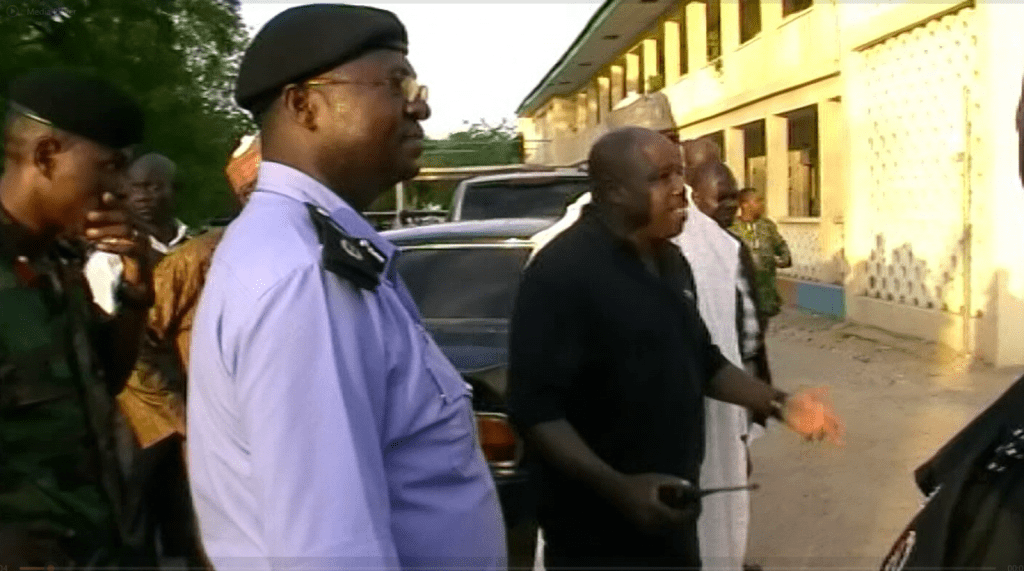
Outside the police headquarters in Maiduguri, Yusuf was captured on camera, alive in custody, seated and handcuffed. Later, he was dead, his body riddled with bullets. The state said he had been shot while trying to escape. The footage with his hands tied, however, invalidated that claim.
What followed was brutal and systematic. Raids spread across northern states, with Maiduguri at the centre. Security forces targeted hospitals and local pharmacies. They forced staff to identify and lead them to patients treated for gunshot wounds or related injuries. Those patients were taken to the State Police headquarters. Some could barely stand. Some were on crutches. Some were executed at close range in the presence of this reporter, as documented here.
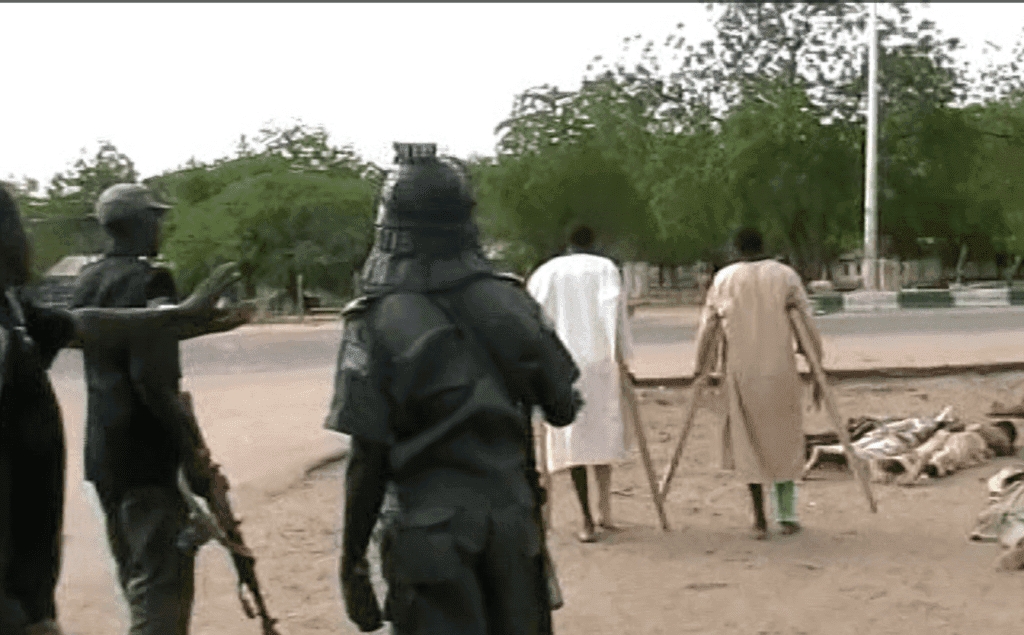
For followers, the image of Yusuf became proof of everything he had preached about state injustice. This was the moment the war entered the family’s bloodstream. His children, who had already grown up under his teachings, now witnessed his extrajudicial death.
Abu Musab was central to the next phase.
The rise and fall of Abu Musab
Relatives remember him first as a disciplined son who rose through the ranks. He became a Munzir, later Ka’id, fiya, then a Waliy. He read deeply. He gained influence not only because he was Yusuf’s son but because he appeared to embody knowledge and steadiness.
Some accounts describe him as a serious internal voice within the insurgency, especially in doctrinal disputes over takfir and the treatment of ordinary Muslims. At one point, some within the movement argued that any Muslim who refused to migrate to the bush and live under insurgent control was an unbeliever. The practical effect of that doctrine was robbery, extortion, and killing.
Abu Musab is remembered by those close to him as having resisted that direction. “People had reasons they could not leave,” he said in one of his recorded messages. “Not everyone outside the bush was an apostate.” That detail does not make him humane in any broad sense. He remained a leader in a movement that killed, abducted, raped, extorted, and terrorised civilians. But it does place him more accurately within the insurgency’s internal tapestry. He was part of the crop of leaders who believed Shekau had gone too far.
That split would define the next phase of the war.
After Yusuf’s death, Abubakar Shekau turned what remained of the movement into a machine of spectacle and indiscriminate terror. His fighters razed villages, bombed markets, assassinated Muslim clerics, and turned young women and girls into delivery systems for explosives. Entire communities were punished under expansive accusations of unbelief or collaboration. Shekau did not merely fight the Nigerian state. He fought whole populations, including the Muslims his faction claimed to defend.
Inside the movement, dissent built over time. Some of Yusuf’s old followers, including members of his family, believed Shekau had broken from the founder’s original doctrinal line. They still believed in jihad. They still rejected the Nigerian state. But they did not accept his disregard for restraint and counsel.
When the movement pledged allegiance to the Islamic State, those internal disputes widened. That split changed the insurgency’s logic. Shekau’s faction remained rooted in Sambisa and in a politics of fear, punishment, and theatrical violence. ISWAP, under Abu Musab, moved toward an equally brutal but more organised form of insurgent governance around the Lake Chad Basin. It taxed fishermen, farmers, and traders. It built courts, regulated movement, and sought not merely to kill but to rule.
It was still a terrorist organisation. It still abducted, extorted, murdered, raped and coerced. But its method of domination differed from Boko Haram. Where Shekau often destroyed civilian life outright, ISWAP frequently sought to occupy it, supervise it, and harvest from it. Communities brutalised by both insurgents and the military often did not think in abstract moral categories. They thought in terms of survival. To some, ISWAP looked more predictable than Shekau’s men, less erratic, and more likely to tax than to massacre. In this phase, Yusuf’s family became an infrastructure.
Some sons moved into command, others into ideological work. Some daughters married senior figures, tightening bonds between bloodline and leadership. One of Yusuf’s wives, Hajja Gana, later married Abubakar Shekau. The geography of Lake Chad then amplified everything.
Once a vast inland body of water, the lake has, over the decades, become a shifting geography of reeds, channels, islands, marshes, and seasonal passages where state borders blur, and state authority thins into abstraction. A fighter can move from Nigeria into Niger or Chad with less friction than a trader might face at a conventional checkpoint. Armouries can be hidden on islands. Training camps can be relocated across terrains that conceal unfriendly surveillance. Tax routes can be imposed on fishing channels more effectively than the Nigerian state can regulate ordinary commercial life in some border communities.
Yet dynasties do not move cleanly. They fracture from within.
Abu Musab’s rise inside ISWAP did not end in settled power. Internal struggles sharpened. Rivalries widened within the rank-and-file and the shura. Family accounts describe a period of captivity that placed him in real danger. The Boko Haram faction led by one Bakura Doro wanted him dead. Some within ISWAP opposed his return to influence, reflecting deeper internal fractures shaped by ideology, loyalty, and competition for authority. Yet he retained a critical asset: He was a recognised member of the shura within the broader Islamic State network. That status placed him within a transnational decision-making architecture that extends beyond the Lake Chad Basin, linking local commanders to the central leadership historically based in the Levant and later dispersed across multiple theatres.
According to a high-profile source, “a decision was made to extract him, perhaps toward North Africa or the Middle East.” Such a move would align with patterns seen in the Islamic State’s global operations, where experienced figures are sometimes redeployed across provinces. These decisions are often driven by strategic need, internal distrust, or the desire to preserve individuals with institutional memory and ideological legitimacy within the wider ISIS ecosystem.
That plan never reached its destination.
Instead, he moved through Nigeria under concealment. He spent time with one of his wives and their child. He moved through Kano. He surfaced in Kaduna. The high-profile source said, “Kaduna was the location chosen for him to wait for his travel documents to be processed.” HumAngle gathered that he was in the process of obtaining a Niger Republic international passport. At his Kaduna hideout, between April 21 and May 19, 2023, one of his couriers was tracked and security agents followed the trail to the house.
What remains most striking is that they appear not to have known whom they were closing in on. They suspected criminality, but by available accounts, they did not know they were approaching Abu Musab al-Barnawi himself.
Abu Musab heard heavy banging at the gate, mixed with men shouting and the rumble of vehicles. He knew immediately it was security forces. HumAngle gathered through extensive interviews that he was calm, almost detached. He told his young wife, who was holding their young child, to open the gate. As she moved toward it, he slipped into the room’s toilet. Moments later, he detonated the explosive vest strapped to his body.
The blast stunned everyone outside, including his wife. The sound cut through the compound without warning. He chose death over arrest, over public disgrace, over the certainty of spending the rest of his life behind bars.
There was no public announcement after the blast that killed Abu Musab, no official triumph, no clear state recognition that one of the most significant insurgent figures in the region had died in that house. The insurgents, too, remained quiet, neither publicly mourning nor confirming the incident. Instead, the kunya Abu Musab continued to circulate, adopted by others as part of the deception and continuity that sophisticated insurgent networks rely on.
So he died in near silence.
A complex conflict
The temptation in telling this story is to simplify it into a mirror, a dreadful, clean reflective script revealing the ugliness and wretchedness of ruthless power mixed with aloof governance. The state is wholly guilty. The insurgents are evil. The civilians are trapped. All of that is true, and none of it is enough.
Yusuf’s movement drew strength from three elements that must be held up together if the story is to make sense.
The first was ideology. A structured creed, nourished by transnational currents, that delegitimised secular authority and imagined an Islamic order justified by violence.
The second was a grievance about corrupt governance, collapsed services, absent justice, police extortion, and growing poverty and unemployment across northern Nigeria.
The third was impunity: lawlessness by the state, extrajudicial killings, collective punishment, detention without process, and the routine treatment of poor people as disposable.
Some of the young men who heard and looked up to Yusuf died in 2009, before the insurgency fully matured. Some fled and returned. Some crossed into Chad, Niger, Cameroon and Sudan. Some started living normal lives. Some became commanders, teachers, recruiters, executioners, or administrators in the insurgent order. Some of his children, like Abu Musab, moved into leadership. Others remained within family or support structures inside the insurgent ecosystem. Some died. Some vanished. Some married deeper into the insurgency. Some had children in forest camps and island settlements. Those children then formed a third generation.
That third generation may be the hardest part of this story.
Across parts of the Lake Chad Basin, children have grown up under insurgent authority or the culture of violence, with no memory of peace. Their parents’ stories are not about school, court, civic life, or public trust. They are about raids, camps, betrayal, martyrdom, command, and survival.
In Borno, Yobe, and across the Lake Chad region, insurgency is not sustained only by ideology at the top. It is sustained by marriages, kinship, cattle routes, fishing economies, clerical contentions, clans, dialects, borderland trade, and the practical calculations of communities trying to stay alive between insurgent taxation and military suspicion. A woman’s marriage can be an alliance, survival, coercion, and entrapment all at once. A boy’s movement from the city to the forest can be due to indoctrination, family obedience, or a lack of alternatives. A trader may pay insurgents not because he supports them but because the state has left him no other safe route.
That is also why the story cuts beyond Nigeria.
The symmetry is brutal. The state killed the father after capture. The son killed himself to avoid capture. Between those two deaths lies the whole distortion of the northeast conflict. A state too often governed by force rather than law. An insurgency that chose violence over any serious claim to humanity. A population trapped between them, paying in graves, hunger, displacement, and silence.
More than a decade after Yusuf’s death, the conflict he helped set in motion has not collapsed into victory or defeat. Instead, it has settled into a prolonged contest between military containment and insurgent adaptation.
The Nigerian military and the Multinational Joint Task Force have, despite operational limitations, prevented a full territorial takeover by Boko Haram and ISWAP. At multiple points, especially between 2013 and 2015, insurgents controlled significant territory. That phase was rolled back through sustained military pressure.
However, these successes were fundamentally limited. The military has achieved containment, not resolution. This creates a circle where military gains are repeatedly eroded in the absence of credible state presence, turning the conflict into a durable stalemate rather than a solvable war.
The danger now is not only that Nigerians forget Mohammed Yusuf’s actual place in this history. The danger is that the next generation inherits only the myths. On one side, the state myth that terrorism came from nowhere and can be resolved through raids, procurement, press releases, and more force. On the other side, the insurgent myth is that an unbelieving state martyred a “righteous founder” and that his children merely carried forward a sacred duty.
Both myths kill.
The truer version is harder. Yusuf was a product of corrosive ideology, ambition, and grievance. That is why this story still matters.
Nigeria did not invent militant Salafi ideology. It did not write the script of the Afghan jihad. It did not create global takfiri currents. But Nigeria did something unforgivable in its own space. It abandoned millions of citizens to conditions in which men like Mohammed Yusuf could speak with authority. Then, when the blowback came, it answered with the same habits that had already emptied the state of legitimacy in the eyes of many.
There is one final image that remains.
Somewhere in northern Nigeria, perhaps in Lake Chad, perhaps in a displacement camp, perhaps in a community held loosely between one armed authority and another, a child is being taught. The question is not whether that child will learn religion. The question is what will be wrapped around it.
Support Our Journalism
There are millions of ordinary people affected by conflict in Africa whose stories are missing in the mainstream media. HumAngle is determined to tell those challenging and under-reported stories, hoping that the people impacted by these conflicts will find the safety and security they deserve.
To ensure that we continue to provide public service coverage, we have a small favour to ask you. We want you to be part of our journalistic endeavour by contributing a token to us.
Your donation will further promote a robust, free, and independent media.
Comments
6 comments
Mohammad Sule Maidawa
5 May 2026, 21:35
Wow. This is eye opening. Always a detailed piece by the boss. I’m so shocked to find out that Abu Mus’ab too blew himself up. And the name continued to echo like nothing happened. Subhanallah.
Joe
26 Apr 2026, 22:14
This is quite detailed. The sad thing is that the FG government we’ve had since 2015 is such that thrives in abuse of power and humanity. We hoped that buhari would have solved these problems. Instead, he made them worse. He gave them hope. But deceitfully abandoned them once he got what he wanted. His successor isn’t human either, more corrupt, brutal and inhuman.
Sarah Eke
26 Apr 2026, 21:03
Thank you Ahmad for this article. My takeaway: The emergence of insurgency may begin with ideology, but its persistence is ultimately driven by governance failure and survival dynamics, as seen in the endurance of Boko Haram and ISWAP in northern Nigeria. While rooted in extremist doctrine, these groups have adapted into systems of control, leveraging porous borders in the Lake Chad Basin, territorial dominance, and the indoctrination of younger generations to sustain themselves. More critically, they fill gaps left by the state, providing basic needs and a sense of order in areas where government presence is weak or absent. This blurs the line between coercion and dependence, forcing civilians into alignment with insurgents for survival. Military force alone is insufficient because insurgencies thrive in environments where the state fails to meet basic needs. When civilians lack security, economic opportunity, and access to governance, they are more likely to depend on insurgent groups for survival. Without addressing these underlying conditions, military actions may weaken insurgents temporarily but cannot eliminate the system that sustains them.
Oluwadamilare Oladipupo Olatunji
25 Apr 2026, 21:30
This is very profound and rigor. Well done to the Humangle Team. This Boko Haram issue is complicated than the public perceives it. I guess we can only manage it and not completely eradicate it.
Abdulkadir Usman
25 Apr 2026, 16:56
Gd evening. I want to suggest that u investigate the circumstances surrounding the death of the woman who gave birth to 5 children at AKTH
Z
24 Apr 2026, 11:56
Great and detailed read. “But Nigeria did something unforgivable in its own space. It abandoned millions of citizens to conditions in which men like Mohammed Yusuf could speak with authority. Then, when the blowback came, it answered with the same habits that had already emptied the state of legitimacy in the eyes of many.” Nothing but fact.
Sign in to join the discussion.
Of course, we want our exclusive stories to reach as many people as possible and would appreciate it if you republish them. We only ask that you properly attribute to HumAngle, generally including the author's name, a link to the publication and a line of acknowledgement.