The US Launched an Airstrike in Northwestern Nigeria. Here’s How it Went
US forces launched an airstrike in Sokoto, northwestern Nigeria, yesterday, claiming to target members of ISIS. HumAngle visited the location to assess the impact. Here’s what happened.

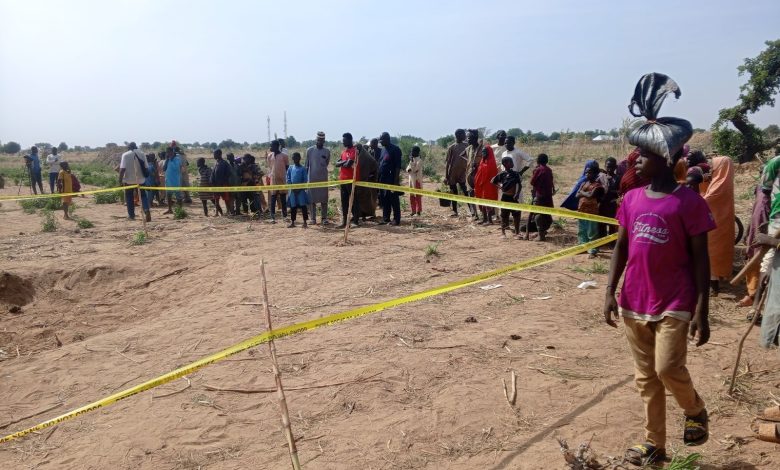
A few locals gathered in an open area around 10 p.m. on Thursday, Dec. 25, when they saw a projectile hovering above them. Within minutes, a blast sent panic through the town, igniting a hail of fire and fury in Birikini, a rural settlement in Jabo, Tambuwal Local Government Area (LGA), Sokoto, North West Nigeria.
The explosion threw the community into chaos, with locals running towards the site of the strike to find out what had gone wrong.
“I was sitting at a joint when we saw a reddish item falling from the sky, illuminating the community. Suddenly, we heard a loud bang. I thought a car tyre had burst and caught fire at the same time,” said Ismail Umar, a local in Jabo town. “When we moved, we saw many people shouting and rushing towards the scene. Some thought it was an aircraft that fell. This raised tension, and people couldn’t sleep throughout the night. I went home around 12 a.m., but when I woke up for the morning prayer around 5 a.m., people were still outside, discussing the incident.”
The heavy artillery shell landed on an expanse of cultivated farm field in the area. When locals arrived at the scene, they found shrapnel scattered in the community and wondered where the strike had emerged. No casualties were recorded, according to locals who spoke to HumAngle. They noted that such an incident was unusual to them, as the area has not witnessed any terrorist attack in years.
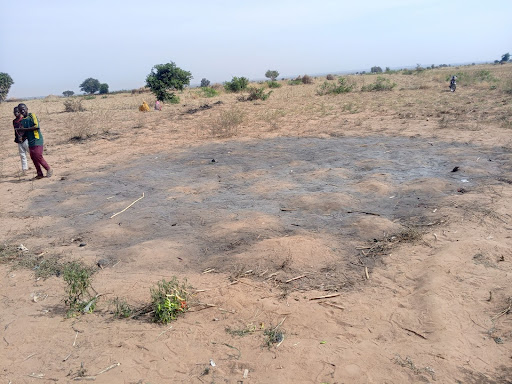
Musa Dandare, an elderly man in the community, said he saw the projectile descending towards the town before it hit the ground with a loud bang. Although it was a bloodless attack, villagers insisted they were disturbed because they had never experienced such a military-grade airstrike.
Later that night, Donald Trump, the United States President, announced that the country’s military “launched a powerful and deadly strike against ISIS Terrorists in North West Nigeria…” He claimed that terrorists were dead and pledged that many more such attacks would happen. The US Africa Command (AFRICOM) and the US Department of War also confirmed the strikes.
Kimiebi Imomotimi Ebienfa, a spokesperson for the Nigerian Foreign Ministry, stated that the “precision hits on terrorist targets” were the result of a joint security and intelligence collaboration between the two nations.
“It was a successful operation,” said Yusuf Tuggar, Nigeria’s Minister of Foreign Affairs, though he did not disclose specific damage assessments. “We will have to wait for those who handled the operational aspects of the episode to return with the details.”
In November, President Trump threatened military action against Nigeria, accusing the government of failing to protect Christians from Islamic State terrorists. He also designated it as a country of particular concern. Although existing data and conflict show that the country’s security challenge cannot fit into a religious tag, Trump’s claim has drawn the attention of the international community to the insecurity in Africa’s most populous nation and has also deepened polarisation within the country.
ISIS in northwestern Nigeria?
Nigeria is home to several armed groups, including two that are associated with the Islamic State of Iraq and Syria (ISIS). One of these groups is the Islamic State West Africa Province (ISWAP), which emerged from the Boko Haram extremist faction and operates mainly in the northeastern region. Another is the Lakurawa terror group, which is active in the northwestern region. While the US forces have stressed that they were targeting ISIS fighters in Nigeria, security analysts suggest that they likely targeted the Lakurawa terrorists, a group that has become increasingly dangerous in Sokoto and Kebbi states in the past year.
The Lakurawa terrorists have operated in many communities in Sokoto State, including Tangaza, Gudu, and Silame, but they have recorded no activities in the Tambuwal LGA. The terrorists thrive in towns located along the permeable borders of Sokoto State, allowing armed groups to move easily between Nigeria and the Niger Republic. After crossing the border, they set up camps in the area’s vast bushland.
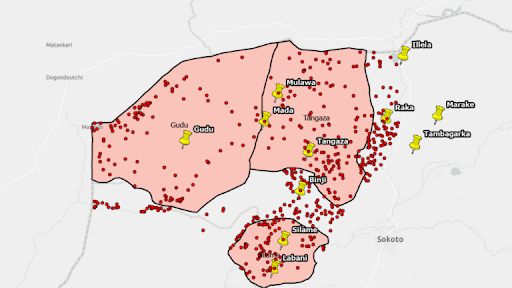
Exactly a year ago, on Dec. 25, a military airstrike targeted at the Lakurawa terror group killed up to ten civilians and injured several others in the Silame area of Sokoto State.
At the time, the Nigerian military said those killed had been “positively identified as associated with the Lakurawa group”. Military authorities later attributed the civilian deaths to secondary explosions, explaining that the strike hit a terrorist logistics hub and arms cache, triggering detonations that sent stored munitions exploding in multiple directions.
The aftermath
Meanwhile, locals in Jabo who spoke to HumAngle stressed that the locality targeted by the US forces is not controlled or infested by any terrorist group like other areas in the region. “It’s a peaceful place,” one local told HumAngle.
The locals said they have combed the entire Birikinin village and have found no civilians or terrorists hit by the US strike.
However, locals fear that this singular strike might cause the terrorists to beam searchlights on them. Unlike places like Isa, Sabon Birni, and Gada, which have had deadly terrorist attacks in the past, Jabo seems to be a haven for locals seeking calm and tranquillity in the state. The locals wondered why the US strike ignored terrorist enclaves in the state to target a thriving civilian community.
“It was the first time we heard what a bomb sounded like in this community,” Musa said. “Many of us couldn’t sleep throughout the night.”
Aliyu Garba, a local chief in Jabo, expressed concerns over how some locals have collected the relics of the explosive materials from the strike scene, saying some of the shrapnel might detonate or harm them. “It was as big as a car’s gearbox,” he said, describing one of the broken explosives found on the ground.
Garba added that they have lived in the community peacefully for years, praying that this new event would not bring calamity to them. Locals reiterated that they have not noticed any form of terrorist activities in the area for years, let alone the Islamic State operations that might call for such an airstrike.
According to Armed Conflict Location & Event Data (ACLED) records covering 2010 to 2025, Tambuwal LGA has experienced only a handful of violent incidents, primarily involving small-scale attacks and abductions by criminal groups. The dataset records no previous incidents involving airstrikes, heavy artillery, or aerial bombardment in the area. In the past 15 years, for instance, only seven significant events were recorded in the LGA, and none happened in the Jabo town.
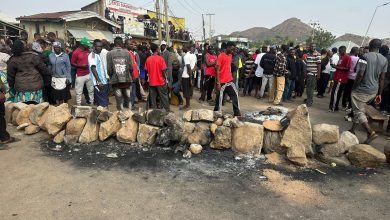
HumAngle has obtained videos of civilian activities after the airstrike. The videos showed locals panicking and asking government officials to assure their safety. Another video showed the presence of security operatives in the community, with officers barricading the scene of the airstrike. HumAngle also observed that many residents are fleeing the area in fear of similar incidents, and this could cause widespread displacement. Local authorities tried to hold them back and assure them of their safety.
On December 25, a projectile hovered above a rural area in Jabo, Sokoto, Nigeria, leading to an airstrike that caused panic but no casualties. The US announced it was targeting ISIS terrorists; however, locals in Jabo, a region not known for terrorist activity, were disturbed by the unexpected military-grade strike. The US Africa Command validated the strike, alleging it was part of a joint operation with Nigeria against terrorist groups like Lakurawa in the region.
Residents expressed concern over potential impacts from the strike, fearing it might incite retaliation from terrorists, despite a history of peace in their community. There were no signs of terrorist presence or nearby casualties, puzzling the community over the choice of target. Despite past occurrences of violence in broader Sokoto, Jabo has remained largely peaceful, with locals now worried about becoming future terrorist targets due to the recent airstrike.
Support Our Journalism
There are millions of ordinary people affected by conflict in Africa whose stories are missing in the mainstream media. HumAngle is determined to tell those challenging and under-reported stories, hoping that the people impacted by these conflicts will find the safety and security they deserve.
To ensure that we continue to provide public service coverage, we have a small favour to ask you. We want you to be part of our journalistic endeavour by contributing a token to us.
Your donation will further promote a robust, free, and independent media.
Donate HereStay Closer To The Stories That Matter