Trump Threatens Military Action Over Alleged Killing of Christians in Nigeria
President Trump accused the Nigerian government of “allowing” the killing of Christians and threatened to end all U.S. aid and assistance to the country if what he described as “Christian persecution” continued.
Listen to this story

2 Nov 2025
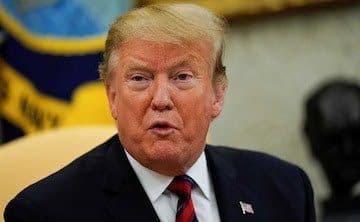
United States President Donald Trump has directed the Department of War to prepare for what he called “possible action” to eliminate Islamic terrorists in Nigeria, citing alleged widespread attacks on Christians. The directive, issued through his Truth Social media platform on Saturday, marks one of the most aggressive foreign policy statements by the Trump administration since returning to office.
In the post, President Trump accused the Nigerian government of “allowing” the killing of Christians and threatened to end all U.S. aid and assistance to the country if what he described as “Christian persecution” continued.
“If the Nigerian Government continues to allow the killing of Christians, the U.S.A. will immediately stop all aid and assistance to Nigeria, and may very well go into that now disgraced country, ‘guns-a-blazing,’ to completely wipe out the Islamic terrorists who are committing these horrible atrocities,” Trump wrote. “I am hereby instructing our Department of War to prepare for possible action. If we attack, it will be fast, vicious, and sweet, just like the terrorist thugs attack our cherished Christians! WARNING: THE NIGERIAN GOVERNMENT BETTER MOVE FAST!”
The remarks came barely a day after Washington redesignated Nigeria as a “Country of Particular Concern” (CPC), a status applied to nations accused of tolerating or engaging in severe violations of religious freedom. Nigeria was previously placed on and later removed from the CPC list under the Biden administration.
Nigerian President Bola Ahmed Tinubu responds cautiously, “Nigeria is a Secular Democracy.” He rejected Trump’s claims and designation, describing them as “ill-informed and unhelpful”, adding that “Nigeria remains a secular democracy anchored on constitutional guarantees of freedom of religion and belief.”
The Nigerian presidential office said in a statement from Abuja, “We reject any characterisation that seeks to define our complex security challenges through a single religious lens.” The Nigerian government maintains that ongoing violence in the country’s Middle Belt and northern regions is driven by multiple intersecting factors—including poverty, criminality, land disputes, and weak governance—rather than a campaign of religious persecution.
Security analysts and conflict researchers have similarly warned against oversimplifying Nigeria’s insecurity as a Christian–Muslim conflict. “What we see in places like Plateau, Benue, Zamfara, and Borno are overlapping crises involving ethnic competition, resource scarcity, violent crimes, and terrorism,” said a recent HumAngle report.
The HumAngle analysis titled Nigeria’s Conflicts Defy Simple Religious Labels revealed that communities of both faiths have suffered from terrorism and violent crimes, and that attackers often frame violence around identity to justify or mobilise support for their actions.
While Boko Haram and its offshoot, the Islamic State West Africa Province (ISWAP), continue to target civilians and security forces in attacks that often include Christian victims, the violence has also claimed thousands of Muslim lives.
HumAngle’s investigations have shown that the narrative of a “Christian genocide” obscures the complex and fluid alliances that define local conflicts. Extremist groups, criminal gangs, and vigilante forces often operate with shifting motives, depending on context.
Analysts say Trump’s statement may reflect both foreign policy posturing and domestic political calculation. With the 2026 midterm elections approaching, evangelical Christian groups have increasingly highlighted claims of Christian persecution across the world, particularly in Africa and the Middle East.
Support Our Journalism
There are millions of ordinary people affected by conflict in Africa whose stories are missing in the mainstream media. HumAngle is determined to tell those challenging and under-reported stories, hoping that the people impacted by these conflicts will find the safety and security they deserve.
To ensure that we continue to provide public service coverage, we have a small favour to ask you. We want you to be part of our journalistic endeavour by contributing a token to us.
Your donation will further promote a robust, free, and independent media.
Comments
0 comments
No comments yet.
Sign in to join the discussion.
Of course, we want our exclusive stories to reach as many people as possible and would appreciate it if you republish them. We only ask that you properly attribute to HumAngle, generally including the author's name, a link to the publication and a line of acknowledgement.