Peacebuilding Actors Say ‘Christian Genocide’ Rhetoric Is Eroding Their Work in Nigeria
Recent statements by US President Donald Trump describing Nigeria’s insecurity as “Christian genocide” are, according to peacebuilding actors, disrupting years of interfaith dialogue, community trust-building, and conflict-resolution efforts across the country.

Temisan Etietsola works as a media strategist at Search for Common Ground, a think tank focused on peacebuilding through media and communications, where he designs peace messaging and coordinates social change interventions across northern and southern Nigeria.
Over the years, he has facilitated dialogue sessions and helped strengthen community cohesion in communities where mistrust once ran deep. Now, he worries that the growing narrative describing the entirety of Nigeria’s insecurity as a “Christian genocide” threatens to unravel much of the progress communities have made.
“The framing instantly undoes years of patient, local dialogue by endorsing a narrative of religious war,” Temisan said. To him, the claim does not reflect the realities peacebuilders confront daily. “Both Christians and Muslims have been victims of terrorism and communal clashes,” he added, stating that Nigeria’s conflicts are driven instead by “resource control, governance failure, poverty, ethnic tensions, and secessionists.”
Temisan fears that external remarks like those made by US President Donald Trump could energise individuals and groups who already dismiss dialogue and moderation. “It gives them that international validation,” he said.
On Oct. 31, the Trump administration designated Nigeria as a Country of Particular Concern over alleged state-backed religious freedom violations. However, the Nigerian government has rejected the claim. “…any narrative suggesting that the Nigerian State is failing to take action against religious attacks is based on misinformation or faulty data,” said Mohammed Idris, the country’s Information Minister.
Supporters of the “Christian genocide” framing, including some local Christian leaders and US-based political leaders and organisations, argue that attacks on churches, clergy killings, and mass kidnappings targeting communities dominated by Christians amount to systematic persecution. They point to high-profile incidents in Benue, Kaduna, and Plateau states as evidence that Christians face disproportionate violence. However, conflict researchers say these attacks, while real and severe, occur within a broader landscape of insecurity that affects people of multiple ethnicities and faiths.
While some terror groups and mobs occasionally carry out religion-targeted attacks, the scale is far smaller than the rhetoric suggests. Armed Conflict Location & Event Data Project (ACLED) data shows that between January and June 2022, only about 5 per cent of recorded armed violence explicitly cited religious identity. Those incidents affected both Christians and Muslims.
Temisan stressed that Nigerians must not allow political narratives to distort their efforts. “We must find our solutions within. We don’t need an external source politicising our problems and tilting them toward divisive lines,” he said. For him, unity remains the only way forward.
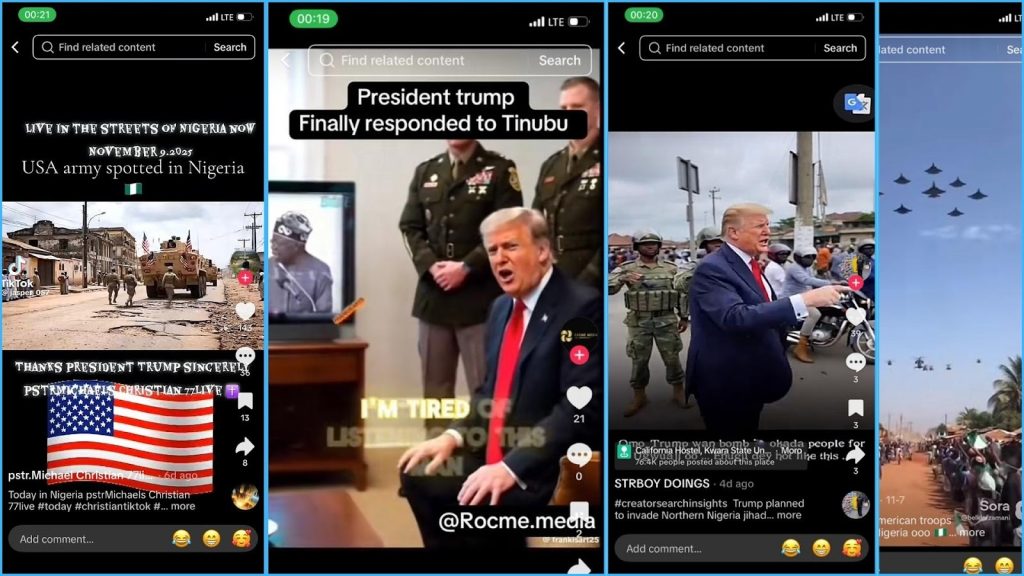
His concern is already visible in Nigeria’s information space. In recent weeks, renewed discussion around the “Christian genocide” rhetoric has deepened polarisation online. Social media users have begun profiling ordinary residents out of fear.
On Dec. 2, one X user posted a video of random travellers with the caption: “Ibadan residents express concern as a truckload of young men, motorcycles, and cows arrives from the North,” prompting dozens of replies reflecting anxiety and distrust. Another user shared an AI-generated image of people brandishing guns in front of various church buildings, falsely claiming, “Christian terrorists are now brandishing weapons and posing for pictures… only God knows the number of atrocities perpetrated with these weapons.”
Such disinformation, often mixed with satire and skit-style content by influential comedians, has hardened suspicion, amplified fear narratives, and eroded the fragile progress built through years of interfaith peacebuilding work across the country.
This rising distrust is felt most sharply in conflict-affected communities. “What we need is more support to continue the peace work we started and not more statements that bring suspicion,” said Abubakar Hassan, a resident of Gwoza, in Borno State, northeastern Nigeria.
Five years ago, Abubakar participated in a peacebuilding and interfaith dialogue training that, he said, helped reduce distrust between people of all faiths in his community. “What we learned there helped us rebuild trust in our community after many years of conflict,” he said.
While they rebuild trust amongst themselves, community members also demand justice and security to prevent continued attacks by insurgents. “On Nov. 14, in Gwoza, passengers, including Christian and Muslim faithfuls, were attacked by terrorists on the road along Limankara,” Abubakar said. “The incident was pathetic and simply unacceptable.”
“We suffer the same violence and insecurity together. Statements like this [referring to the ‘Christian genocide’] only create fear and can threaten the trust we have been trying to build.”
Several organisations, including those funded by the now-defunct USAID, have executed peacebuilding programmes, including trauma-healing activities, sport events, and interfaith dialogue, within communities that have experienced communal clashes across the country.
One such initiative is the Engaging Communities for Peace in Nigeria (ECPN), a Mercy Corps programme, implemented across the country’s North East and the Middle Belt. ECPN brought together local community leaders, farmers, herders, and youth mediators to rebuild trust after years of violence. Through dialogue forums, conflict-resolution training, and joint economic activities, communities that once viewed each other as enemies began to cooperate again.
Farming and pastoralist leaders built alliances, pastors and imams attended peace workshops side-by-side, and previously hostile ethnic groups slowly began restoring broken relationships.
Ardo Danlami, a pastoral community leader in Ashige Community, Nasarawa State, in North Central Nigeria, said he met his wife, who is from a farming community, during one of those ECPN workshops. “When I expressed my intention to marry her, we got her father’s blessings,” he said. “The rest is history, like they say.”
In conflict-affected communities like Ashige, peacebuilding actors helped people interact across various faith and ethnic identities, correct dangerous stereotypes, and learn ‘Do No Harm’ principles. The interventions, built slowly and carefully over the years, have reduced tensions and empowered civil society organisations to promote interfaith coexistence within their communities.
“I never thought the day would come when farmers and pastoralists would engage in trust-based economic transactions because of all the atrocities in the past,” said Solomon Igbawau, a Christian leader in Zongo Community, Benue State, who participated in the ECPN programme. “These activities brought us together, and we got to know more about one another.” He added that a herder, who is also a muslim, in his community, “gave one of his cattle to me on credit.”
Initiatives like ECPN depend on a shared understanding that Nigeria’s violence is multi-layered and rooted in social, political, and economic pressures, rather than a singular religious war.
However, the glowing testimonies of people such as Solomon and Ardo stand at risk of fading as the divisive rhetoric continues to erode the trust and solidarity built over the years.
Former US President Donald Trump's remarks referring to Nigeria's insecurity as "Christian genocide" have disrupted years of peace-building and interfaith dialogue in the country. Such framing has been criticized by peacebuilders like Temisan Etietsola, who emphasize that Nigeria's conflicts are driven by factors such as resource control and governance failure, affecting both Christians and Muslims. The rhetoric further polarizes the community and provides undue validation to extremist views, threatening the delicate trust developed over years.
Despite high-profile attacks on Christian communities, researchers argue that violence affects various ethnic and religious groups. Initiatives like the Engaging Communities for Peace in Nigeria (ECPN), which promote interfaith dialogue and conflict-resolution training, have been crucial in rebuilding trust. However, the divisive narrative undermines these efforts, potentially dissolving alliances and understanding across different factions. Such statements polarize communities deeper, hindering the ongoing peace and reconciliation processes.
Support Our Journalism
There are millions of ordinary people affected by conflict in Africa whose stories are missing in the mainstream media. HumAngle is determined to tell those challenging and under-reported stories, hoping that the people impacted by these conflicts will find the safety and security they deserve.
To ensure that we continue to provide public service coverage, we have a small favour to ask you. We want you to be part of our journalistic endeavour by contributing a token to us.
Your donation will further promote a robust, free, and independent media.
Donate HereStay Closer To The Stories That Matter