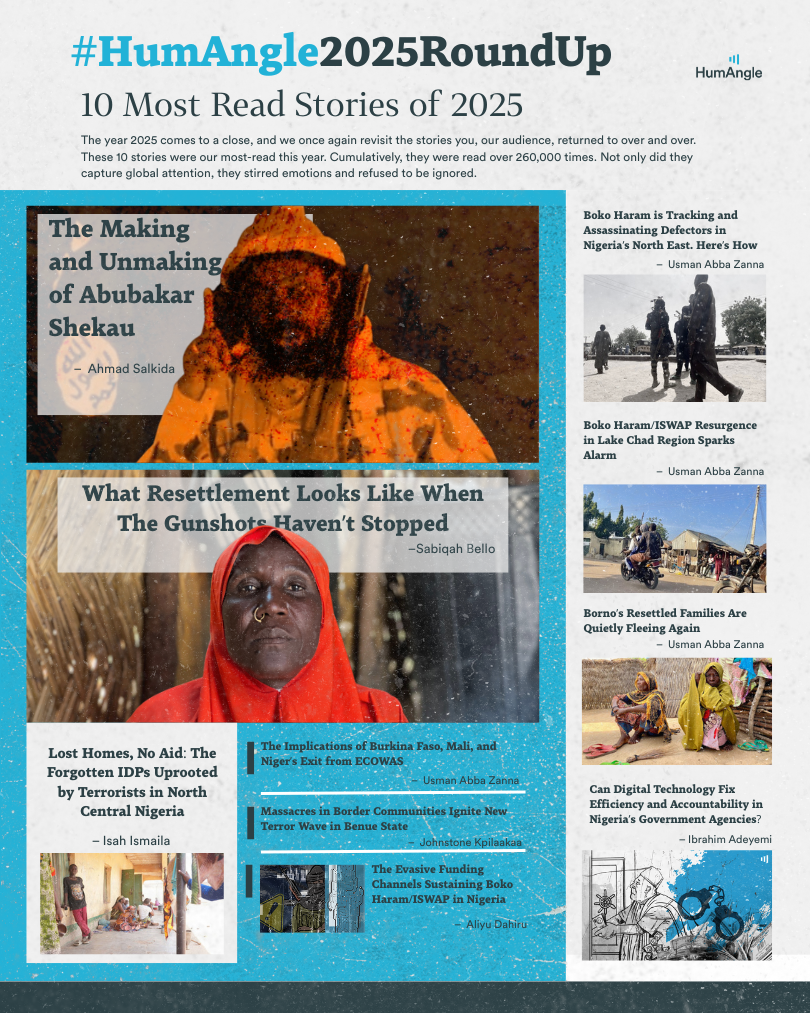
#HumAngle2025RoundUp: Here are HumAngle’s 10 Most Read Stories of 2025
The year 2025 comes to a close, and we once again revisit the stories you, our audience, returned to over and over. These 10 stories were our most-read this year. Cumulatively, they were read over 260,000 times.

1. The Making and Unmaking of Abubakar Shekau – Ahmad Salkida (43,043)
To understand the present and make corrections for the future, we must revisit the past. This investigative exposé details the making and unmaking of Abubakar Shekau; how a boy who was good at playing football became a perfume seller and then a terrorist warlord who orchestrated abductions, killings, and terror across Nigeria.
2. What Resettlement Looks Like When The Gunshots Haven’t Stopped by Sabiqah Bello (35,710)
In this delicate story about Fati Bukar and her son, we look at how lives are affected by insecurity, displacement, and resettlement. This story shows us that the human fallout of the insurgency doesn’t manifest only in the fear of lives and properties; it also takes form in the fear of saying goodbye to a loved one, not to death, but to distance. The story is a reminder that government solutions must involve the people they were created to serve and consider the nuances of their lives.
3. Lost Homes, No Aid: The Forgotten IDPs Uprooted by Terrorists in North Central Nigeria by Isah Ismaila (35,387)
Due to terrorist activities, residents have moved to a Shiroro displacement camp in Niger State, North Central Nigeria. But for these people, life is stalled. Business owners have abandoned their shops, children can no longer go to school, and healthcare doesn’t exist. In this story, we highlight how institutional neglect traps citizens in a cycle of poverty and despair.
4. Boko Haram is Tracking and Assassinating Defectors in Nigeria’s North East. Here is how. By Usman Abba Zanna (29,904)
We reported how former Boko Haram members trying to reintegrate into society have a target on their backs by the group. Here, we showed that renouncing allegiance to the terror groups doesn’t end the war; it simply makes you a different kind of target.
5. Boko Haram/ISWAP Resurgence in Lake Chad Region Sparks Alarm by Usman Abba Zanna (29,553)
Through sophisticated operations, incessant small-scale abductions, and major funds generation from high-profile abductions, we document the resurgence of Boko Haram and ISWAP attacks in the Lake Chad region. These early warning signs show communities witnessing fresh assaults from terrorists, and through open-source monitoring, we reveal how terrorists are amplifying their online presence by leveraging TikTok.
6. Borno’s Resettled Families Are Quietly Fleeing Again by Usman Abba Zanna (24,416)
In 2019, the Borno State government commenced the resettlement of displaced families to Kawuri, their hometown in northeastern Nigeria. The returnees believed that life would return to what they were used to, but their current state is deplorable. In this report, we found that they have no healthcare, no basic essential supplies, and the persistent presence and growing threat of Boko Haram insurgents is forcing them to flee once again.
7. Can Digital Technology Fix Efficiency and Accountability in Nigeria’s Government Agencies? by Ibrahim Adeyemi (21,054)
Nigeria has a long history of a lack of accountability and transparency in public spaces. To reduce this and boost efficiency in Government parastatals, the Central Bank of Nigeria (CBN) established the DocFlow and the MDA Naira Payment Solution.
The DocFlow system was created to digitalise the daily operations of government workers, replacing paper-heavy processes. The MDA Naira Payment Solution is focused on automating payment processes for Ministries, Departments, and Agencies (MDAs), with a system promising to make transactions faster and more accurate while also preventing fraud and reducing errors. We looked at the efficiency of these systems.
8. The Implications of Burkina Faso, Mali, and Niger’s Exit from ECOWAS by Usman Abba Zanna (19,297)
In January, Burkina Faso, Mali, and Niger exited ECOWAS and formed the Alliance of Sahel States (AES). While this exit was celebrated by mass rallies across the three countries, it sent shockwaves through the region. Here, we looked at the economic ramifications and implications of this break.
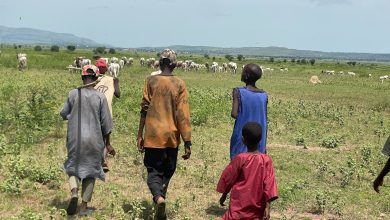
9. Massacres in Border Communities Ignite New Terror Wave in Benue State by Johnstone Kpilaakaa (18,923)
Benue communities in North-Central Nigeria have been at war with recurring violence between farming communities and nomadic herders over land and resources. This crisis has forced people, young and old, into displacement. In this report, we show that for the old, home no longer exists as they knew it; for the young, home is a place born out of violence and death.
10. The Evasive Funding Channels Sustaining Boko Haram/ISWAP in Nigeria by Aliyu Dahiru (15,036)
People often wonder and ask how terror groups can fund their operations and provide for themselves far away from society. To answer the age-old question of terror financing, this analysis showed us that beneath the violence, beyond the battlefield, terrorists have taken control and now govern civilian spaces, collecting taxes, enforcing laws, and offering basic welfare, particularly within their strongholds in the Lake Chad region. Other illicit financial flows come from crypto donations, smuggling, and black market operations.
The provided content discusses a series of investigative stories covering issues around terrorism, displacement, and digital technology in Nigeria.
Stories include the life and actions of terrorist Abubakar Shekau, the challenges faced by internally displaced persons due to terrorism, and the resettlement issues in regions affected by insurgency. It highlights the targeting of defectors by Boko Haram and the resurgence of this group along with ISWAP in the Lake Chad region.
Additional articles address border massacres in Benue State, the potential of digital technology to improve government efficiency, and the economic implications of Burkina Faso, Mali, and Niger's exit from ECOWAS.
Also covered are the funding channels for Boko Haram/ISWAP and their impact on society. These stories emphasize the broader socio-economic and security challenges within affected Nigerian communities, urging more informed and people-focused solutions.
Support Our Journalism
There are millions of ordinary people affected by conflict in Africa whose stories are missing in the mainstream media. HumAngle is determined to tell those challenging and under-reported stories, hoping that the people impacted by these conflicts will find the safety and security they deserve.
To ensure that we continue to provide public service coverage, we have a small favour to ask you. We want you to be part of our journalistic endeavour by contributing a token to us.
Your donation will further promote a robust, free, and independent media.
Donate HereStay Closer To The Stories That Matter