Fact-Check: Trending Photos of Nnamdi Kanu in Prison Uniform Are AI-generated
The images trending on Facebook that claim to show Nnamdi Kanu in a Nigerian prison are AI-generated. While they may resemble the IPOB leader, they contain tell-tale signs of AI manipulation, including distorted anatomy, illegible text, and unnatural visual artefacts.
Listen to this story

3 Dec 2025
Multiple photos have shown Nnamdi Kanu, the leader of the Indigenous People of Biafra (IPOB), in an awkward prison setting, suggesting how he is faring in custody, following his recent life sentence after years of legal battle with the Nigerian government. The photos, widely shared on Facebook and other social media platforms, portray him languishing in Sokoto’s correctional facility in northwestern Nigeria, where he’s currently serving his jail term, appearing to be wearing a blue prison uniform.
Facebook users shared the fake photos to push different narratives in a seemingly sarcastic but believable manner, appealing to some audiences.
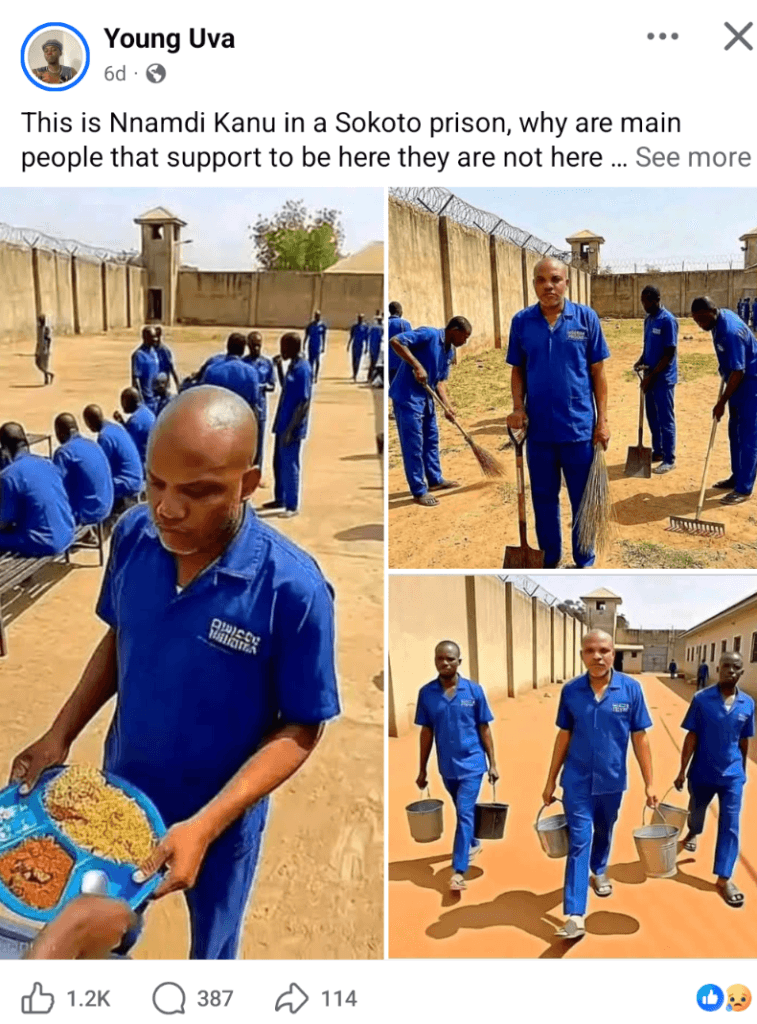
A Facebook user claimed the picture shows the “leader now a servant in a cage that is in the zoo controlled by Janjaweed.” The post amassed over 200 likes, dozens of comments and more than 70 shares. Kanu had often described Nigeria metaphorically as a zoo; hence, the Facebook post satirically taunted him. While a few people doubted the post’s authenticity, many others seemed to believe it based on their comments. Another Facebook reel featured a caged Kanu, wearing a blue uniform and eating bean cake and pap, in a place described as “Sokoto Prison”; the post received more than 1,000 likes and over 300 comments.
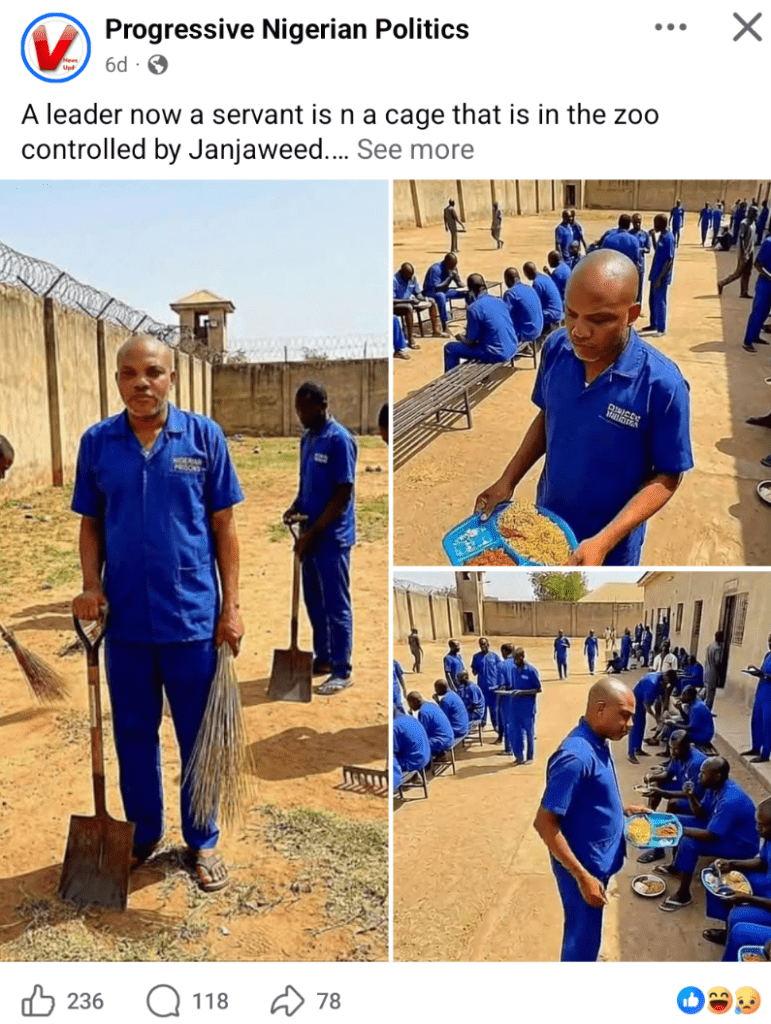
The Facebook posts illustrate a recurring trend in which digitally manipulated or entirely AI-generated images are used to spread misinformation about high-profile political figures, such as Kanu. Although AI-generated, many social media users mistook them for pictures of the IPOB leader in detention.
Several Facebook users glamorised Kanu’s fake prison images, claiming that going to jail was a common trait of “great minds and leaders”. One poster commenting on the photos said: “Don’t worry. It’s just a matter of time. He must surely be free. Great leaders pass through the process. They gain experience of all kinds to lead well.”
Background
Nnamdi Kanu was sentenced to life imprisonment by the Federal High Court in Abuja on Nov. 20 after being convicted on multiple terrorism-related charges. The sentencing was delivered by Justice James Omotosho, who found Kanu guilty on all seven counts brought against him by the Federal Government.
Specifically, he was sentenced to life imprisonment on counts one, two, four, five, and six, while counts three and seven carried 20 and five-year jail terms, respectively, without the option of a fine. The judge noted that although the charges could have warranted a death penalty, the court opted for life imprisonment instead, citing proportionality and judicial discretion.
This ruling marked the culmination of a lengthy legal battle that began with Kanu’s arrest and extradition to Nigeria in 2021, following years of separatist agitation through IPOB to secede the South East from Nigeria to form the Biafran state.
Over the years, the outlawed separatist group has terrorised the southeastern region with gun violence, imposing a sit-at-home order that has debilitated the social and economic lives of locals. Frequent attacks have resulted in numerous casualties among both civilians and law enforcement officers. Nigerian authorities continue to struggle with this crisis, which is further complicated by the group’s alleged support from local and international entities.
The judgment sparked widespread reactions across Nigeria, particularly in the country’s South East. Critics, including Bello El-Rufai, a member of the House of Representatives, condemnedthe inconsistency in Nigeria’s justice system, claiming that while Kanu received a life sentence, a convicted Ansaru terrorist, Hussaini Ismail, was sentenced to only 20 years.
This disparity has fueled debates about fairness, selective justice, and the political undertones of Kanu’s prosecution, with many Igbo leaders and clerics previously calling for dialogue rather than harsh punishment. Kanu’s life sentence also carries significant political and social implications. The Nigerian government has long outlawed IPOB, and Kanu’s conviction reinforces the state’s stance against separatist movements, intensifying long-standing tensions.
Verification
A simple Google search for “Nnamdi Kanu’s pictures in Sokoto prison” returns with even more distorted, AI-generated images of the subject. The physical features of AI-generated images are glaring in all the photos deployed on Facebook to push different narratives, signalling a new wave of disinformation about the subject. Since Kanu’s incarceration by the Department of State Services (DSS) following his rendition in 2021, the only verified, genuine images of him are typically those taken during closely monitored court appearances, released by his legal team, or cleared by the government. The circulating images lack the indicators of authenticity.
The first thing that gives out the images is the graphic imperfections associated with AI-generated photos. The pictures used to portray Kanu in prison embody poor lighting and inconsistent human anatomical features. They are typically circulated without clear context – date, location, photographer – and originate from unverified social media accounts rather than his official family, legal representatives, or reliable news organisations. The AI-generated photos appear to be deployed to advance various, often contradictory narratives regarding Kanu’s status and the separatist movement, capitalising on an information vacuum and his audience’s emotional investment.
When subjected to an AI image-detecting tool, the five most trending pictures used to spread inaccurate information about Kanu’s detention turned out to be 100 per cent AI-generated, with zero chance of originality. We used Decopy AI, a digital public tool known for identifying AI images; the result shows that “overall, the image has multiple indicators of AI generation, including unnatural human poses, uniform textures, and inconsistent shadows.”
The Decopy AI analysis reveals that the figures in many of the sample photos exhibit unusually stiff, unnatural walking postures, stressing that “the arm and hand positions holding the buckets appear overly simplified and lack natural muscle tension and variation typical of human movement. The symmetry and alignment of limbs look artificially generated rather than natural.” The analysis of the images indicated that the blue outfits exhibited a relatively uniform, flat colouration, lacking realistic folds, stitching details, or the texture typical of fabric. The lighting on the clothing appears overly smooth, missing the subtle variations and shadows typically present in real textiles.
The digital tool explains that “the shadows on the ground are inconsistent and oddly shaped – the shadow edges are unnaturally smooth and do not correspond well with the figures’ feet”, noting that one shadow is disconnected from the object casting it, indicating artificial rendering. It also describes how the background walls and ground have an overly uniform texture without detailed imperfections or natural variation. The barbed wire and tower structure appear simplified and lack realistic depth or complexity.
To be clear, we examined a seemingly original photo of Nnamdi Kanu in court that news platforms in Nigeria used, as seen here. The picture was tagged as an original human origin image because “the overall composition of the image exhibits natural depth, with proper focus on subjects at various distances. The lighting is consistent, with soft highlights and shadows that naturally correspond to the room’s light sources.”
Verdict
The images trending on Facebook that claim to show Nnamdi Kanu in Sokoto prison are generated using Artificial Intelligence. While they may resemble the IPOB leader, they contain tell-tale signs of AI manipulation, including distorted anatomy, illegible text, and unnatural visual artefacts. They are not sourced from any credible media or official channels. They serve as a powerful example of how synthetic media is leveraged to manipulate political narratives and mobilise public opinion by exploiting hope, fear, and a scarcity of authentic information.
Support Our Journalism
There are millions of ordinary people affected by conflict in Africa whose stories are missing in the mainstream media. HumAngle is determined to tell those challenging and under-reported stories, hoping that the people impacted by these conflicts will find the safety and security they deserve.
To ensure that we continue to provide public service coverage, we have a small favour to ask you. We want you to be part of our journalistic endeavour by contributing a token to us.
Your donation will further promote a robust, free, and independent media.
Comments
0 comments
No comments yet.
Sign in to join the discussion.
Of course, we want our exclusive stories to reach as many people as possible and would appreciate it if you republish them. We only ask that you properly attribute to HumAngle, generally including the author's name, a link to the publication and a line of acknowledgement.