The Plastic Collectors of Makoko
Far from home, young men from Northern Nigeria navigate life in a Lagos slum, healing the earth at a steep cost.

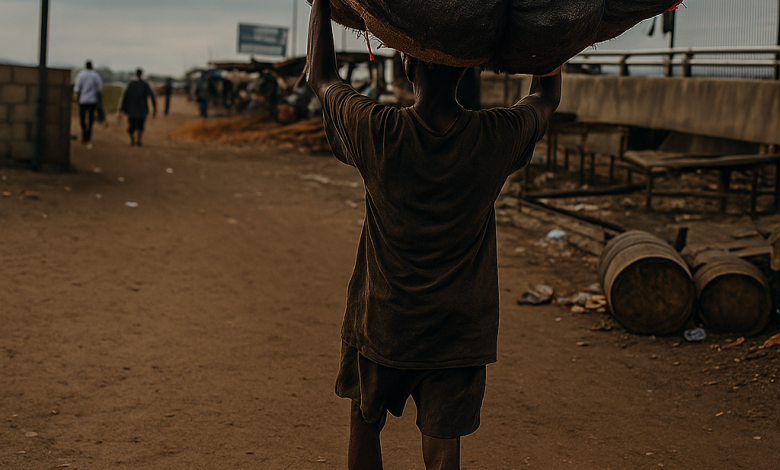
As Yusuf collects plastic from the floating streets of Lagos’ Makoko, memories of his wife bring home back to him. Together, they used to attend wedding parties in Makoda, Kano State, North West Nigeria, where he grew up and worked on his father’s rice farm before kidnappers changed everything. He remembers them as masked, armed men advancing on bikes.
In Makoko, the water is black with sewage. Beneath it lie broken glass, rusted nails, and other dangerous relics of generations of fishermen and their families. Yet Yusuf’s hope each day is to find enough plastic to eat, save, and send money to relatives at home, who are too afraid to return to their farm.
Two of his friends never made it back from captivity. The only one who did died after reaching home. “That was why I ran,” Yusuf said.
One friend fled to Abuja in North Central Nigeria, another to Sokoto. Yusuf came to Lagos on the back of a truck, and for three months, he has lived among other young people pushed down south by conflict or hunger.
After morning prayers, the young migrants spread out across Makoko’s black water, each wading in barefoot, hoping to fill their bags with plastic by evening.
Makoko, a massive slum in the Yaba area of Lagos, South West Nigeria, is home to an estimated 200,000 people, including fishermen and their families. Its densely packed stilt houses leave only narrow waterways where canoes scrape and collide. Many homes lack proper toilets or waste disposal systems, turning the lagoon beneath them into a receptacle for human sewage. Empty bottles and soft drinks used in religious rituals drift on the surface, forming part of the community’s plastic stream. The rest is carried by rain and floodwaters from the wider Lagos metropolis.
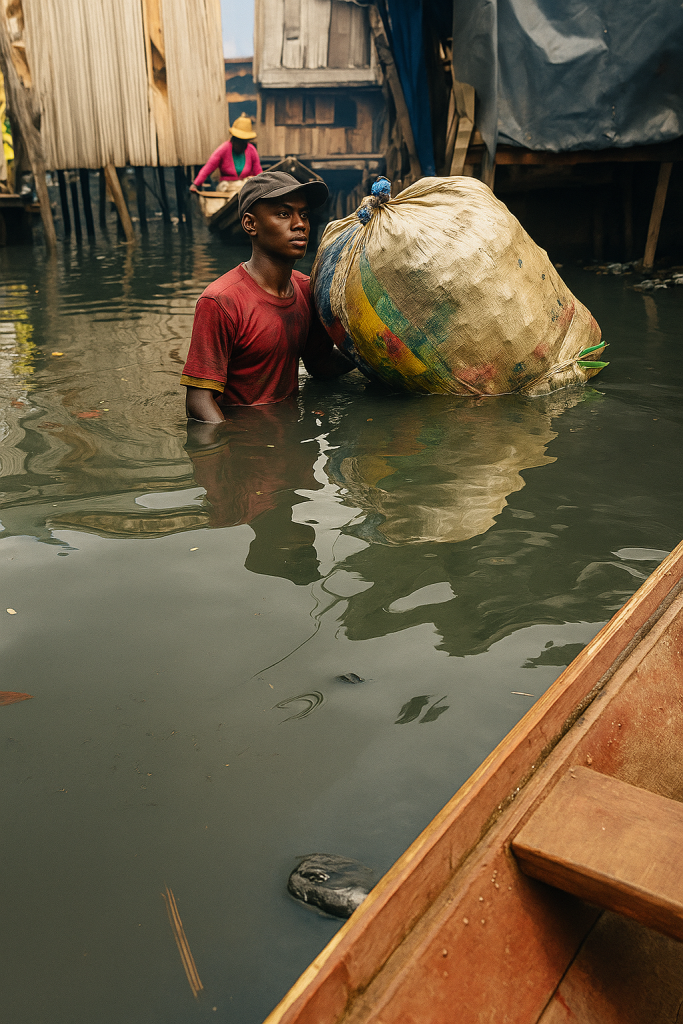
Saada was 12 when he began bringing money home after working on people’s farms in Kawari, Katsina State, in northwestern Nigeria. Now 21, with farm owners no longer paying labourers in his village, he also moved to Makoko, where he collects plastic from 7:00 a.m. to 5:00 p.m.
Plastic collectors work daily in Makoko.
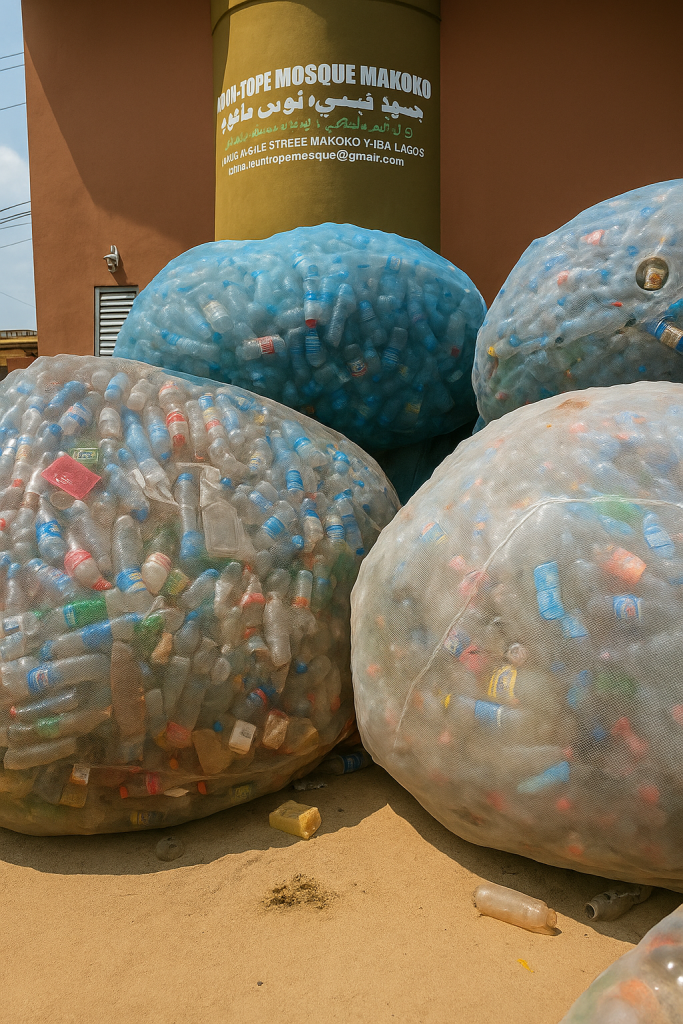
In the evening, they head to the scale. A kilogram of plastic bottles sells for between ₦150 and ₦300, while a kilogram of plastic bags goes for about ₦100, paid by men believed to be agents for local recycling companies. On a good day, a collector with two full sacks can earn up to ₦7,000.
Thirty-five-year-old Sa’idu, a much older collector who has spent several years on the job, narrated his arithmetic of survival:
“I didn’t make more than ₦3,500 yesterday, as I didn’t come early [to the scavenging site],” he said. “If I pick a full bag of plastic, I make between ₦5,000 and ₦6,000.”
Sa’idu spends ₦1,500 on food in the morning and ₦1,200 in the evening. He also sends money home to plant on his late father’s farm.
Another collector, Abubakar, 35, gathers enough plastic to feed his family and occasionally buy himself new clothes, yet he longs to return to Katsina State. His memories of Batagarawa, the town where he grew up, are stained with images of masked, armed terrorists riding in on bikes.
“My father said they were Boko Haram,” he told HumAngle.
Boko Haram has ravaged northern Nigeria for over a decade. It is notorious for suicide bombings, mass killings, and abductions, especially at the height of its terror between 2009 and 2015. Other armed groups like the Islamic State West Africa Province (ISWAP), Ansaru, and Lakurawa also contribute to insecurity in the region, in addition to frequent farmer-herder clashes.
One night, Abubakar fled with his family to Mani, a town in the same state, where his parents, wife, and child still live. It is Mani that he hopes to return to someday to acquire land and farm again.
Though the young migrants pass their nights in makeshift huts beside heaps of plastic at the scale, they hardly know the fate of their catch.
“It’s my boss, Zagiru, who buys it from me,” said Sa’idu.
While he may help load the plastic into a truck, he doesn’t know the ultimate beneficiaries of his labour. Lagos-based recycling companies Wecyclers, Alef Recycling, and Lexsz Plastics Limited have also not responded to HumAngle’s emails seeking to verify links with Makoko’s collectors.
Scavengers in Lagos, some of whom are southerners, carry a reputation for theft and are often treated with suspicion. In January of this year, the state assembly accused them of stealing and vandalising public infrastructure like manhole covers, pedestrian bridge railings, and streetlight cables, with one lawmaker calling for a ban on their activities.
“Some chase us with sticks because of those who steal their pots and other metallic objects,” Sa’idu told me, describing how Makoko residents sometimes react to them.
Yet their work forms one of the most effective waste-interception systems in Lagos, according to Adesehinwa Adegbulugbe, an environmental and social safeguards specialist with Abuja-based Seismic Consulting Group. Just one week without them, he said, could set off a month of malaria, a season of hunger, and a year of lost mangrove carbon sinks.
“Mangroves will suffocate, crabs will die, fish will flee, and the food chain will also stagger,” he said.
Lagos collectors prevent tons of plastic bottles annually from lodging in mangrove prop roots, according to Adesehinwa, translating into the protection of hectares of mangrove fringe. “Each hectare of healthy mangrove removes up to 1.1 kg of nitrogen daily, mitigating eutrophication and harmful algal blooms downstream,” he added. “Hence, the scavengers’ labour helps to amplify the lagoon’s natural capacity at a scale that formal waste infrastructure has yet to match.”
By removing between two and three tons of plastic waste daily, the environmental specialist also said, scavengers, like the ones in Makoko, prevent roughly 700 to 1,100 tons of material from washing into the Atlantic Ocean.
“Plastic bottles do not biodegrade; instead, they photodegrade into microplastics within 6 to 12 months in waters, especially within the tropics,” he said.
“These particles, when ingested by zooplankton, can be transferred to planktivorous fish such as tilapia and catfish and ultimately end up in the human system. This is highly poisonous. The intervention by plastic bottle scavengers disrupts a toxic cascade. By reducing the substrate available for microplastic generation, scavengers lower the body burden of persistent organic pollutants in commercially important fish stocks.”
But for many collectors, the work is strictly about survival. They stir the still water each day to eat and support relatives back home who can no longer farm or trade because of insecurity. And since those who disturb the rusted metals of history may suffer wounds from someone else’s neglect, Saada already carries scars from his few months on the job. The one on his hand, he said, came from a nail jutting out of a boat. The owner paid for his treatment at a nearby clinic.
“If the wound isn’t deep, I take medication. If it is deep, I take an anti-tetanus injection,” he said.
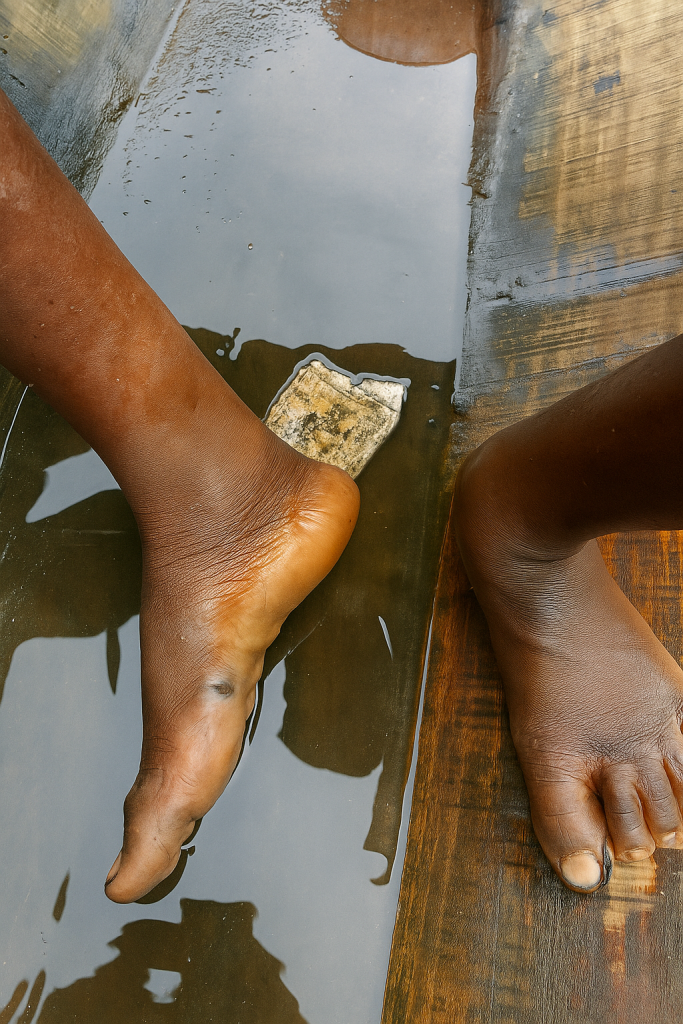
Yusuf said his body itches from long hours in dirty water. Rashes and small wounds, he said, dot his skin, and his legs have turned pale.
Meanwhile, Sa’idu’s leg is a gallery of scars. Once, he was unable to work for two months after stepping on a nail.
“There’s a drug we take after coming out of the water to prevent itching and rashes,” Yusuf explained. “We bathe immediately after leaving the water, then apply the drug, which is locally sold.”
The drug is called Waraka, sold for between ₦200 and ₦1,000, depending on the quantity. “We rub it on our skin after work,” he said.
Adesehinwa said the collectors are at risk of infections such as tetanus and hepatitis B, and would benefit from proper vaccination. Personal protective equipment like gloves, safety boots, reflective life jackets, and goggles, he said, would offer an additional layer of protection, while first aid is essential in emergencies.
The collectors recalled a colleague who died from electrocution while picking plastic and was only discovered three days later. They remembered Usman and Buhari, who fell seriously ill and are now recovering back home. Mamuda, another collector, nearly died after consuming soft drinks thrown into the water as offerings to spirits.
One evening, Sa’idu returned home to find his brother and uncle had been killed. The two market labourers were caught in a clash between rival area boys’ factions in Lagos. They were the ones who had brought him to Lagos, where he first began collecting plastic bottles on the streets. Now, with them gone, he is left alone in the city.
Such violent clashes are common in Lagos. Sometimes they erupt between rival cult groups; other times, they are sparked by minor misunderstandings between residents of the same or different ethnic backgrounds. In 2019, a dispute between a Yoruba and a Hausa scavenger at the Olusosun dumpsite in Ojota escalated into an ethnic clash that left two people dead. A similar confrontation three years earlier claimed no fewer than five lives in Mile 12.
“My relatives were killed by terrorists at home, and here in Lagos, my relatives have also been killed,” said Sa’idu.
Every four months, Yusuf returns home to be with his family for a week. For ₦25,000, he secures a spot on a truck and travels a full day. The journey back to Lagos is cheaper but takes two days, slowed by the weight of loaded trucks.
“I go home to have sex,” he said bluntly.
His 18-year-old wife is now pregnant with their first child. Yusuf dreams of bringing her to Lagos, to an apartment and shop he hopes to rent once he has saved enough.
Migrants navigate generations of human neglect in a city that had no place for them. But amid the toil and danger, they retain a subtle sense of purpose.
If the water could talk, one collector mused, “it would thank me for ridding it of plastic.”
This is the first of a two-part ‘Down South’ series exploring migration from areas of Northern Nigeria to Lagos. The second part can be found here.
In Lagos' Makoko, migrants like Yusuf and Sa’idu, displaced by conflict in northern Nigeria, collect plastic waste from polluted waters for survival. Their labor is crucial in mitigating environmental issues, yet they face harsh conditions and stigma. Despite infections and injuries from scavenging, they continue to support families who are unable to farm due to insecurity. The collectors' efforts significantly reduce plastic waste in waterways, highlighting the intersection of displacement, poverty, and environmental conservation. Yet, safety and medical support remain inadequate for these workers who are integral to Lagos' informal waste management system.
Support Our Journalism
There are millions of ordinary people affected by conflict in Africa whose stories are missing in the mainstream media. HumAngle is determined to tell those challenging and under-reported stories, hoping that the people impacted by these conflicts will find the safety and security they deserve.
To ensure that we continue to provide public service coverage, we have a small favour to ask you. We want you to be part of our journalistic endeavour by contributing a token to us.
Your donation will further promote a robust, free, and independent media.
Donate HereStay Closer To The Stories That Matter