Ngoshe Attack: The Fragile Promise of “Safe Resettlement”
Six years after residents of Ngoshe in northeastern Nigeria returned home under a government resettlement programme, the community was overrun by terrorists, who killed and abducted many, while forcing others into displacement once again. HumAngle spoke to survivors.

Two children he found while fleeing the Ngoshe attack clung to his hands, struggling to keep up as they stumbled across the uneven ground. Behind them, armed terrorists pursued, closing in.
From the distance, smoke rises, and shouts echo. The children stumbled again. Solomon Ali Talake pulled them and kept running. He could not run at full speed, and yet the terrorists would kill him if they caught up. So, he made a quick decision.
“Run that way,” he told the children, pointing toward the bush, while he turned in the opposite direction. He was spotted, however. He darted behind a tree, his chest pounding.
For a moment, he froze there, whispering a prayer under his breath.
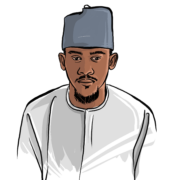
Some hours before, Solomon could not have imagined that his life would change so completely. He is a primary school teacher in Ngoshe, a community in Borno, northeastern Nigeria, where he spends his days teaching pupils to read and write. On the evening of March 3, his routine unfolded like it always had. He returned home from school, sat with his family in the compound, and had dinner.
Then the gunfire began.
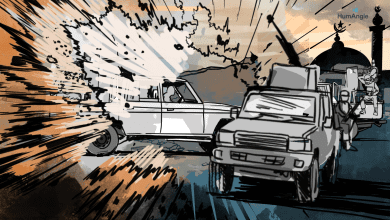
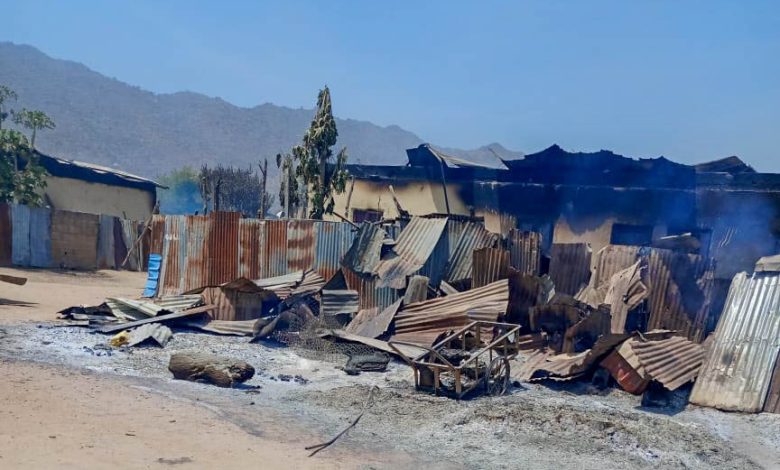
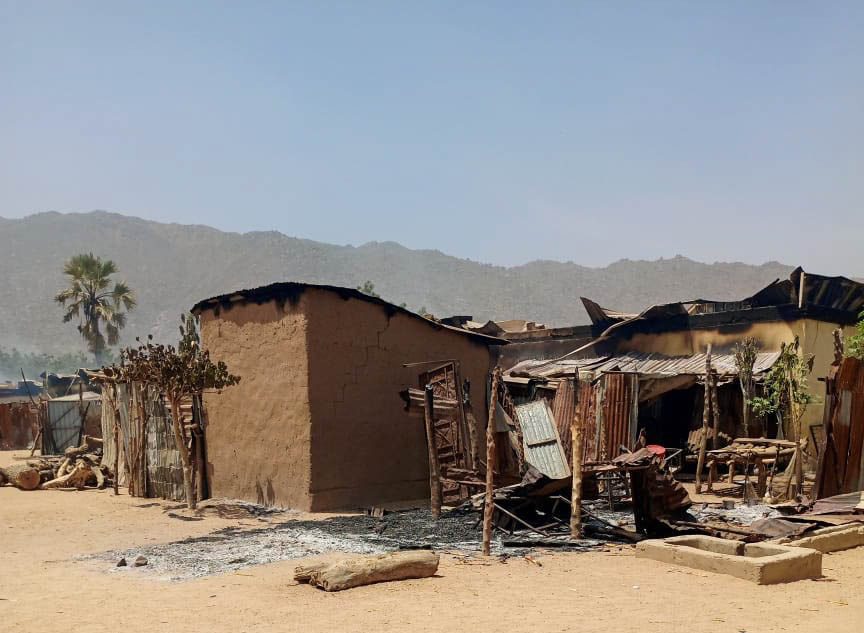
Terrorists stormed Ngoshe that evening, attacking a military base before spreading through the town, setting houses ablaze. Reports say the attackers killed over 100 and abducted over 300 more, but survivors said the casualty is too many to count. They said the assault, which lasted for several hours, forced thousands to flee the community that had been resettled only a few years ago as part of the government’s post-conflict programme.
“They attacked around 6:25 p.m.,” Solomon recalled.
His house sits close to the military base, so the first sounds came from there. The attackers, he said, struck the base before moving toward the community.
The military returned fire, according to Maina Bukar, another resident of Ngoshe who is now displaced in Maiduguri. “But they were overpowered, so they withdrew.”
When residents saw soldiers pulling back from the base, panic spread through the village. Families ran in every direction, but the terrorists followed. They caught up with some people and opened fire. Others were cut down as they tried to escape.
Solomon ran towards the bush, along the path leading to Pulka. The terrorists pursued and almost caught up. He hid behind a tree, three houses away from home. The terrorists spotted him but got distracted by movements in a nearby house. They rushed in to search.
Solomon seized the moment. “I climbed the tree and hid among the branches,” he recalled. “I remained there throughout the night.” The sound of the chaos echoed through the night.
Hours earlier, the village had been filled with children returning from school, farmers preparing their evening meals, and Muslim families preparing to break their fast.
The sounds of the attack did not remain confined to Ngoshe. Residents in Pulka, about ten kilometres away, also heard the gunfire.
“We heard it as soon as it happened,” said Muhammad Tela, a resident of Pulka.
Pulka sits close to Ngoshe, separated largely by a stretch of land and the hills of the Mandara Mountains. Both communities are towns in the Gwoza Local Government Area of Borno State.
“Ngoshe to Pulka is about a 25-minute drive because of the condition of the road,” Maina explained.
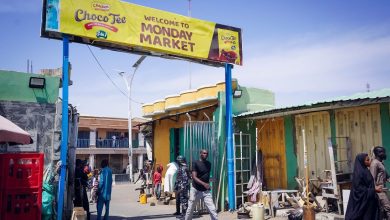
The two communities are closely connected. Every Tuesday and Friday, traders from Ngoshe travel to Pulka for trade under military escort, Maina said.
On the night of March 3, however, the market routes fell silent.
A return that promised safety
For Solomon’s family, returning to Ngoshe once felt like the beginning of a new chapter.
In October 2020, the Borno State government resettled displaced people in the town after rebuilding homes, schools, clinics, and other public facilities destroyed by Boko Haram insurgents in their violent and prolonged effort to topple democracy and establish what they believe to be an Islamic state. The activities of the terror group has killed over 35,000 people and displaced millions.
The Borno State government’s move was presented as part of a broader transition into what officials described as a post-conflict recovery phase. Solomon’s father, Ali Talake, believed in that promise.
Years earlier, when the insurgents first overran Ngoshe and neighbouring communities, he had fled across the border into Cameroon. From there, he eventually made his way to Maiduguri, where he lived inside the Federal Government College, volunteering as a security guard.
But his thoughts rarely left Ngoshe.
“My father was a farmer and a livestock rearer,” Solomon said.
When news spread that the government had begun resettling displaced residents, Ali Talake decided it was time to return. “We returned to Ngoshe on October 15, 2020,” Solomon said. Like many others, the family began rebuilding their lives there.
For six years, Ngoshe once again stood as home.
The community had access to basic facilities. “There is a clinic,” Maina said. “There are doctors and drugs.” The town also had clean water and schools.
Security presence was also significant. Residents say the formation consisted of personnel from the military and volunteer outfits like the Civilian Joint Task Force (CJTF), Nigeria Forest Security Services (NFSS), and surrendered terrorists, popularly called “the hybrid.” Solomon said there were about 300 soldiers stationed in Ngoshe. Maina corroborated this. In addition, “there are about 400 personnel of the CJTF, NFSS, and vigilantes,” he said. Before the attack, Maina estimated, about 10,000 people lived in the community.
“They patrol the town at night,” he said of the security operatives. “They would start patrolling by 6 p.m. until 6 a.m. the next morning.”
Despite that, residents said they did not always feel safe.
The town had faced insecurity before. “A similar major one [attack] happened on June 21, 2025,” Solomon recalled. Like in the recent attack, the community was overrun. “They did not kill anyone or burn buildings during that attack,” Solomon said.
Security later improved, and the town gradually returned to normal. But residents, especially farmers, could rarely venture beyond one kilometre from the town, Maina said. “Those who go beyond that are often abducted or killed by terrorists.”
For large-scale cultivation, people often travelled to Monguno and communities on the outskirts of Maiduguri, the state capital, such as Jakana. Adamu Zakariya, a resident of Ngoshe who had returned to Maiduguri months earlier to harvest his crops, agreed. “After harvest, we would return with the crops to Ngoshe,” he said. But this time, he decided to remain in Maiduguri because of a security job he recently got, while his family stayed in Ngoshe.
“Two weeks ago, they abducted some girls who had gone behind the mountains to gather firewood,” Maina said. “No ransom was demanded, and they were never returned. We later heard they had been married off, including a 12-year-old.”
Young boys were also at risk. “They would kill young boys who go out of town,” Maina said.
Before the recent Ngoshe attack, some residents had heard rumours. “Although we don’t know the authenticity, there were rumours that the terrorists would come to break their fast with us,” Solomon recalled. Such rumours circulated within the community and even reached security personnel. Some residents relocated. Others stayed.
The night of the violence
From the top of the tree Solomon climbed, he could see the village below. “They burnt all our houses, including my own room. I saw them,” he said. The attackers moved through the settlement, setting homes ablaze and pursuing residents who tried to escape.
At one point, several terrorists gathered beneath the tree where Solomon was hiding. “They were arguing,” he said. He held his breath and prayed. “I asked God to cause confusion so they would not look up.”
One of the fighters suggested firing at the tree. “Let me have this gun and scatter this tree,” Solomon remembered him saying. Another replied, “No, just leave it.” A third asked for a torch to check the branches. Again, someone stopped him. The men eventually moved away.
From his hiding place, Solomon said he saw about 27 attackers moving through the area. Some carried cutlasses and knives, others held guns. He recognised rifles such as AK-47s, although some weapons were unfamiliar to him.
Maina and his family also fled towards Pulka when the attack began.
“They came on motorcycles,” Maina said of the attackers. “Bullets were flying everywhere. The whole place was lit with gunfire.”
He arrived Pulka around 1 a.m., barefoot.
Media reports of March 6 state that a yet-to-be-identified terror group has claimed responsibility for the attack. However, testimonies from survivors revealed that the attack is suspected to have involved terrorists from both the Islamic State West Africa Province (ISWAP) and Jama’atu Ahlussunnah Lidda’awati Wal Jihad (JAS).
“Those who attacked the military base left immediately after taking vehicles and weapons,” Solomon said. They withdrew toward the direction of Pulka but veered into the bush before reaching the town.
“It was those on the mountain who attacked the community,” Solomon said, referring to JAS fighters based in the Mandara Mountains. “Afterwards, they climbed back up.”
For the JAS terrorists, residents believe the attack may have been retaliation. On Dec. 19, 2025, the Nigerian Army announced that troops of Operation Hadin Kai had killed a terrorist commander and several fighters in the Mandara Mountains the previous day. Maina said the commander was later beheaded by members of the CJTF.
“They cut the heads of some of them,” Solomon said of the soldiers killed during the recent attack. “I was told they killed about ten soldiers.”
Adamu said some former JAS members who had previously surrendered were living in Ngoshe with their families. “When those members of JAS from Ngoshe attacked the town with their colleagues, they took away some of their family members,” he said. “Especially young men and women of reproductive age.”
He added that the attackers also killed some who had previously defected from the group. Tracking and killing defectors has been a recurring tactic among the JAS terror group. In November 2025, HumAngle reported cases of former terrorists being tracked and assassinated across Borno.
“The terrorists took what they could carry from the military armoury and set what they could not carry ablaze,” Maina said.
“It was said the soldiers from Pulka drove into buried mines on the way to Ngoshe,” he said. “Two of the soldiers were my friends. One died, and the other was injured.”
The road between the towns has long been dangerous. “The terrorists dig holes along the road and bury mines inside them,” Maina said.
The use of roadside explosives has become increasingly common in recent months. In April 2025, Improvised Explosive Devices (IEDs) planted along the Maiduguri-Damboa road killed at least seven passengers and injured several others.
Muhammad said soldiers from Pulka remained near the border and helped injured survivors reach the hospital in Pulka.
On March 6, Nigeria’s President, Bola Tinubu, condemned the attack, describing it as a “heartless assault on helpless citizens.” The president then charged “the military and other security agencies to work urgently to rescue those kidnapped by the terrorists.” As well as “intensify their efforts to protect civilians nationwide and prevent attacks on military installations in the North East.”
At dawn, Solomon saw the attackers switch on a generator and begin the call to prayer. He realised it might be his chance to escape.
“I climbed down at 5:10 a.m. and ran,” he said. “When I heard them saying they would check trees and uncompleted buildings after burning the houses, I knew I had to leave when I got the chance.”
He hid again until about 6 a.m.
The morning after
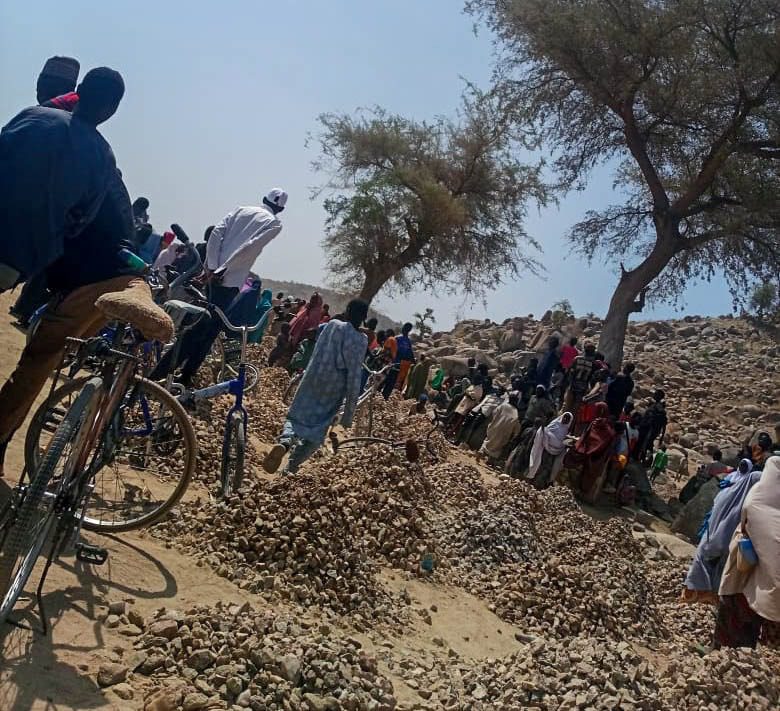
By 7:10 a.m., he had reached Pulka, where many survivors had gathered.
“Most people came barefoot,” Muhammad Tela said. “Others carried the elderly on push carts. Some even brought the corpses of loved ones.”
Many arrived carrying whatever they could salvage: bags of clothes, goats, and small belongings gathered in haste. Others fled further: toward Maiduguri, Cameroon, and Abuja.
Media reports later suggested that about 100 people were killed and more than 300 abducted. Survivors say the numbers are difficult to confirm.
“They cannot be quantified,” Maina said. “But the people I reached Pulka with and those we met at the entrance, including women, children and the elderly, were about 2,000 from my estimation.”
Solomon saw two children being abducted while they were fleeing.
Two of Solomon’s nephews were also taken during the attack. One is 14 years old and the other is 11.
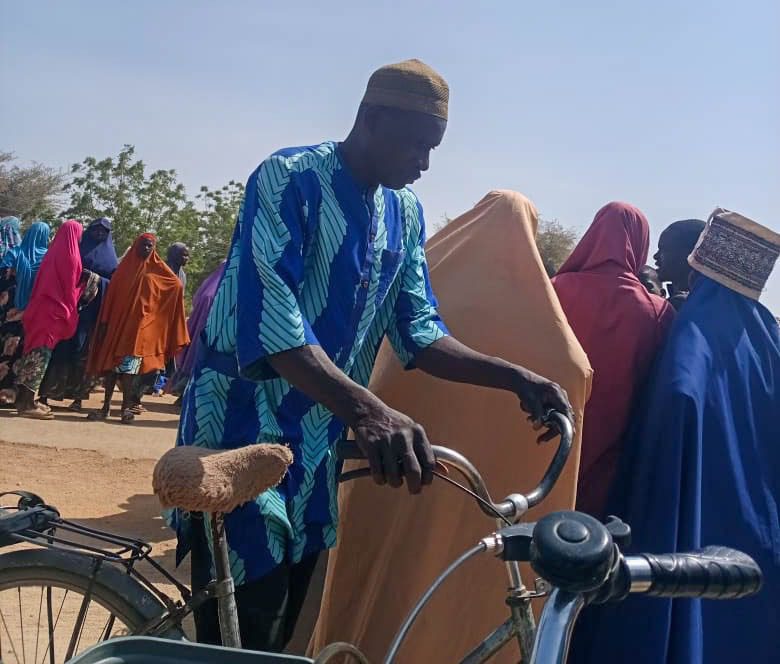
Later, when soldiers briefly returned to Ngoshe, Solomon returned as well. His father had been killed. “He was 68,” he said. From his father’s body, Solomon collected two small items: a cap and a wallet.
“They are something to remember him with,” he said. Victims like Solomon’s father were buried two days later in a mass burial.
The new fear
Recent months have seen a wave of attacks by ISWAP fighters across Borno, particularly targeting security formations.
A member of the Nigerian Forest Security Service (NFSS) said terrorists attacked a military base in Konduga on March 5 and burned several buildings. The base, located near an area known as “High Bridge,” lies close to Malari.
According to him, the terrorists killed several soldiers and took away vehicles and weapons.
Earlier, on Feb. 14, terrorists attacked a military base in Pulka. Two days later, troops launched a counter-operation that reportedly killed a commander and recovered ₦37 million. On Feb. 5, terrorists attacked a military base in Auno, a community close to Maiduguri along the Maiduguri-Damaturu road, according to a military source who asked not to be named. On Jan. 26, terrorists attacked a military base in Damasak, killing seven soldiers and capturing 13 others, including their commanding officer. Eleven managed to escape.
Earlier, on Nov. 14, 2025, terrorists ambushed a military convoy along the Damboa-Biu road. Two soldiers and two CJTF members were killed. Brigadier General M. Uba, the Brigade Commander of the 25 Task Force Brigade, was abducted and later killed. On Nov. 20 of the same year, they attacked a CJTF base in Warabe, killing eight people and leaving three others missing. And on Dec. 25, a suicide bomber detonated at a mosque in the Gamboru Market area of Maiduguri. Five people were killed, and 35 others were injured.
Terrorists have also targeted reconstruction projects.
On Jan. 28, about 30 construction workers were killed in Sabon Gari, Damboa. Earlier, on Nov. 17, 2025, workers fled after terrorists stormed a construction site in Mayanti, Bama.
Resettled communities have also come under repeated attack. On Sept. 5, 2025, fighters attacked Darajama in Bama, killing at least 63 people, including five soldiers, and burning about 24 houses. Many residents fled again.
Umara Ibrahim, a professor of International Relations and Strategic Studies at the University of Maiduguri, said the attacks may be intended to undermine government resettlement efforts.
“Because their movements are observed and monitored, and perhaps challenged, it is not in their interest for resettlement to proliferate,” he told HumAngle in a February interview.
He added that such violence may also serve a political purpose. “It may be a way to counter government efforts by shaping public perception that the authorities cannot be trusted on security,” he said.
Pulka itself had once been abandoned when insurgents seized the town. After the military retook it in 2017, residents gradually returned. More recently, the government resettled refugees from Cameroon there. On Jan. 28, the government resettled about 300 Nigerian refugees from Cameroon. On Feb. 8, it resettled 680 more.
But the Ngoshe attack has revived old fears. “People don’t feel secure,” Muhammad said. “They think the community could be displaced again. Everyone is thinking about where to go.”
Communication also became difficult. For several days, residents said, there was no network across Gwoza, leaving families struggling to confirm whether relatives were alive.
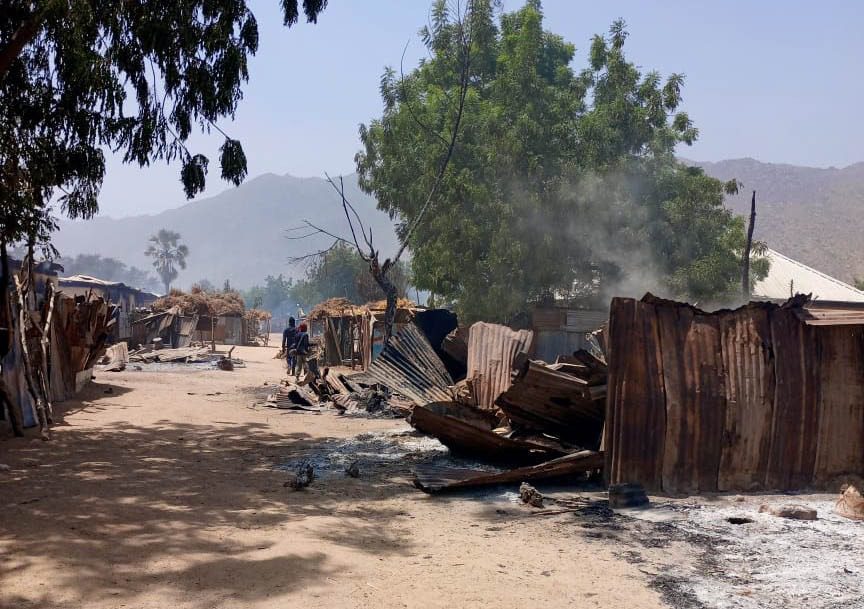
Adamu’s brothers later travelled from Maiduguri to Pulka to retrieve their displaced relatives. Maina did not remain in Pulk as his parents urged him to leave immediately for Maiduguri. Still, he worries about those left behind. He believes the community needs stronger security.
In the days that followed, Solomon also travelled to Maiduguri. Though he is the seventh child in his family, he is now the only available adult son able to organise their next steps. His stepmother and siblings remain displaced.
“I am looking for a house to rent so I can bring them here,” he said. Looking back, Solomon says he had always worried about returning to Ngoshe.
“We had no neighbouring villages,” he said. “We were surrounded by bushes and mountains.” Sometimes, he warned his family. “One day these people might take over,” he recalled telling them. Now the village has emptied again.
And Solomon, a teacher who once spent his days in a quiet classroom, is searching for shelter in a distant city while carrying the memory of a night he survived by hiding in a tree.
In a harrowing account of survival, Solomon Ali Talake, a teacher from Ngoshe, northeastern Nigeria, narrates the events of March 3, when terrorists attacked his community. They overran the military base, set the town ablaze, and forced hundreds, including Solomon and his family, to flee. The gruesome attack, attributed to ISWAP and JAS, resulted in over 100 deaths and more than 300 abductions, leaving survivors grappling with loss and displacement.
The attack shattered hopes of a peaceful resettlement initiated in October 2020, which aimed to reintegrate displaced individuals back into Ngoshe after previous insurgencies. Despite enhanced security measures, the town was not entirely safe, as evidenced by previous incidents of abductions and assaults on residents venturing beyond the town's perimeter. The tragedy underscored persistent insecurity despite governmental efforts, as Solomon, now displaced in Maiduguri, struggles to rebuild life amid uncertainty.
Support Our Journalism
There are millions of ordinary people affected by conflict in Africa whose stories are missing in the mainstream media. HumAngle is determined to tell those challenging and under-reported stories, hoping that the people impacted by these conflicts will find the safety and security they deserve.
To ensure that we continue to provide public service coverage, we have a small favour to ask you. We want you to be part of our journalistic endeavour by contributing a token to us.
Your donation will further promote a robust, free, and independent media.
Donate HereStay Closer To The Stories That Matter