Lake Chad Communities Vulnerable Following MNJTF Exit Due to Boko Haram Attacks
In the border town of Kirawa, the withdrawal of Multinational Joint Task Force (MNJTF) operatives following a deadly attack last month has left already fragile communities exposed to further violence.

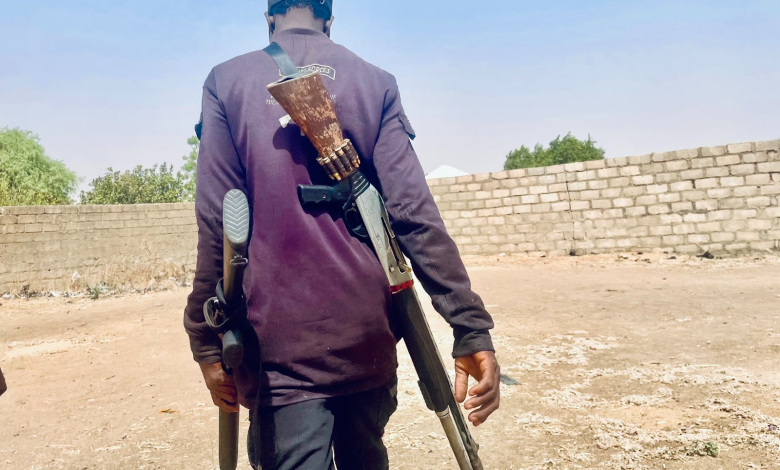
The recent Boko Haram attack on Kirawa, a border town in Gwoza Local Government Area of Borno State, northeastern Nigeria, has once again exposed the fragility of security in repatriated communities across the state.
The insurgents had stormed military barracks on Aug. 7 and burnt military hardware, killed soldiers, burned civilian houses and vehicles, and abducted a teenage girl on their way out of the town.
The destructive incident led the Multinational Joint Task Force (MNJTF) operatives stationed in the town to withdraw, and, one month later, they have still not returned, locals told HumAngle.
“We thought the MNJTF would reinforce and secure the community after the attack, but instead, they packed up and left,” Ummate Hamza, a resident who fled with his family that night, said.
A few days after the attack, residents observed military personnel from Cameroon returning to the burnt MNJTF base to retrieve their belongings. “They came back gradually to pack their stuff. We saw them carrying cooking gas cylinders and other camping equipment,” recalled Baba Mala, a resident. The sight deepened fears among the community, as it signalled a complete withdrawal rather than a reinforcement of security.
Residents who returned days later to salvage belongings found not just their homes in ruins but also the absence of military security presence. The MNJTF base, once a point of protection, now stands empty with its charred remains.
Kirawa residents, many of whom had been repatriated from displacement camps across Nigeria and neighbouring countries since 2022, now find themselves struggling to adjust to a cycle of rebuild, face attack, flee, and return again.
This latest withdrawal by the MNJTF intensifies fears that the community has been left to fend for itself against uncertainties. Kirawa now relies on the Civilian Joint Task Force (CJTF), local vigilantes, and hunters’ groups for protection. However, these community-based forces have limited resources to provide adequate security protection against the imminent threat from Boko Haram.
Since the attack, residents told HumAngle that families no longer feel safe sleeping in their homes and that daily life has been completely disrupted. “We are all scared. More than 80 per cent of our people, especially women and children, no longer spend the night in Kirawa since the attack,” Abba Mohammed explained.
Abba added, “Only the brave old men and exuberant youths remain, gathering at the Kirawa Central Mosque’s premises near the border to take refuge at night.”
In addition, the majority of residents now cross into Cameroon by 6 p.m. to spend the night before returning in the morning, while others have fled permanently into Cameroonian communities. Some families have also relocated to Nigerian towns such as Pulka and Bama in search of safety.
Business activities have come to a halt, the weekly market that once attracted traders from surrounding areas has drastically shrunk, and many farmers have abandoned their fields, leaving vast farmlands unattended. The collapse of these livelihoods has deepened the community’s hardship, cutting off both food supplies and sources of income.
“Our community is going back to square zero. We used to have military presence throughout, but they are gone; we are on our own. It is like being abandoned in the middle of nowhere. If soldiers cannot stay here, how can ordinary people survive?” One of the residents who preferred anonymity told HumAngle.
Kirawa has endured repeated attacks since 2014, with each chain of violence followed by displacement, return, and renewed insecurity. But the withdrawal of forces after such a devastating attack sends a troubling signal about the state of counterinsurgency efforts in the region.
In the aftermath of the attack, government officials, community stakeholders, and Nigerian military officers visited Kirawa to commiserate with the population. Residents told HumAngle that during the visit, they were given assurances that security would soon be restored in the town and that Cameroonian soldiers, who had withdrawn after the attack, would also return to their positions. However, months later, the promised protection has yet to materialise, leaving the community in a state of fear.
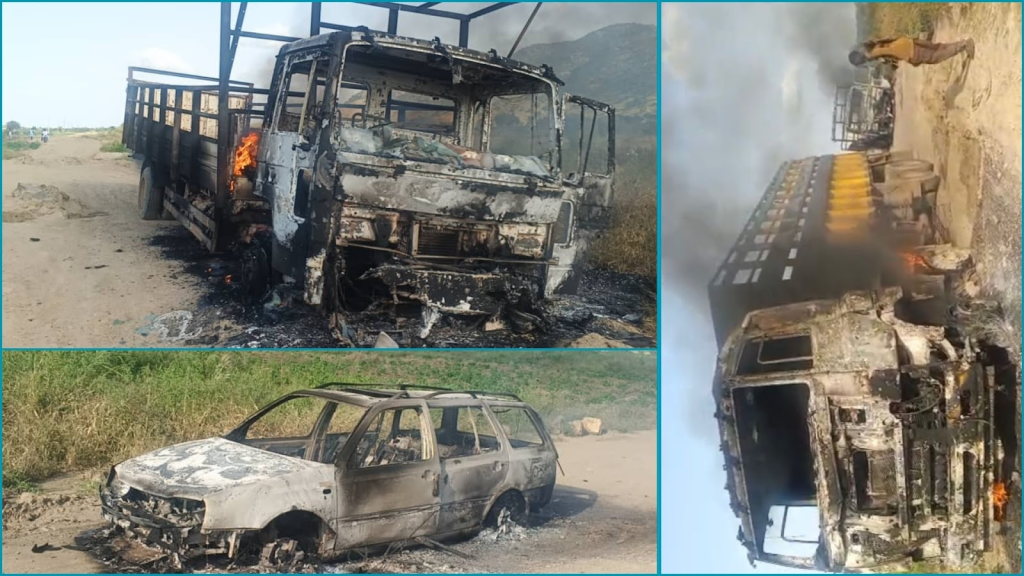
On Friday, Sept. 26, Boko Haram launched another attack, this time targeting commuters along the Kirawa–Pulka road. One member of the Civilian Joint Task Force (CJTF) was killed, and many were injured, while several civilian vehicles and trucks carrying goods were set ablaze, leaving travellers stranded. The incident deepened fears among locals, who say the road has become increasingly unsafe for movement, cutting them off from essential trade, supplies, and access to neighbouring towns.
The recent incident has stirred concern among government officials and community stakeholders. Nigerian media outlets reported that Senator Mohammed Ali Ndume, who represents Borno South in the National Assembly, condemned the Friday attack and called for an urgent reinforcement of military presence in the border town to protect civilians and restore confidence.
Similar attacks on military bases were recorded in the same period, and this has raised concerns across neighbouring border villages, which remaine vulnerable.
Between Sept. 19 and 20, a military barracks in Banki, a border community, came under attack just weeks after a series of deadly raids on nearby villages. Banki lies only 40 kilometres from Kirawa.
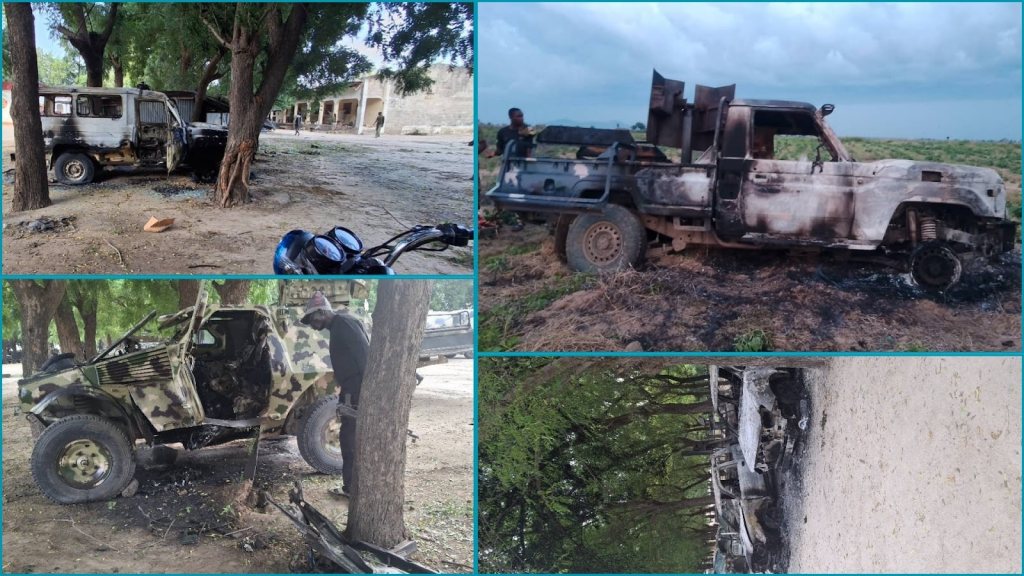
Boko Haram carried out attacks on the town from Friday night into Saturday, but the fighters made it clear to locals that civilians were not their target. Instead, they engaged in fierce battles with the military, raided the barracks, looted military hardware, and set military vehicles ablaze before withdrawing.
Survivors of the Banki attack described scenes of fear but noted that civilians were spared from direct harm. They said the fighters came in their hundreds from different directions, shooting and taking positions around the town.
Nasiru Bappa recalled how he and a friend narrowly escaped when Boko Haram fighters stormed the town. “Abakar and I were in Banki yesterday when it was attacked. We ran helter-skelter but weren’t harmed because it seemed the attack wasn’t meant to kill civilians,” he told HumAngle.
“They even came to our place, but we managed to run. It appears they didn’t intend to harm us. May God guide us. Boko fighters with guns passed where we were hiding, but alhamdulillah, they didn’t do anything to us,” he added.
For Suleiman Hamman, another resident, the motive behind the assault was clear. He explained that the insurgents’ primary target was the barracks and their weapons cache. “Their actual target was the soldiers. They had heard about the armoury that was brought to the barracks in Banki. So, they started by conquering the town’s periphery and didn’t involve any civilians in the attack,” Suleiman said.
“They surrounded the barracks, set cars and buildings ablaze, and carted away weapons and military equipment. The attack lasted about three to four hours. Some soldiers fled, others hid, but no civilian was harmed,” he recalled.
The Boko Haram attack on Kirawa, a border town in Borno State, Nigeria, highlights the fragile security in repatriated communities. After insurgents destroyed the military barracks and abducted a teenager, the Multinational Joint Task Force withdrew, leaving the town vulnerable.
As a result, residents now rely on inadequately equipped local vigilantes for protection, disrupting daily life, business, and safety in the community.
Despite assurances from government officials and military representatives, security has not been restored, exacerbating fears among residents who often flee to Cameroon or nearby towns for safety.
Recent attacks in neighboring areas like Banki further underscore the volatile security situation in the region.
Support Our Journalism
There are millions of ordinary people affected by conflict in Africa whose stories are missing in the mainstream media. HumAngle is determined to tell those challenging and under-reported stories, hoping that the people impacted by these conflicts will find the safety and security they deserve.
To ensure that we continue to provide public service coverage, we have a small favour to ask you. We want you to be part of our journalistic endeavour by contributing a token to us.
Your donation will further promote a robust, free, and independent media.
Donate HereStay Closer To The Stories That Matter