Insecurity Destroying Healthcare in Nigeria’s Madagali
Amid recurring Boko Haram attacks, destroyed health centres, a strict curfew, and the exit of many medical professionals from the affected areas, residents across Madagali in Adamawa State travel long distances to access basic healthcare.

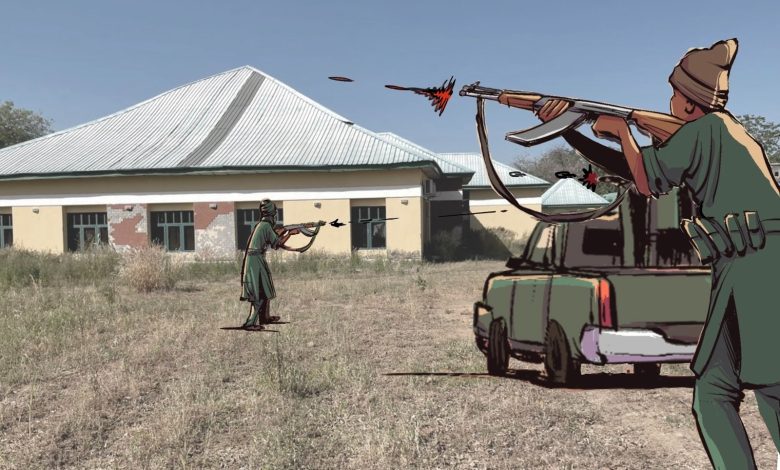
Hannatu Charles* carried her pregnancy to full term. She attended all antenatal sessions and was eager to meet her baby.
In January, when she was due, she went into labour around 7 p.m. Unfortunately, the primary healthcare centre in Kirchinga, a community in Madagali local government area of Adamawa state in northeastern Nigeria, closes around 6 p.m. Her family immediately called one of the traditional birth attendants in the community.
Hannatu laboured for hours, yet her baby did not emerge despite the efforts of the traditional birth attendant. By 10 p.m., warning bells began to ring in her mind, as by that time, all doors in Kirchinga had been shut and all access routes deserted.
“We decided to try to see if we could at least meet one person at the primary healthcare centre, so my husband and my neighbour took me there that night, but we didn’t meet any midwife or any healthcare staff,” she told HumAngle.
The centre was closed. All the healthcare staff had gone and would only return the next morning. Night shifts no longer hold. These changes were made due to the scale of insecurity.
Hannatu told HumAngle they returned home, where she continued to push, but despite her efforts, she was unable to deliver. The birth attendant noted that the baby was in breech position and, therefore, an experienced midwife or a gynaecologist was required. The only way they could access such care was by travelling to the Cottage Hospital in Gulak Local Government or the General Hospital in Michika Local Government, both many hours away.
Hannatu said they would have made the journey that night on a regular day, but now, it was too risky. Movement in Kirchinga was restricted after dark as Boko Haram terrorists roamed the area, especially at night. There was also no way to access vehicles or get a driver to take the,m as all routes were closed.
She said she was willing to persevere until dawn when the roads would reopen, but by midnight, the pain intensified, and the midwife doubled her efforts. A stillborn was delivered.
“I’m not the first to lose a child because of the security situation in this region,” Hannatu said as she talked about how insecurity destroys healthcare. “In fact, I’m lucky to be alive,” she added, stressing that several women and their babies had died.
According to Hannatu, the women who went into labour during the day in Kirchinga are considered lucky.
The healthcare crisis
Kyauta Ibrahim, a community health extension worker, spends her days at the primary school in Limankara, another community in the same Madagali that has, since the past decade, been repurposed as the community’s healthcare centre. Since residents began returning to Madagali in 2016 — two years after Boko Haram attacks displaced them — she and her colleagues have provided medical services from this makeshift facility.
“We are yet to move to the permanent site. We were asked to stay here to perform our duties,” she said. When the insurgents struck, they torched several structures, including the original primary healthcare centre where she worked.
For Limankara residents, this temporary facility remains the only nearby source of medical care. With few doctors remaining in the region, patients are often forced to travel long distances to better-equipped centres in Shuwa, Michika, or Gulak, particularly in emergencies.
Before the insurgency, the primary healthcare centre in Limankara served the local population and neighbouring communities such as Sakur and Lakundi, providing antenatal care, deliveries, and basic medical services. After peace was gradually restored in 2016, the state government converted one of the primary schools into a modest healthcare facility to meet the community’s needs.
A decade later, the school still functions as the healthcare centre. The situation worsened as medical doctors and other professionals began withdrawing, leaving indigenous community health extension workers to manage the facility. In 2016, most health centres in Madagali and Michika were closed because many professionals had either been killed or fled permanently.
As of 2019, the World Health Organisation’s Health Resources Availability Monitoring System (HeRAMS) highlighted that only 45 per cent of health centres in Adamawa were fully functional after 12 per cent had been destroyed and 34 per cent severely damaged by Boko Haram attacks.
Kyauta told HumAngle that, aside from staff shortages, inadequate healthcare equipment continues to affect healthcare delivery in the area. The temporary primary healthcare centre now closes by late evening due to recurring Boko Haram attacks, leaving pregnant women and children most vulnerable.
“When a woman starts labour at night, she can’t even go to the primary healthcare centre and has to give birth at home,” she said. Complicated cases are referred to Shuwa, and if necessary, to the General Hospital in Michika or the Gulak cottage hospital, all of which are some distance away.
Esther Markus, a mother of six from Wagga, another community in Madagali, travels six hours for a round trip to Gulak for medical care. Emergencies are further complicated by a 6 p.m. curfew. Traditional birth attendants handle routine deliveries, but high-risk cases, like breech births or sudden illness at night, go untreated until morning.
“Once it’s 6 p.m., we can’t take sick people to the hospital, so we leave them till the next day in the hands of God, and if the person dies, then we accept it,” said Hamidu Ahmadu, Limankara’s community leader.
Residents said security remains precarious. “A few days ago, the soldiers guarding us were attacked, so since then, they leave once it is 5 p.m. and head back to their headquarters in town. Our youths guard us all through the night,” Esther added.
Hamidu told HumAngle that the community has a population of about 3,000. He acknowledged the efforts of some humanitarian organisations that have visited the area in the past to treat malnourished children and provide basic healthcare services to residents, but the gap remains.
In 2024, the International Committee of the Red Cross (ICRC) resumed operations in Madagali after being unable to operate since 2018. The following year, the organisation provided basic healthcare and nutrition services to residents and also renovated the existing healthcare facility in Madagali town, which has become a haven for displaced persons in villages around the area. This has helped mitigate how insecurity affects healthcare in Madagali.
Despite these humanitarian efforts to restore healthcare access in conflict-prone communities in Madagali, however, factors like the curfew, abductions, and the absence of medical professionals continue to limit access to services.
Medical professionals are fleeing
Kirchinga, the community in Madagali where Halima had the stillbirth, faces a similar plight. Although it has a functional primary healthcare centre, the lack of medical professionals severely affects service delivery.
“Since the insecurity started, the doctors have stopped staying. They no longer live in the community but only show up from time to time,” said Bitrus Kwada, a Kirchinga resident.
Boko Haram terrorists have abducted, killed, or threatened several health and humanitarian workers in the northeastern region. In 2018, some medical workers were kidnapped and later killed in Borno. The following year, Boko Haram attacked Kirchinga and Shuwa communities, burning houses, shops, and clinics after killing three people.
By 2020, Bitrus explained, healthcare workers, including doctors, who once lived in Kirchinga had either been transferred or fled, leaving them only occasionally available and unable to respond to emergencies.
“We suffer when it comes to emergency treatment at night,” Bitrus stated.
Over the years, several women with complicated pregnancies have died during childbirth, along with their babies, due to the absence of doctors and surgeons.
Blessing Dingami, another resident of Kirchinga, told HumAngle that before the insurgency started in 2014, the primary healthcare centre in the community was staffed by a medical doctor, two nurses, and another healthcare provider who ran the facility round the clock, with support from community health extension workers.
Following the attacks, the centre collapsed, forcing the professionals to flee. Although the government has since renovated it, community health extension workers now manage the facility, and the quality of services has declined.
Even though movement in Kirchinga is unrestricted until 10 p.m., accessing medical care is increasingly difficult. “There was a time when people from our community were involved in a ghastly accident at night, and we rushed them to the centre, but there was no professional to handle their case,” Blessing recounted.
She noted that the healthcare centre no longer provides scanning, surgery, and other services it previously offered. Residents now have to travel for over half an hour to Shuwa and sometimes to Gulak, where there is a cottage hospital.
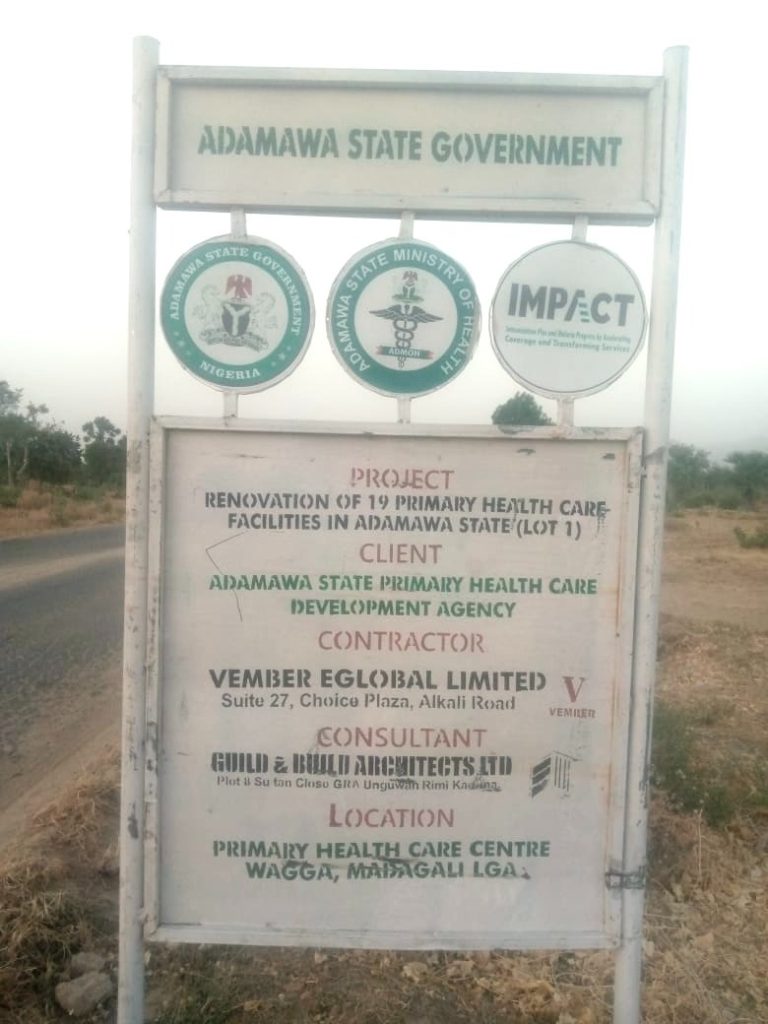
In Wagga Lawan, another community in Madagali, the primary healthcare centre was destroyed during Boko Haram attacks in 2014 but was recently rebuilt and commissioned by the state government.
Despite the renovation, many Madagali residents remain unable or afraid to use the facility. People from Wagga Mongoro, Thidakwa, and even Limankara travel there, yet fear of kidnapping, its remote location, and the surrounding bushes keep many away, particularly at night.
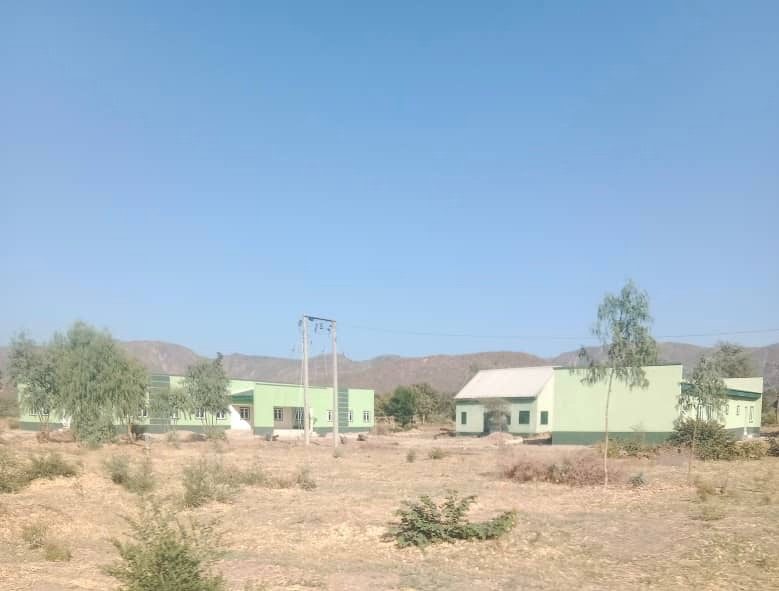
“The centre is located on the outskirts of the town, and bushes surround it, so people are afraid to go there for services, especially at night, due to fear of kidnapping,” said Cyril Ezra, a resident. Travel to the facility takes over an hour by bike.
In 2025, Boko Haram attacked Wagga Mongoro, killing four people, injuring many others, and razing property—underscoring why many remain hesitant to use even the newly rebuilt facility.
Uncertainty
Peace Ijanada Simon, a midwife at Shuwa’s primary healthcare centre, said the facility is overburdened with deliveries and emergencies from surrounding communities, as theirs lack night services. Although staff work night shifts, service is inconsistent due to recent kidnappings and a lack of reliable electricity.
“There is no power supply. We use torchlights for most deliveries. If we can’t handle it, we refer immediately to Gulak or Michika,” she said.
In Kirchinga, locals have lost hope for the return of professional healthcare workers. “From 2014 to today, we’ve been facing security challenges because Boko Haram can attack at any time and destroy our things. Some of our people have been killed. Two years back, the situation changed into kidnappings,” he said.
Bitrus explained that the terrorists mostly show up at night when locals are sleeping and carry out these abductions. “Ransoms have been paid, and some have been released. We have soldiers here, but I don’t think they are taking strong action,” he added.
Maradi, a community near Kirchinga, was attacked on Jan. 23. One resident who resisted capture was killed in his home, while a hunter who confronted the attackers that night was also killed, and another person was abducted that night.
“We don’t sleep. From midnight, we stay awake till 3 a.m. because that’s the time they normally come. We have to stay conscious,” he said.
Hannatu Charles, a pregnant woman in Kirchinga, Nigeria, faced severe challenges when her local healthcare center closed due to insecurity. With no medical staff available at night, she had a stillbirth, a tragedy attributed to Boko Haram's influence in the region.
Many women in Kirchinga and nearby communities face similar fates as health facilities are often abandoned or make-shift, with emergency services inaccessible at night.
Amidst this healthcare crisis, many medical professionals have fled due to threats from Boko Haram, leading to understaffed and ill-equipped centers.
Despite efforts by organizations like the International Committee of the Red Cross, insecurity, abductions, and a lack of medical professionals severely hinder healthcare services in Madagali, leaving pregnant women and children particularly vulnerable.
Support Our Journalism
There are millions of ordinary people affected by conflict in Africa whose stories are missing in the mainstream media. HumAngle is determined to tell those challenging and under-reported stories, hoping that the people impacted by these conflicts will find the safety and security they deserve.
To ensure that we continue to provide public service coverage, we have a small favour to ask you. We want you to be part of our journalistic endeavour by contributing a token to us.
Your donation will further promote a robust, free, and independent media.
Donate HereStay Closer To The Stories That Matter