Grassroots School Turns the Tide Against Crime in Lagos’s Floating Slum
With free education, a community-led educational initiative is keeping children away from crime and other social vices in Makoko, a fishing community in Lagos State, southwestern Nigeria.

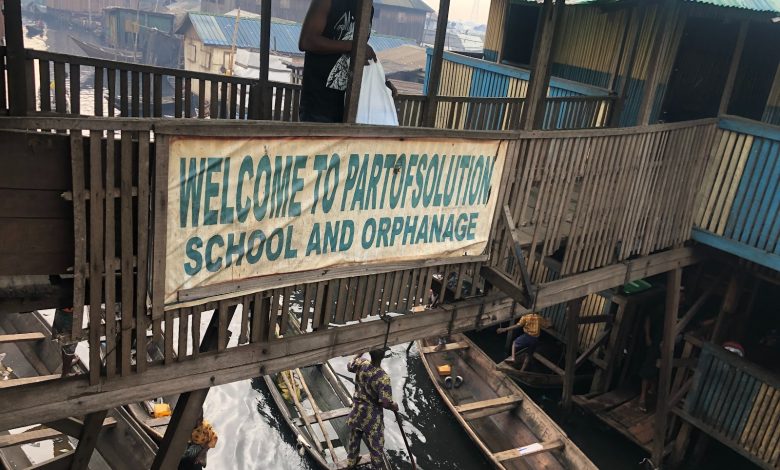
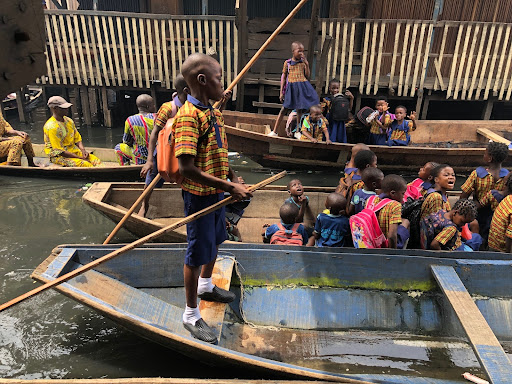
Morning light glints off the water as children in crisp uniforms, polished sandals, and neatly packed schoolbags paddle across the same waters where fights once broke out among young boys. They are heading to Part of Solution Nursery and Primary School, Makoko, in South West Nigeria, a free, floating school that is turning the tide against crime and violence in one of Lagos’s most marginalised communities.
For five years, Segun Opeyemi made this journey every morning.
But before school days and uniforms, mornings like this did not exist for him. Segun spent his days roaming the streets of Makoko, and he slept wherever night met him—beneath market stalls, beside rickety shacks, or along the water’s edge. Hunger dictated his choices, and survival came at a cost.
“When I was on the street, I indulged in all kinds of bad activities just to put food on my table and survive,” he recalled.
By 2018, when Taiwo Shemede, the school’s headteacher, first met him, Segun was about ten years old and already hardened by life on the streets. Taiwo took him and enrolled him at the school. “Thank God for education,” Segun said.
‘Part of the Solution’
The story of the school that changed Segun’s life began eight years earlier.
In 2010, members of the Yacht Club of Nigeria, who often visited Makoko, asked the community’s chief, Emmanuel Shemede, what the area needed most. He told them it was “a school building”. The club raised funds and built Whanyinna Nursery and Primary School, the community’s first floating school, which was handed over to the community and run by the Shemede family.
Soon, Whanyinna became overcrowded. The school’s success drew hundreds of children, and before long, there was no space to accommodate them. Determined not to turn any child away, Sunday Shemede, son of the community chief, and his siblings, including Taiwo, decided to act.
In 2015, they started another school.
“My brothers and I began with just 50 children in our father’s house,” Sunday recalled. “We went to 50 parents and asked each to give us one child we would teach for free.”
That humble beginning marked the birth of Part of Solution Nursery and Primary School, the second free school on the Makoko waterfront, according to Sunday.
As more parents saw how their children were learning to read and write, enrolment grew beyond 400 within months, outgrowing the small family space once again.
A few years later, the Shemedes met Cameron Mofid, an American tourist, who, moved by the lack of uniforms he saw during his visit, started a GoFundMe campaign through his non-profit, Humanity Effect, to raise $5000 for the school. Within a week, over 200 people had donated, contributing more than $100,000.
The funds built an additional wooden school on stilts and provided uniforms, school boats, and other essentials. Another soon followed. Today, the Shemede family runs three free schools across Makoko’s waterside — Whanyinna, Part of Solution 1, and Part of Solution 2 — the only completely free schools in the entire community. Together, they educate more than 750 pupils and operate an orphanage that shelters 31 children, all registered with the Lagos State Ministry of Education.
Segun has lived at the orphanage since he enrolled in the school.
“It was free education with the provision of books and uniforms,” he added. He graduated from the school in 2022 and is now enrolled at nearby Ade Comprehensive Government Junior Secondary School. “The homeless 10-year-old boy of yesterday is now in JSS2 with a dream to become a lawyer,” he told HumAngle.
Welcome to Makoko
Makoko sits on the Lagos Lagoon, just beside the Third Mainland Bridge. The fishing settlement was founded more than a century ago by migrants from the Egun ethnic group of neighbouring West African countries, including the Benin Republic and Togo. It is home to an estimated 100,000 to 200,000 people, though exact figures remain uncertain because the community is considered informal and largely absent from government records.
For generations, life revolved around the waters, with men casting nets, women smoking fish, and children learning the trade as soon as they could paddle a canoe.
Before the rise of community schools, Makoko’s youth often grew up without structure, falling into cycles of crime, violence, and hopelessness. But the efforts of the Shemede family and other humanitarian organisations are changing that through community schools where children can learn, dream, and stay safe.
Building peace through education
Each morning, they paddle to class in small canoes, keeping their books dry in their bags. The atmosphere at the school is lively and disciplined. Pupils recite the alphabet in unison, clap to the rhythm, and eagerly raise their hands to answer questions.
For the founders, literacy was only part of the goal. Education, they believed, was a tool that could prevent the community’s younger generation from drifting into violence.
Before the schools were built, many children like Segun wandered the narrow alleys in canoes or idled at the waterfront. Petty thefts, street quarrels, and fights were part of daily life. Parents expected their children to fish or trade, but without guidance, many drifted into mischief. Teachers say this pattern is shifting.
“For me, keeping them in school keeps them off the streets and away from trouble,” said Juliet Okundere, who has taught at the school for four years. “When we started, most pupils couldn’t read, speak, or write English. Gradually, they began to read and write. That gives them confidence and purpose.”
Twelve-year-old Abutu Lazarus said the school has helped him dream bigger. “Now I can read and write well,” he said with a smile. “I want to be a pilot.”
Across Makoko, others are noticing it too.
“Until recently, young boys fought over little things, and it created bitterness,” recalled Segun Adekunle, a 50-year-old youth leader. “But the coming of education has reduced all that. Even the old ones now go to evening school. So, there’s no time to fight like before. At my age, I am learning how to read, and it gives me joy.”
Jacob Ikeki, an older resident who never had the chance to attend school, has witnessed a transformation in his own family. “When children are not going to school, they just play around and cause trouble,” he said, recalling how he once joined street fights as a child after long fishing trips. “I’m proud to see my son reading and writing perfectly. I know he will not repeat my mistakes.”
Another parent, Mary Rofik, whose son attends the school, said education has brought discipline to her home. “Since he started schooling, he has communicated well in English. When I call him, he responds with ‘Ma’ and calls his father ‘Sir.’ Before, you would see children as young as two or three stealing from their mothers’ pots and talking back to elders. Now, my son has respect, and I know education is shaping him.”
Teachers say fewer children skip class for mischief, traders no longer have to chase them from stalls, and elders notice that quarrels have given way to learning.
Inside the classrooms
On low benches, children lean over their books as volunteer teachers guide them through lessons in English, maths, and basic science. The space hums with energy — the scrape of chalk, the shuffle of feet, the soft rise and fall of young voices eager to learn.
Among the teachers is Samuel Shemede, who grew up fishing but decided to go to school after seeing how education transformed his siblings. He has completed his secondary school education and is now a teacher at the Part of Solution School.
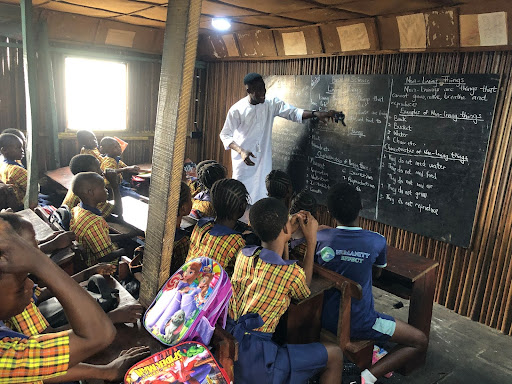
Samuel teaches a kindergarten class. “I make learning fun,” Samuel said. “We sing, we play, and through that, they learn. Class time is not just lessons; it is a moment of joy. I want them to love school as much as I’ve learned to love it.”
Keeping the vision afloat
Part of Solution School and its sister schools remain free, ensuring even the poorest families can send their children. Sunday says this has been key to maintaining high attendance and low street crime in the area.
Still, the school is not without challenges. Classrooms are overcrowded, stipends for the ten volunteer teachers, including Juliet and Samuel, are inconsistent, and learning materials are limited. There are only a few canoes to transport pupils, leaving some to paddle long distances themselves.
Yet the resilience of the community keeps the project afloat. “What we need the most is increased support for our teachers, technological equipment and facilities, and enough canoes for the children,” said Sunday, who still fishes part-time to sustain the project.

But beyond these daily struggles lies a deeper worry — what happens after?
After primary school, many pupils face another barrier: there are no secondary schools within Makoko. Graduates must cross to Lagos Mainland to continue their studies, where most schools charge at least ₦42,000 per term, far beyond what many families can afford.
To prevent them from dropping out, the Shemede family has created a follow-up system.
“We register our graduating pupils at schools in Sabo, on the Mainland, and pay for their textbooks and supplies,” Sunday explained. “We also check on them every three weeks and stay in touch with their teachers.”
So far, more than 200 pupils have graduated from Part of Solution School.
Still, he fears that without broader government support, their efforts may not be enough. “If our children can’t continue beyond primary school, we risk returning to the days of idleness and violence. Everything we’ve built could be undone,” he said.
Despite being Nigeria’s economic hub, Lagos State has a rising number of out-of-school children. While the government has invested in the establishment of schools and the enrolment of students, gaps remain, especially in underserved communities like Makoko.
Grassroots efforts like Part of Solution School have shown how education can calm unrest and open new paths for children. But to secure that progress, they need systemic support — better funding, accessible secondary schools, and consistent policy attention.
Until then, the sight of children paddling to class each morning will remain both a symbol of Makoko’s hope and a reminder of how fragile that hope still is.
This story was produced under the HumAngle Foundation’s Advancing Peace and Security through Journalism project, supported by the National Endowment for Democracy (NED).
In Lagos, Nigeria, the Part of Solution Nursery and Primary School in Makoko has become a beacon of hope for children in one of the city's most marginalized communities. Founded by the Shemede family and supported by an American benefactor, the school provides free education, uniforms, and essential supplies to over 750 students, helping to combat crime and violence. This initiative began after the success of another floating school, Whanyinna, which led the Shemedes to establish Part of Solution in 2015 with just 50 students in their father's house.
Makoko, a fishing community on Lagos Lagoon, suffers from high poverty and crime rates due to a lack of educational infrastructure. The school system initiated by the Shemede family has contributed to a decline in youth delinquency, providing an alternative to street life and fostering dreams among students. Despite facing challenges such as overcrowding and limited resources, these community schools have become vital in transforming lives and providing opportunities for children who would otherwise have none. However, the lack of secondary schools presents a significant barrier for graduates, emphasizing the need for increased governmental support.
Support Our Journalism
There are millions of ordinary people affected by conflict in Africa whose stories are missing in the mainstream media. HumAngle is determined to tell those challenging and under-reported stories, hoping that the people impacted by these conflicts will find the safety and security they deserve.
To ensure that we continue to provide public service coverage, we have a small favour to ask you. We want you to be part of our journalistic endeavour by contributing a token to us.
Your donation will further promote a robust, free, and independent media.
Donate HereStay Closer To The Stories That Matter