
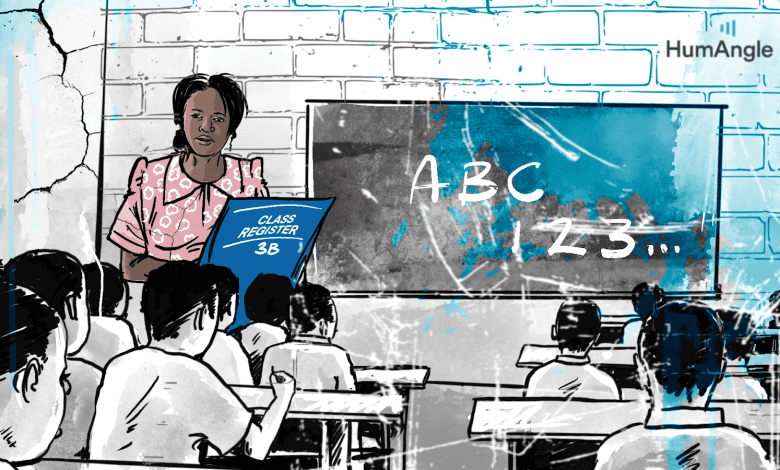
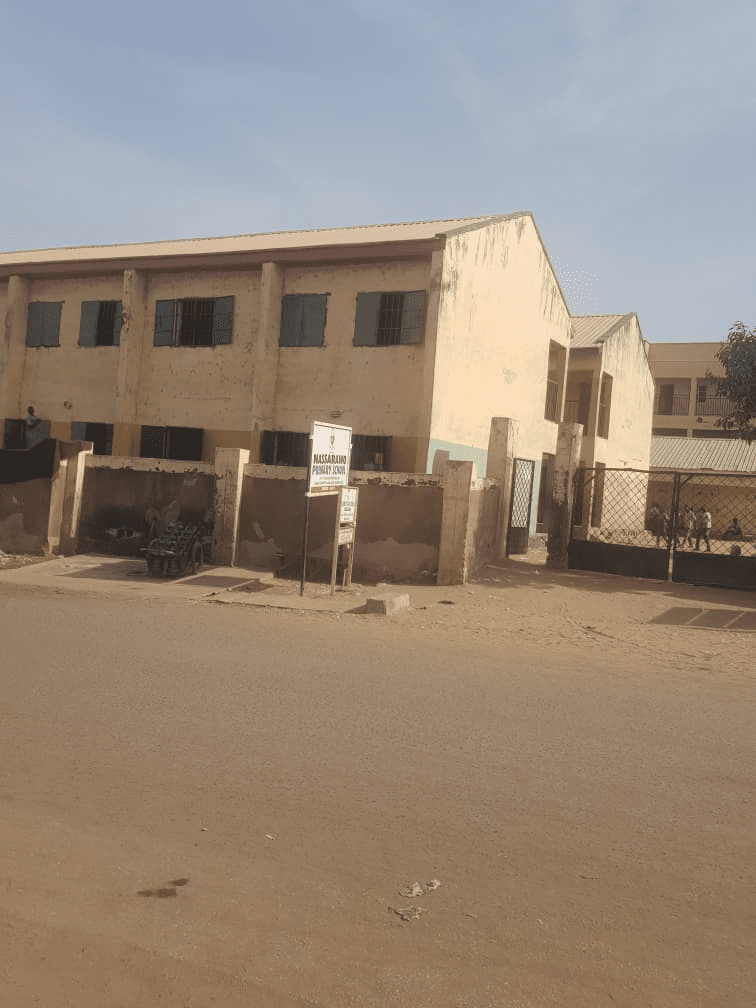
At the start of every school day, Martha Ayuba marks the attendance register of her class of about 50 pupils in Nassarawo Primary School, Jimeta-Yola, in Adamawa, northeastern Nigeria. The 38-year-old is the class teacher of Primary 3B. With a pencil in hand, she calls out names from the register. Each pupil answers, “Present, Ma”, before she ticks the box next to those who are “present” and crosses those who are “absent”.
Her worn attendance book is stuffed with handwritten names, erased marks, and faded ink. A leaking roof threatens to soak its pages, and a scurry of termites could erase weeks of work. Marking attendance is not just a routine; it’s a promise of accountability, and it appears on the report card at the end of each term and in the school’s database.
However, across Nigeria, this ritual of paper and pencil is increasingly out of step with the country’s emerging Digital Public Infrastructure (DPI), a national effort to build interoperable digital identity, payments, and data systems that serve citizens at scale.
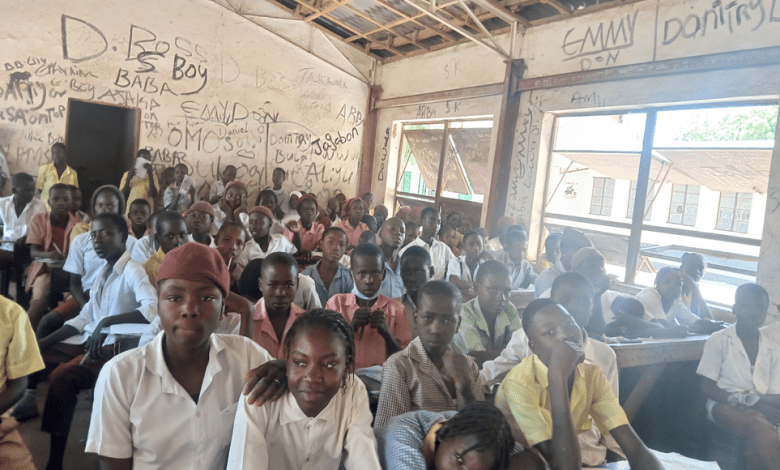
Nigeria’s education system faces a tragic paradox: millions of children remain out of school, yet even those who attend often lack basic record-keeping and support. According to UNICEF, one in four primary-school–age children in Nigeria (about 10.5 million children) are not enrolled in school. In rural areas of Adamawa State, for instance, years of conflict and poverty have made schooling precarious.
At Nassarawo Primary School, Martha juggles teaching and attendance record-keeping duties.
“There was a time when rain fell, and the register got wet,” she recounts. “I lost almost an entire term’s record, and no one could tell how many students were in class during those periods. I had to get another register and start afresh. Imagine if I didn’t have a backup?”
Several schools in Nigeria, including some public tertiary institutions, still rely heavily on manual recordkeeping, as Olubayo Adekanmbi, the CEO of Data Science Nigeria, notes.
For Martha, that means precious minutes of class are spent on paperwork. This drudgery breeds frustration. “I know these kids by heart,” she says, “but we have to write it down. Otherwise, next year the next teacher won’t know what happened to them.” She keeps one copy at school and one at home, fearing theft or damage. Yet neither copy can travel with her if the children move to a different school or state. Even a single register lost in a fire or flood can erase months or years of history.
Why paper recordkeeping fails
Manual registers not only burden teachers; they distort national planning.
In Nigeria’s basic education subsector, school funding, teacher allowances and student support programmes all hinge on accurate attendance and enrolment data. Each child “counts” not just for classroom pride but for allocation of resources. For example, the Universal Basic Education Commission (UBEC) earmarks School-Based Management Committee (SBMC) funds (for feeding programmes, sanitation, and learning materials) based on pupil numbers. In 2024, UBEC disbursed SBMC – School Improvement Programme support funds to 1,171 schools in all 36 states.
If Martha’s register fails to reflect every student, such support might not reach deserving children. A missing name in the data could mean missed school meals, missing textbooks, or even being excluded from government scholarship programmes. Hence, school officials cannot adjust to “changing patterns in attendance” or identify which children need support.
Beyond individual schools, the absence of reliable data hampers policy and planning. At best, education officials compile annual school census figures, but these are months old and riddled with errors. Many rural schools report at a snail’s pace, if at all, because principals must physically carry piles of handwritten forms to local government offices.
Recognising this gap, Nigeria has begun transitioning toward a national Education Management Information System (EMIS) built on District Health Information System Version 2 (DHIS2). An overview of the UNICEF-supported says Nigeria is “moving from fragmented, manual processes to a unified, digital platform”, aiming for “real-time, accurate data for evidence-based planning and decision-making”.
In plain terms, that means that if Martha could click an app on her smartphone to log her attendance, higher-ups could see up-to-the-minute figures: student dropouts, teacher absences, resource gaps, and everything else. Real-time school data would highlight, for instance, which classes are short on books or which districts have the most teacher vacancies.
What Nigeria is doing
The Nigerian government has taken tentative steps toward digitisation.
In 2024, UBEC launched a digital quality assurance platform to evaluate schools electronically. This system is designed to stream data on school infrastructure, teacher qualifications, and learning resources into a centralised dashboard, replacing laborious paper inspections. Although the platform is operational within UBEC’s inspection and monitoring system, nationwide adoption is still scaling up as infrastructure, connectivity and digital capacity in schools improve.
Similarly, the Federal Ministry of Education unveiled the Nigeria Education Data Initiative (NEDI) to build a “single, secure platform” of educational data across basic and tertiary levels.
NEDI aims to “leverage the National Identity Management Commission’s (NIMC’s) unique identification number” – the national ID, “for accurate student tracking”. In other words, each child’s attendance and progress would be linked to a lifelong digital ID, so that Martha’s tallies could follow her students even if they moved schools or states.
At the state level, pilots are underway, but slow.
A consortium led by HISP Nigeria and UNICEF is rolling out a District Health Information System Electronic Management Information System (DHIS2 EMIS) module in twelve states, including Adamawa, to “improve education planning and outcomes for millions of children”.
Local education authorities have been trained to use tablets and smartphones to enter enrolment, attendance, and infrastructure data directly into the system. In Bauchi State, for example, ministry officials held workshops for local supervisors to practice uploading school census data via mobile devices.
Complementing government action, non-governmental organisations and agencies have jumped in. For instance, Data Science Nigeria helped launch the Gates Foundation-funded EdoCert, a digital certificate registry piloted in Edo State. EdoCert uses Sunbird, an open-source, “digital public good” to archive students’ exam results and transfer credentials online. EdoCert has since secured 1.9 million paper certificates since its launch. Its developers emphasise that the same approach could be used for attendance records. Experts point out that collecting comprehensive data could help “better track and adapt to changing patterns in school attendance” and guide the allocation of resources such as the national school lunch programme.
Meanwhile, other partners focus on connectivity.
UNICEF’s GenU9ja initiative, local telecos, and the Federal Ministry of Education are racing to wire schools to the internet. By early 2025, more than 1,000 public schools had been connected via routers and provided with devices for digital learning, according to UNICEF. Training modules have been rolled out to thousands of teachers on basic computer skills and e-learning platforms. These efforts aim to lay the foundation for any future digital register: after all, you cannot click an app without power or Wi-Fi.
Even so, Martha and her peers remain on the front lines of a slow handover from paper to digital.
Lessons from elsewhere
Nigeria is not alone in this challenge. Across Africa and the global south, educators have confronted broken attendance systems with creative digital fixes. In Rwanda, for example, the Ministry of Education introduced a mobile attendance app for teachers in 2025. Teachers simply log in and tap each day’s present students. The app immediately flags prolonged absences so that counsellors can intervene before a child drops out. At the end of 2025, more than 2,300 schools were enrolled in the system, and the government hopes that rapid data collection will reduce dropout rates. Rwanda’s example shows that with modest smartphones and training, even large rural systems can leapfrog paper.
In India and Uganda, UNICEF piloted a simple SMS/voice system called EduTrac. Community monitors phone schools daily to collect attendance via interactive voice-response or text. Since school records can be altered later, EduTrac’s immutability ensures honesty: once a teacher reports numbers, they cannot be changed. In India, EduTrac covered over 15,000 schools across four states by 2015. Cluster coordinators, each overseeing about 20 schools, used it to verify reports and spot chronic absenteeism.
The system required only basic phones and connectivity, making it ideal for remote villages. UNICEF noted that EduTrac has cultivated a culture of accountability: teachers and school heads know their numbers are being checked in real time.
What needs to change
Nigeria needs a pragmatic overhaul of its attendance system. Obaloluwa Ajiboye, an innovation governance specialist who has worked at the African Union, UNDP, and UNICEF, said one practical way to address gaps in student tracking is to assign every child a unique digital identity built on Nigeria’s existing framework, managed by the National Identity Management Commission.
“By linking school attendance records to a single, nationally recognised ID number, each child would retain one continuous education record, even when transferring between schools or moving across local government areas,” Obaloluwa noted. He explains that this kind of consistency is central to what DPI is designed to achieve. If properly implemented, it would allow attendance data to follow the child rather than remain tied to a specific school.
However, Obaloluwa added that such digital solutions will fail without power and connectivity.
Although internet penetration has increased across Nigeria, about 41 per cent of the country’s population remains offline, according to the Nigerian Communications Commission. According to Obaloluwa, the government should prioritise solar panels, school internet, and devices (tablets or laptops) for teachers.
Nigeria’s GenU9ja programme shows what is possible: it connected over 1,000 schools and trained 63,000 educators in one year. Scaling such programmes nationwide, with specific funding for data systems, is critical, Obaloluwa noted.
Additionally, Olubayo Adekanmbi, CEO of Data Science Nigeria, noted that schools like Nassarawo Primary School should be equipped with affordable digital registers that work even without constant internet access. “Many of the needed solutions already exist: for example, Sunbird (used by EdoCert) can run on laptops or tablets offline and sync later,” he added.
Olubayo said that the attendance register should not live in isolation. “It must feed into larger platforms (UBEC reports, state EMIS). Systems should be interconnected to include open APIs so that daily attendance synchronises with the annual school census”. In practice, that means digital systems built on standards (the way EdoCert operates).
Martha believes that “if only we had a quick way to mark attendance, I could spend that time helping the kids”. Nigeria has various frameworks and local and international support to make the shift, but how long will it take to achieve?
This report is produced under the DPI Africa Journalism Fellowship Programme of the Media Foundation for West Africa and Co-Develop.
Support Our Journalism
There are millions of ordinary people affected by conflict in Africa whose stories are missing in the mainstream media. HumAngle is determined to tell those challenging and under-reported stories, hoping that the people impacted by these conflicts will find the safety and security they deserve.
To ensure that we continue to provide public service coverage, we have a small favour to ask you. We want you to be part of our journalistic endeavour by contributing a token to us.
Your donation will further promote a robust, free, and independent media.
Donate HereStay Closer To The Stories That Matter