8 Unarmed Protesters Dead, 16 Injured in Nigeria’s Adamawa State
Though the Nigerian army denied shooting at unarmed protesters yesterday in Adamawa, northeastern Nigeria, HumAngle counted eight bodies and spoke to injured survivors who insist it was the military who shot at them.

The Nigerian military has, on Monday morning, allegedly opened fire on unarmed protesters in Adamawa State, North East Nigeria, killing eight people, seven of them women.
According to the locals who spoke to HumAngle, the tragedy happened after a 24-hour curfew was imposed by the police in Lamurde to stop a communal clash in the community. Not satisfied with the decision, some women from Lamurde stood on the route to BaShaka, a community around the Lamurde axis, waving their leaves and chanting songs in protest. Hours later, HumAngle learned, members of the Nigerian military deployed to secure the area allegedly opened fire on them.
“When the soldiers came, they met the women standing on the highway, blocking the access road. The soldiers didn’t say anything to the women. They just opened fire. These women had nothing on them but leaves, and who attacks women during battle?” Morison, an eyewitness who also lost his son in a previous episode of the clash, said.
After the gunshots broke out shortly after the soldiers arrived at the scene, seven women and one man were found dead at the spot. The rest fled with bullet wounds. One of the survivors, who is currently receiving treatment at the Numan General Hospital, recounted the harrowing incident to HumAngle.
“When the soldiers arrived in their vehicle, they first fired gunshots in the air, and while we began to disperse, one particular officer knelt with a gun in hand and aimed at us, then he opened fire at us. He killed them all,” she said.
She escaped with a gunshot wound in the hand. The other women are receiving treatment at the female surgical ward in Numan General Hospital, while some have been referred to the Moddibo Adama Teaching Hospital in Yola. A total of 16 people, mostly women, are currently receiving treatment at the Numan General Hospital.
The soldiers left the scene after the incident, and later that day, locals crept out and carried the bodies, transporting them to the morgue in Numan Local General Hospital. HumAngle saw the bodies at the morgue today. The seven women and one man were wrapped in white clothes and placed on a local mat. They were later placed in a vehicle and conveyed back to their hometown in Lamurde for a mass burial.
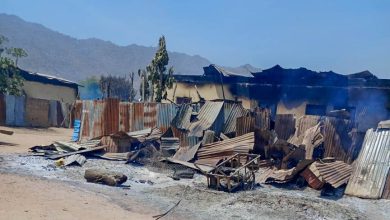
HumAngle gathered that the clash began Sunday night and by Monday morning had intensified. Homes were razed, properties destroyed, and many died, while several others were injured that morning. So far, the cause of the fresh clash is yet to be determined, but locals blame it on past grievances over land.
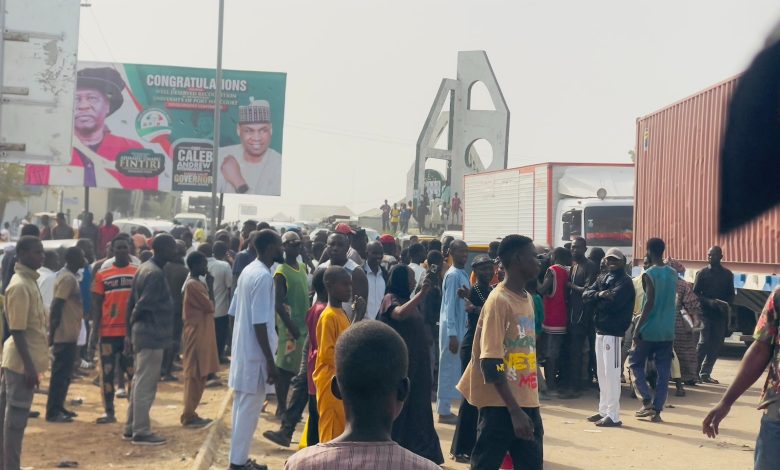
On Tuesday at dawn, a group of protesters consisting of men and women dressed in black from the Numan community stormed the Numan–Lamurde highway to protest in solidarity over the killing of the women.
What the military is saying
In a statement issued via X and its other social media handles, the Nigerian Military denied killing the women.
“While moving to secure the Secretariat, some women blocked the road to deny troops passage to the Secretariat, while armed men suspected to be fighting for Bachama extraction fired indiscriminately within the community. Troops then created a passage and proceeded to the Local Government Secretariat ( LGS) to secure the area. At this point, no woman was shot or injured. Otherwise, troops would not have been allowed to find any passage through the crowd,” a part of the statement read.
The military further blamed the death of the women on the unprofessional handling of automatic weapons by the local militias, whom they described as ‘not proficiently trained to handle such automatic weapons.’
Eyewitnesses like Morisson allege the military is shielding itself from accountability, and while the Bachama community in Lamurde and Numan is aggrieved over the killing of the women, Hyginus, the Tshobo community leader, says his people are in a dire situation as the security forces that have been deployed to the local government have camped in Lamurde town, leaving villages vulnerable.
“We are just here. We don’t know what will happen next,” he said.
The deceased have been laid to rest in a mass burial in Lamurde amidst hushed discussions of retaliation from their kinsmen.
In September, HumAngle reported how a land dispute tore apart both communities, who are just a kilometre apart despite sharing the same resources. In the clash, walls were torn, homes were burnt, valuables like motorcycles were set ablaze, and animals were slaughtered and left to bleed in the compounds where they were found.
Speaking about the current incident, Hyginus Mangu, the leader of the Tshobo community, says he doesn’t know what caused the incident.
“We just saw houses being set ablaze in Wammi 2 from Sunday night, and by Monday, it intensified,” he told HumAngle.
The community leader explained that by Monday, three villages inhabited by Tshobo locals in Lamurde were completely burnt after being looted. The villages are Wammi 2, Bashaka, and Sabon Layi.
In Rigange, a Bachama-dominated community, Morrison Napwatemi, a resident of the area, explained that the clash resulted in the deaths of many natives, including his son.
He explained that despite the intervention of the Adamawa State Governor in the past month, the fresh clash hints that the dispute is far from over. Even though the community is still under curfew, Morrison said there is a lot of tension in the land as locals are aggrieved.
“It’s a terrible situation. It’s not something one would want to talk about,” he said.
In Tshobo communities, the community leader explained that locals have currently rallied under a shade for safety, while some have climbed the mountains bordering Gombe.
“Right now, we have no food, water, or security. We don’t know what will become of us later,” he said.
While he doesn’t know the exact number of casualties so far, Hyginus said they have recorded many deaths. He fears his tribe might be wiped out as the clash is getting more deadly.
The Nigerian military allegedly opened fire on unarmed women protesters in Adamawa State, killing eight people. The incident occurred after a 24-hour curfew was imposed to prevent a communal clash, and the protest was against this decision. The military denied the accusations, attributing the casualties to local militias' mishandling of automatic weapons.
Tensions between the Tshobo and Bachama communities over land disputes have been simmering, leading to violence and destruction of properties. Despite intervention attempts, the conflict continues, leaving residents in dire conditions without food, water, or security. Concerns grow as locals fear the escalation might result in more casualties or the decimation of their community.
Support Our Journalism
There are millions of ordinary people affected by conflict in Africa whose stories are missing in the mainstream media. HumAngle is determined to tell those challenging and under-reported stories, hoping that the people impacted by these conflicts will find the safety and security they deserve.
To ensure that we continue to provide public service coverage, we have a small favour to ask you. We want you to be part of our journalistic endeavour by contributing a token to us.
Your donation will further promote a robust, free, and independent media.
Donate HereStay Closer To The Stories That Matter