ISWAP Used Theology to Absorb the Shock of Its Deadliest Week
The Islamic State reached for a battle fought 14 centuries ago to absorb the shock of the killing of Al-Minuki and the resulting disarray. Now, they have paused migrations from fighters in Iran and Iraq into Nigeria.
Listen to this story

10 Jun 2026
For the Islamic State (IS) and its West Africa Province (ISWAP), the third week of May 2026 began with a compound disaster and ended with a theology lesson. The group faced one of its most shocking moments, at least in West Africa or, more specifically, Nigeria.
With its headquarters in Nigeria, ISWAP has been the most active wing of the Islamic State globally, claiming more attacks than any other IS province since its central operations in Iraq and Syria were largely overpowered. Following the call for its members to migrate to Africa, ISWAP has, in the past two years, temporarily overran Nigerian military installations, including at least one super camp. The group was enjoying relative success when a turning point came: one of its most important first-generation commanders was killed.
The operation that killed Abu Bilal Al-Minuki between midnight and 4 a.m. on May 16 was described by the Nigerian military as “meticulously planned and highly complex”. It not only left the terrorist dead, but it also caused a crisis of morale that ISWAP’s propaganda machine would spend the following days trying to contain through a theological message.
Ahmad Salkida, a leading conflict analyst who has been observing the situation since it emerged, described the killing of Al-Minuki as a “serious disruption” to the activities of ISWAP in the Lake Chad region.
Airstrikes and special forces raids followed. More people were killed, and confusion reportedly descended. The operations, according to some reports, may also have killed the likely successor to Al-Minuki, another terrorist commonly known as Ba Shuwa, opening a new and, perhaps, unplanned chapter in the insurgency.
By May 19, Nigeria’s Defence Headquarters reported that 175 ISWAP and Boko Haram militants had been killed since the joint offensive began. According to the report, at least 20 died in a single engagement. By the time Nigerian authorities stopped counting, the joint operation had become the most lethal week the group had faced in years.
The theology of a bloody week
Within that catastrophic week, the Islamic State released its Al-Naba newsletter with a pointed editorial. Although it did not mention Al-Minuki or the numerous fighters killed, the editorial retold a story of a battle that happened 14 centuries ago to boost the morale of a group in disarray.
Reports suggest there was internal suspicion, even before the death of Al-Minuki, that some fighters may have leaked information leading to his death, driven by internal discontent over the unequal treatment between foreign fighters who migrated to the ISWAP and the local fighters in Nigeria. However, the editorial tried to shift away from that and present the losses as a normal sacrifice.
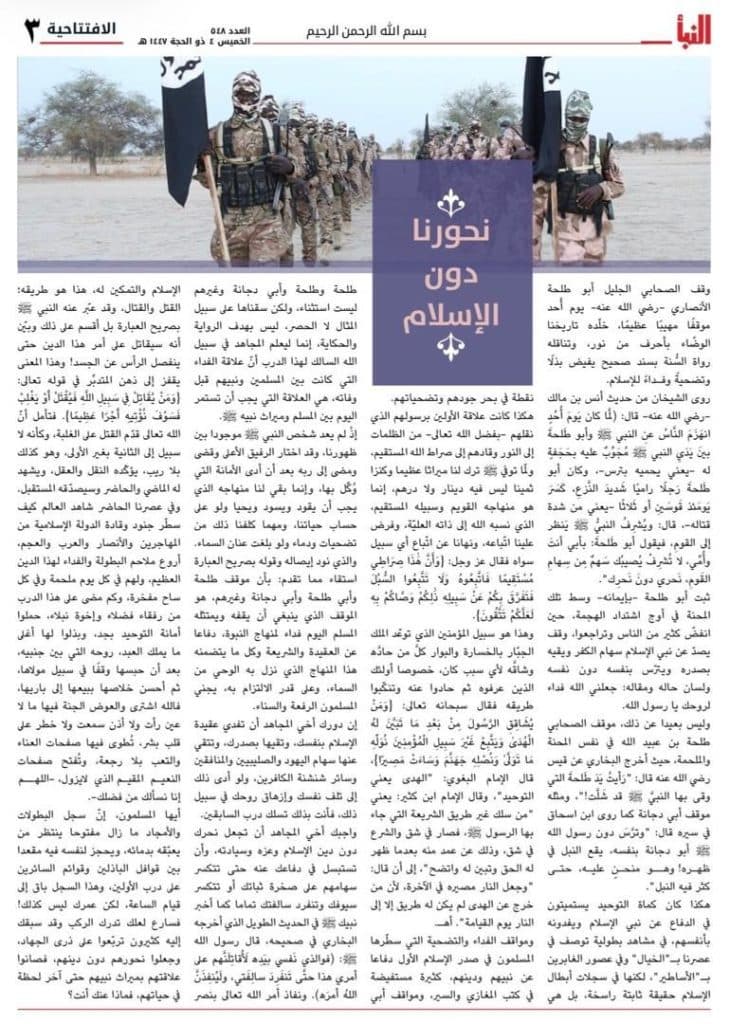
Everything in the editorial is deliberate. The piece opens on Talha ibn Ubaydullah, a companion of the Prophet Muhammad, at the Battle of Uhud. The selection is pointed in ways that any reader with a classical Islamic education would immediately recognise.
Uhud was a near-disaster for early Muslims because of an internal division. It was a battle in which archers abandoned their positions, turning a momentary advantage into a rout that left dozens of companions dead and the Prophet himself wounded.
What Islamic tradition preserved, and what the Al-Naba propaganda wanted to convey from that valley, however, was not only the memory of tactical failure but of individual men who placed their bodies between the Prophet and death – an important sacrifice for the existence of Islam.
The editorial tells ISWAP fighters who have fallen into fear, confusion, or doubt after the loss of Al-Minuki and other fighters that a similar situation occurred during the Battle of Uhud. However, because the Prophet’s companions believed they were fighting for Islam, they did not see it as a problem.
In essence, the message is that they may ultimately be killed, suffer injuries, or even think they have already achieved victory and begin collecting spoils of war, only for circumstances to turn against them. Yet, regardless of whatever hardships or setbacks they face, they should not regard themselves as having lost, because they are fighting for their religion.
“Your role, O my mujahid brother, is to make your chest a sanctuary for the religion of Islam and guard it with your body,” the editorial reads.
This is a recognisable pattern in IS editorial strategy. After senior commanders are killed, Al-Naba invokes early Islamic battles such as Badr, Uhud, and Khandaq as mirrors, casting present losses as the preconditions for eventual triumph. The rhetorical architecture is consistent and has appeared after every major command-level strike against the organisation. What changes each time is only the particular story pulled from the tradition.
In 2019, when Abubakar Al-Baghdadi, the former leader of Islamic State, died, Al-Naba compared the situation with that of early Muslims after the death of Prophet Muhammad, in which many of his companions fell into disbelief until they were calmed by the first caliph Abu Bakr As-Siddiq. Al-Naba issue 207 argued that if Islam could survive the death of the Prophet Muhammad, the Islamic State could also survive the death of Al-Baghdadi.
The choice of Talha in the recent issue of Al-Naba, specifically after the death of Al-Minuki, adds a layer to the editorial. Talha survived Uhud and fought many more campaigns. The editorial addresses not only those who died but also those who lived through the week. The message to fighters still alive in the Lake Chad Basin, still holding ground, is legible between every sentence.
“It is the duty of my mujahid brother to walk those same paths in defence of the religion of Islam, its honour, and its sovereignty,” the editorial says.
The crisis of succession
The theology in the Al-Naba editorial could steady nerves or explain deaths. It could also transform defeat into sacrifice. However, it could not answer the practical question now hanging over the movement: who would lead after Al-Minuki?
For years, ISWAP’s resilience has rested on its ability to survive leadership decapitation. Commanders and factional leaders have died, been assassinated, or removed. Yet the organisation endured because a pool of experienced first-generation figures remained available to absorb the shock. However, this time may be different.
A HumAngle analysis observed that Al-Minuki’s most likely successor was Ba Shuwa. However, he too may have been killed in the subsequent strikes; if confirmed, the movement would lose not only its most influential commander but also the man widely expected to replace him.
Al-Minuki belonged to a shrinking class of terrorists who entered the movement before the 2009 uprising transformed Boko Haram from a fringe extremist religious organisation into a regional insurgency. He embodied institutional memory, battlefield experience, and personal relationships that spanned multiple generations of fighters.
Ba Shuwa, although younger in status within the movement, still belonged to that older ecosystem. Their simultaneous deaths would accelerate a transition that many inside ISWAP had anticipated but few expected to happen so suddenly. The names now circulating inside insurgent circles to replace Al-Minuki and Ba Shuwa show the scale of that transition.
Among the strongest contenders, as HumAngle gathered, is Abu Salem, a commander who grew up entirely within the insurgency’s wartime environment. He reportedly combines military authority with religious credentials, a combination that carries considerable weight inside ISWAP’s hierarchy.
Another frequently mentioned figure is Bana Chingori, long regarded as a close associate of Ba Shuwa and an influential commander in his own right.
However, beneath the movement’s ideological claims lies a complex web of battalion loyalties, personal networks, ethnic affiliations, and historical rivalries. Fighters speak the language of the caliphate, but leadership legitimacy is often negotiated through social structures that long predate the insurgency itself. The question is not merely who is capable of leading, but who can command obedience across the various factions that make up the movement.
This is where the editorial in Al-Naba becomes more interesting. The Islamic State understands that leaders can be replaced. What is more difficult to replace is cohesion.
The editorial’s invocation of Uhud was not simply a sermon about perseverance. It was also an attempt to create continuity at a moment when continuity is under threat. By reminding fighters that early Muslims endured confusion after battlefield losses yet remained united, the editorial implicitly addresses the danger of fragmentation.
For nearly a decade, ISWAP distinguished itself from rival jihadist factions partly through its ability to maintain organisational discipline. While Boko Haram under Abubakar Shekau frequently splintered under pressure, ISWAP developed bureaucratic structures capable of surviving individual losses. The current transition will test those structures more severely than any succession crisis since the death of Abu Musab al-Barnawi and the removal of other senior figures from the Muhammad Yusuf generation.
The paused migration
Beyond the succession question lies another bigger development. ISWAP has announced that the flow of fighters migrating from Iraq and Syria to Nigeria has been effectively paused.
For years, the Islamic State’s call for migration to Africa was one of ISWAP’s most reliable sources of experienced foreign fighters. Foreign fighters who had trained and fought in the central theatre arrived in Lake Chad with tactical knowledge, ideological authority, and direct personal connections to IS central command.
Al-Minuki himself was a product of that ecosystem. The suspension reflects the bigger issue that ISWAP is facing, in which local ISWAP members feel foreigners are given more priority in the insurgency, and they’re being relegated. This, according to some sources, was one of the reasons that opened a loophole that led to the intelligence leading to the killing of Al-Minuki.
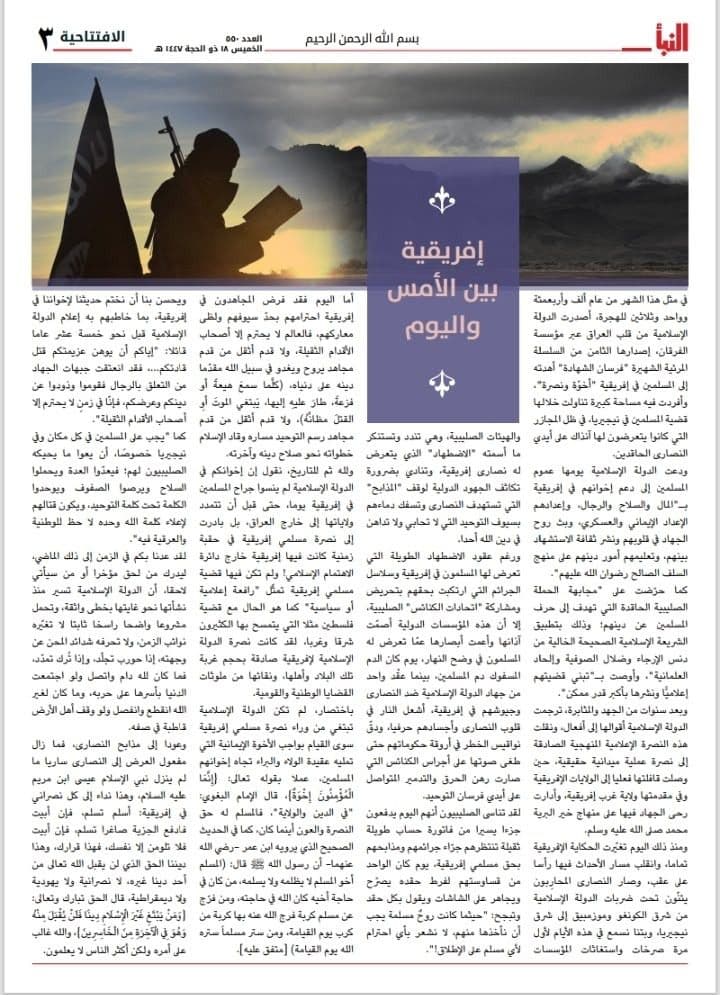
Al-Naba issue 550 addressed the question of migration indirectly. The editorial, titled “Africa Between Yesterday and Today”, spoke in the past tense about those who had already made the journey. “Those who came before you from Iraq walked this path,” the editorial told terrorists currently in Africa, “and they carried the weight of this religion on their shoulders.”
The joint US-Nigeria strike that killed Al-Minuki demonstrated a targeting capability that ISWAP had not previously faced at this intensity in the Lake Chad theatre. The use of American intelligence assets alongside Nigerian special forces created a surveillance environment that makes the movement of senior figures, especially those arriving from abroad, significantly more dangerous than before.
For IS central, sending experienced insurgents into a degraded environment risks losing irreplaceable assets to an adversary that has now demonstrated it can find and kill the most protected figures in the organisation. The pause in migration is both a strategic retreat and a rational response to changed targeting conditions.
The commanders now being discussed as replacements for Al-Minuki are men who grew up entirely inside the Nigerian insurgency. Whatever their capabilities, they appear to lack the cross-theatre experience and IS central relationships that figures as Al-Minuki carried. The migration pause has narrowed the field of who can credibly lead it.
Support Our Journalism
There are millions of ordinary people affected by conflict in Africa whose stories are missing in the mainstream media. HumAngle is determined to tell those challenging and under-reported stories, hoping that the people impacted by these conflicts will find the safety and security they deserve.
To ensure that we continue to provide public service coverage, we have a small favour to ask you. We want you to be part of our journalistic endeavour by contributing a token to us.
Your donation will further promote a robust, free, and independent media.
Comments
0 comments
No comments yet.
Sign in to join the discussion.
Of course, we want our exclusive stories to reach as many people as possible and would appreciate it if you republish them. We only ask that you properly attribute to HumAngle, generally including the author's name, a link to the publication and a line of acknowledgement.