Shrinking Lake Threatens Livelihoods in Adamawa Amid Poor Management
Once a thriving source of livelihoods that supported farming, fishing, and economic growth in Adamawa, northeastern Nigeria, the Geriyo community is facing growing hardship over the diminishing status of Lake Geriyo.
Listen to this story

5 Jun 2026
“Life was good back then. We had everything in abundance.”
When Jummai Usman says this, she is anchoring herself to a version of Geriyo, a community in Yola, Adamawa State, in northeastern Nigeria, that younger generations in the area may never know.
Born and raised on the shores of Lake Geriyo, she considers this place her ancestral home. Her parents were fish traders, and she married a fisherman. Her husband would catch the fish and bring them to her to roast and sell to traders, and for decades, this trade sustained them and their children.
Jummai, then married, was 16 years old when the Federal Government of Nigeria established the Lake Geriyo Irrigation Project in 1976. The 24-hectare initiative was managed by the Upper Benue River Basin Development Authority (Upper Benue RBDA) in Yola, under the Federal Ministry of Water Resources.
It began with 52 registered local farmers, offering them irrigation water and modern agricultural extension services, with water pumped directly from the River Benue. Residents were excited about the project at the time, Jummai recalled, and considered it a means of advancement. Farmlands were carved out and assigned to registered farmers, and an office was established to oversee these activities.
“We paid a fine back then, but I don’t remember how much. My husband paid for it. We called it the water and land levy,” Jummai, who is now 66 years old, said.
Over time, more people flocked to the area, and the lakeside settlement gradually expanded. The site has since grown to cover 429 hectares and now accommodates more than 2,000 farmers.
Among them are people like Ali Usman*, who built his life around Geriyo Lake. He moved to the area at the age of 15 and has lived there for about 25 years, farming and fishing along the lake. “I rent three hectares of land annually. I used it to harvest 100 to 120 bags of rice combined,” he said.
Now a father of seven, Ali fears he may no longer be able to provide for his family, as farming and fishing around Geriyo are becoming harder for thousands who depend on the lake for survival.
Long credited with improving livelihoods in the area, the Lake Geriyo Irrigation Project is now at the centre of a slow-moving crisis: a shrinking lake, years of institutional neglect despite millions of naira in rehabilitation funds, and a community that has lost its home. HumAngle spoke to several of the residents, who described losing their livelihoods to years of neglect that have left the lake overwhelmed.
‘Geriyo Lake is dying’
The ecological collapse of Geriyo Lake did not happen overnight. Residents have watched it shrink steadily over the years, especially over the past five years, as its waters have receded, its fish have become scarce, and its capacity to sustain farming and fishing has diminished season by season.
Jummai, who has seen the lake in its glory, says it is dying. She believes the shrinking is responsible for the decline in fishing in the area. “Even when we were living by the riverbank decades ago, the place barely got flooded,” she said, adding that the lake had depth back then.
The heavy rainfall on May 18 in Yola brought much-needed relief to farmers in the area, marking the start of the farming season. However, it also stirred fear and concern among the residents of the Geriyo community. Residents say that if the rain continues at this intensity, their homes and farms may be submerged, and farming will come to a standstill.
Since farmland is usually flooded during the rainy season, some residents told HumAngle they had stopped farming in the area. Others, however, still take the risk, even though the results are often catastrophic.
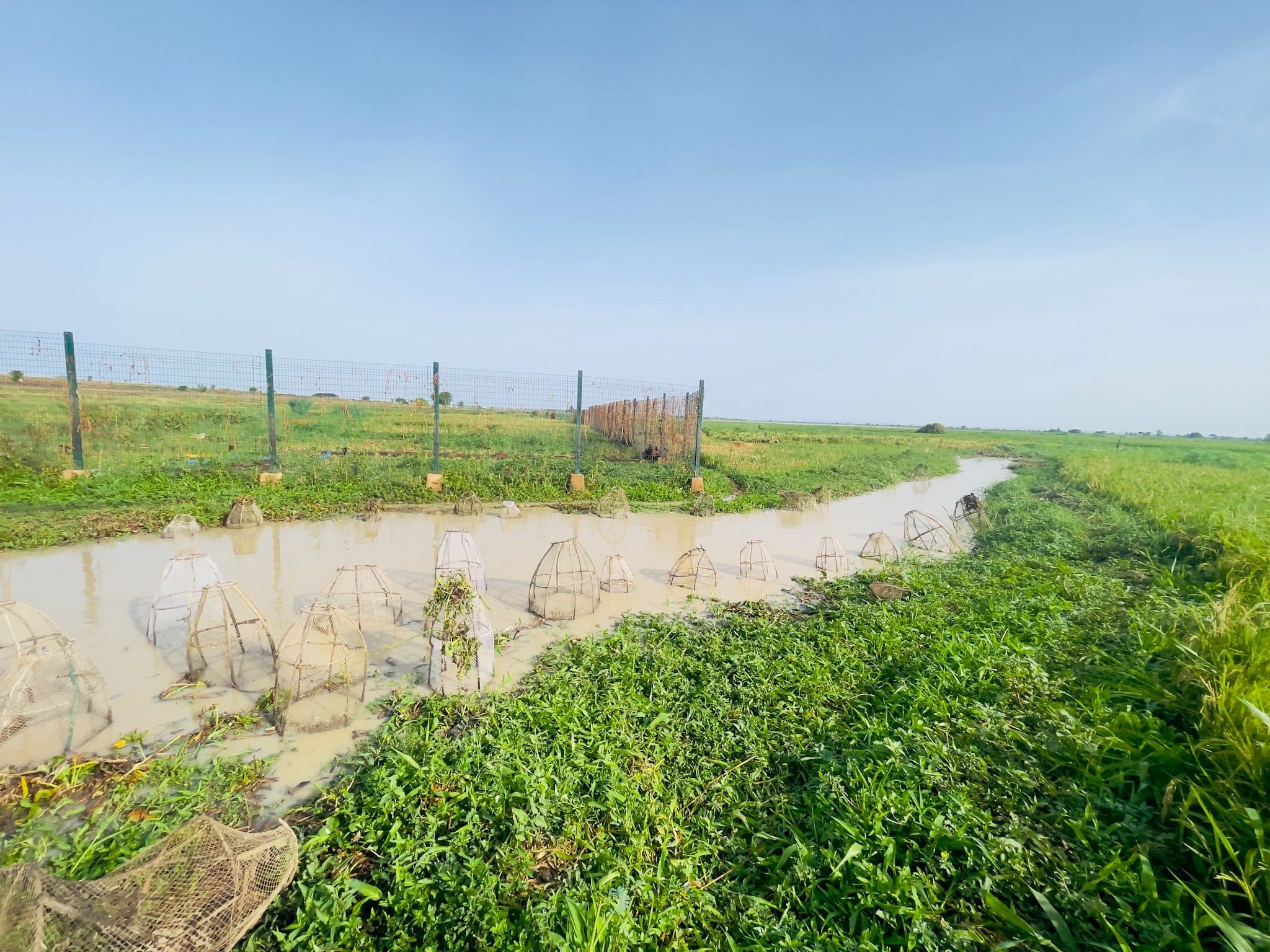
While this fear lingers in the hearts of farmers who are yet to harvest the crops they planted during the dry season, some fishermen seized the opportunity to cast their nets, as they haven’t done so in a while due to the shrinking lake.
“Fish are scarce. We don’t get it like before, so we take advantage of every water channel across the lake to cast our net,” a fisherman in the area told HumAngle, adding that the shrinking lake has affected his trade in the area, making what was once a regular activity only an occasional one.
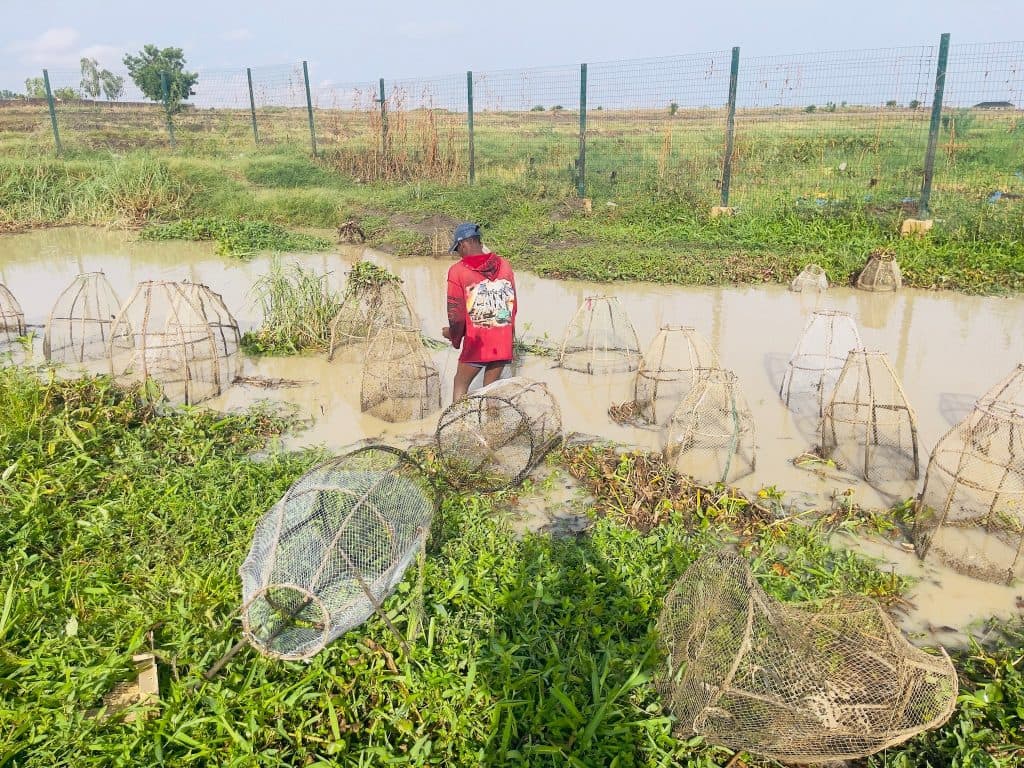
Bala Abubakar*, another fisherman in the area, said that overfishing, the shrinking of Lake Geriyo, and poor regulatory practices all contribute to the challenges faced by fishermen. Even though regulations stipulate that only registered fishermen are allowed to fish in the lake, and guards have been stationed to secure the lake at night, Bala said some fishermen still bypass these rules by paying a token fee to the guards.
To control fishing in the area, HumAngle learned, the Geriyo Lake is often declared closed by the Upper Benue RBDA and then reopened for a limited period – typically during the dry season when the lake dries up.
“At the time the lake will be opened, there will be a leader for each group, and the leader will present the list of his group members, and they might say the group will pay a hundred or ₦200,000 as a passage fee. It depends. And when the lake opens, the group members will go and catch fish for specific months,” Bala explained.
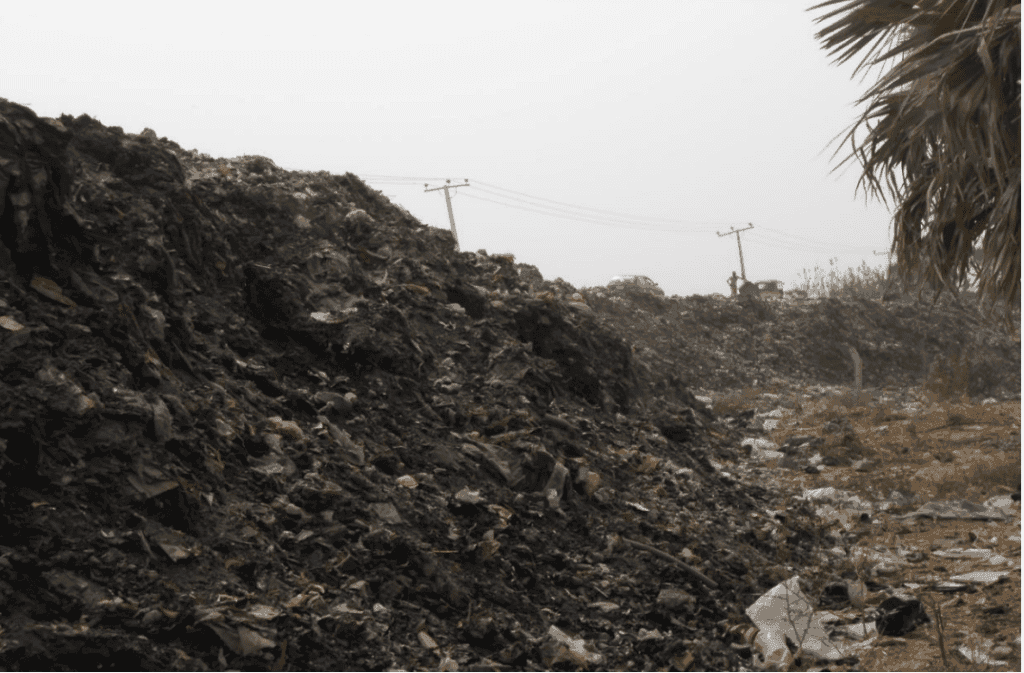
An environmental assessment by researchers at the Federal College of Education, Yola, in 2024 found that fish populations in Lake Geriyo are declining due to largely unregulated fishing practices. The researchers stated that severe pollution of the lake, caused by urban waste and agricultural runoff, has also displaced the fish. The effects are visible in the market.
Rukaiyatu Sani, a resident of Geriyo and a fish seller, says her business has suffered over the past few months. She noted that when the fishermen make a catch, they sell the fish at a higher price because they have other water levies to pay. “For instance, we used to buy a basket of fish for ₦20,000, but now we buy at either ₦40,000 or ₦45,000,” she said.
Bashir Abubakar, a professor of environmental resource management at Modibbo Adama University, Yola, corroborated the researchers’ findings. He attributed the shrinking to “a lot of things”, including siltation. “There are encroachment and unsustainable land uses, overfarming, overfishing, tree cutting, and sediment erosion from urban expansion activities around the lake. So all these are inimical to the survival of the lake itself,” he said.
Bashir explained further that the recurring floods in the Geriyo area stem from its close hydrological relationship with the Benue River — itself under severe stress.
“When the River Benue becomes full as a result of heavy rainfall, Lake Geriyo also becomes full. When there is a reduction in the size or volume of water in the River Benue, naturally, Lake Geriyo too becomes relatively dry,” he said, adding that siltation, climate change, population explosion and pollution are the basic issues affecting Geriyo.
“More than 70 per cent of what used to be the river Benue is now land with evidence of permanent vegetation, which shows water has not been reaching those places. So this one affects Lake Geriyo, too,” the professor said.
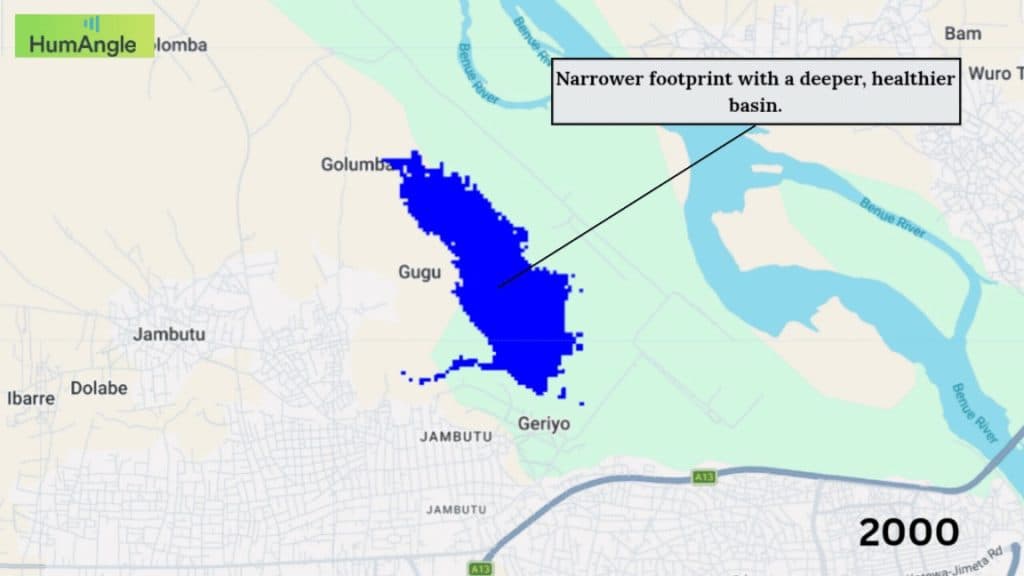
We used a combination of planetary mapping tools in Google Earth Engine to track the lake’s footprint over more than two decades. We pulled historical data from NASA and the USGS’s Landsat 9 satellite to map Lake Geriyo as it was in 2000, and contrasted it with high-resolution imagery captured by the European Space Agency’s Sentinel-2 satellite in 2026.
From high above, satellite images of Lake Geriyo reveal a vital ecosystem being choked to death from the bottom up. As the lake loses depth, it accumulates soil over the decades through soil erosion, causing loose soils to progressively fill the lake’s deep basin with mud.
The satellite imagery shows that the visible water area actually climbed from 1.28 sq km to 1.91 sq km. Meanwhile, the terrain satellite explains why: the average slope of the entire lake basin is a mere 1.35 degrees, a gradient so low that the choked water has nowhere to go but out, creating a shallow basin detrimental to both aquatic and life near the banks.
While fishermen in the area are grappling with a changing environmental landscape, farmers are also bearing the brunt of Geriyo’s degradation, which leads to annual flooding and loss of soil fertility.
For instance, Ali, who used to harvest over 100 bags of rice from his combined three hectares, now barely makes half that amount. “If I get 50 bags, that means I am lucky,” he said.
The Lake Geriyo Irrigation Project, established primarily to provide irrigation and agricultural extension services to local farmers in the region, appears to be falling short of its mandate to supply water. While some locals attribute this to the lake’s shrinking, others believe the rise in fuel prices is to blame.
Farmers say they pay a standard levy, but not all of them have access to the same level of service. The higher the service fee paid, the higher the quality of service one can expect from the Upper Benue RBDA office at Geriyo, according to local sources.
“I pay ₦4000 per bed, which only covers the rent fee for land. Those who pay higher enjoy access to irrigation services from the office. Their farms are supplied with enough water, and their harvests are always bountiful compared to ours,” he said.
The complaints about unequal access to irrigation come despite significant public spending on the project in recent years.
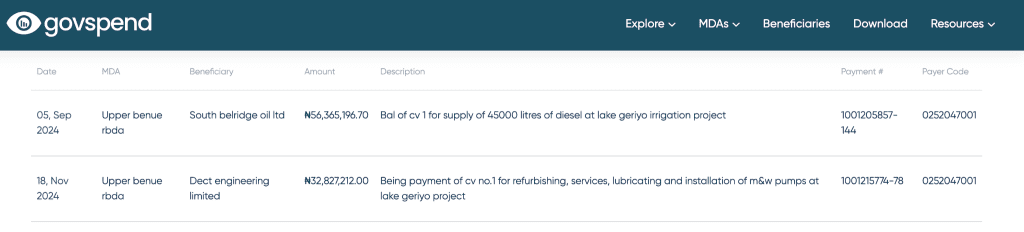
Records on GovSpend, a civil society-run platform that tracks and analyses federal government spending, show that ₦32,827,212 was paid to Dect Engineering Limited for “refurbishing, services, lubricating, and installations of M&W pumps at Lake Geriyo Project” on Nov. 18, 2024. Another ₦56,365,196 was paid to South Belgride Oil on Sept. 5, 2024, for the supply of “45,000 litres of diesel” to the site. Both payments were made under the supervision of Upper Benue RBDA.
Despite these investments, farmers say the benefits are not evenly distributed. In Geriyo, the irrigation plant operates mainly between December and May annually, the area’s peak irrigation season, with water pumped two to three times a week. While this suggests that the system is functional, access to the pumped water remains unequal. Consistent with earlier complaints, farmers who pay higher levies receive water directly from the irrigation network, while lower-paying farmers often have to fetch water from the lake themselves.
The disparities extend beyond water access. HumAngle learned that land allocation is also linked to rental costs, with more expensive plots generally regarded as more fertile. Ali said he pays between ₦70,000 and ₦100,000 per year in land rent, while others pay more. Since all fingers are not equal, low-income farmers suffer most from environmental degradation.
The sudden notice to vacate
The ecological crisis, devastating as it is, has been compounded by a series of state decisions that have left the community with nowhere to turn.
In 2023, locals living along Geriyo Lake received a notice from the local office ordering them to leave the area. While some residents left within weeks of the notice being issued, others remained. For Jummai, Geriyo is the only place she has ever known, so she had nowhere else to go.
“We were told that the place belonged to the Adamawa Emirate Council, so the government came to take over,” Ali said. “When they noticed that we were not willing to leave our homes, they gave us a total sum of ₦5 million, which was shared among every household that was yet to vacate the area back then. Each household got ₦57,000, and since people were hungry, we took the money, packed the items we could carry and left our homes.” Jummai’s family also received the money.
A few days after the locals left, houses at the Geriyo Lake were destroyed. The site was declared a government property, and a wall was erected. During a visit to the area in May, HumAngle observed that the fence area is yet to be developed.
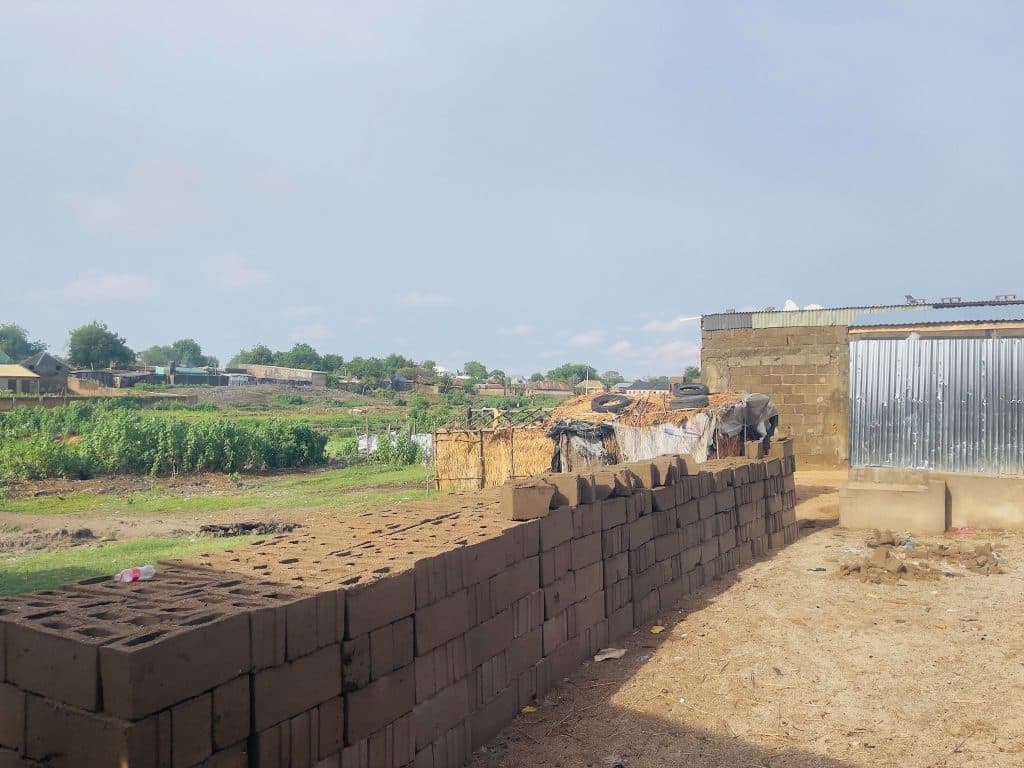
Ali told HumAngle that since the sum each household received was insufficient to pay rent for large households or to secure new homes, the affected group went to an open field behind the lake, erected makeshift homes, and settled there so they could continue farming and fishing.
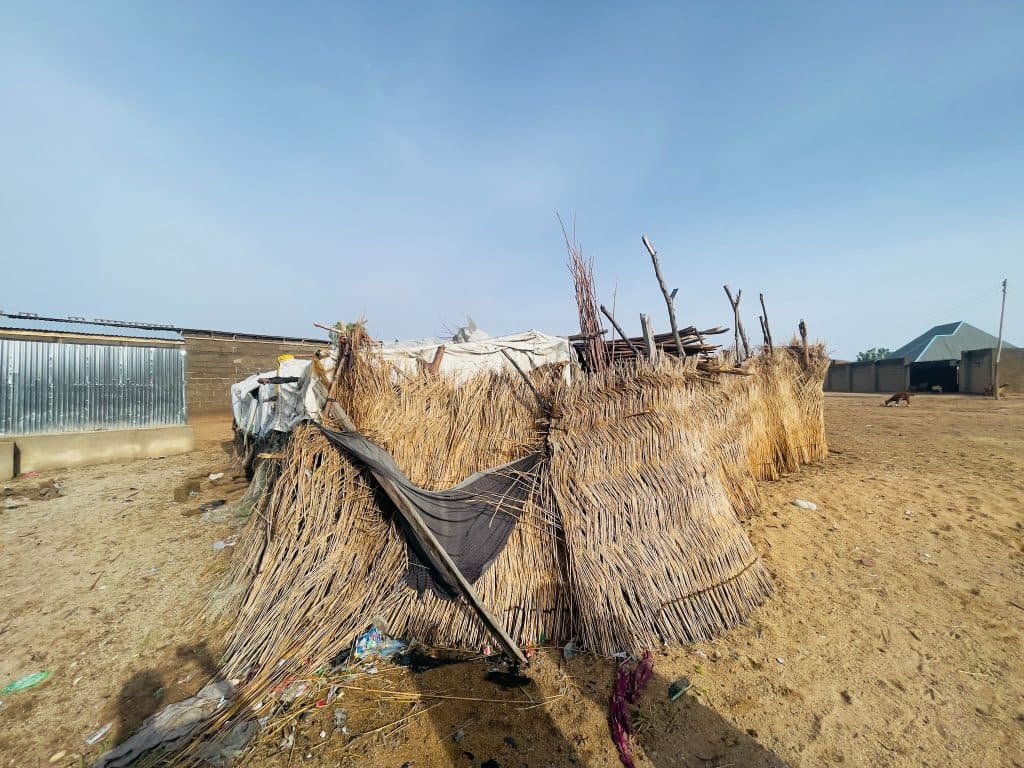
For Jummai, being dislodged from Geriyo Lake meant being stripped not just of her ancestral home but also of her access to a good life. “Before the government came with vehicles and levelled our houses, I lived with my husband and children in a decent home,” she said. Jummai now lives in a makeshift tent with her family. They still fish, but occasionally.
Bashir believes that humans are stewards of the environment, and that displacing them undermines the very interventions meant to save it.
“Whatever policy that the government or any agency is making in those areas towards curtailing or reversing what has already happened there, the human perspective should be taken much more seriously within the context of sustainability,” he said, adding that dislodging the dwellers strips every intervention of the human element needed to maintain the environment and sustain livelihoods.
₦500 million, and not so much to show
Another damning dimension of Geriyo’s crisis is not ecological, but administrative.
According to EYEMARK, a government-run digital platform that tracks federal infrastructure projects, more than ₦500 million was allocated for the rehabilitation of Lake Geriyo, which was made by the Federal Ministry of Water Resources to the Upper Benue RBDA from 2019 to 2024, with the project listed as the Yola Reclamation (Lake Geriyo) Project. EYEMARK indicates that the project is ongoing and only 1 per cent complete.
When HumAngle visited the site in May, there were no visible construction activities.
HumAngle filed a Freedom of Information (FOI) request with the Upper Benue RBDA in Yola, seeking information and documents related to dredging, ecological restoration, irrigation, and other related development projects in line with the Lake Geriyo project. We also sought information on the funds appropriated by the Federal Ministry of Water Resources for the Lake Geriyo project from 2019 to 2024.
The Authority had not responded to the FOI request at the time of publication.
Residents around Geriyo, however, said the river has never been dredged.
“One time, we got frustrated over the services and reported to the local office, but nothing was done. We even went to the local radio station to voice our grievances, but nothing has changed,” Ali said.
According to Bashir, effective management of the Geriyo area would require collaboration between the governments of Nigeria and Cameroon, since the Ladgo Dam flows into the Benue River, meaning that what happens upstream has direct consequences for Geriyo’s downstream.
“There is no strong commitment on the part of our government in terms of having a bilateral agreement with Cameroon as to the management of the river itself. So that is why we are always at the receiving end,” he said.
Anxiety heightens
The rainy season has just begun, and Geriyo residents are already on edge, particularly farmers who are yet to complete their harvest from the dry-season farming.
Bashir, the environmental expert, warns of long-term risks if Geriyo Lake is not dredged and rehabilitation measures are not implemented. “The river is becoming shallower and shallower. So whenever we have a lot of water, the river will not contain the water. So you find that the entire floodplain is submerged, with losses of agricultural land, houses, and so on. So these are, of course, things that are increasing year in year out,” he said.
Bashir added that since the government has not taken technocentric measures such as dredging the river, residents can settle for local measures to protect the land and the river.
“People should be encouraged to plant trees. If there will be massive afforestation within those areas, I’m very much sure it will go a long way in addressing the issue and reversing it to some level,” he said, adding that planting trees at the riverbanks and areas within the floodplain will help attenuate and reduce the effect of the rainfall.
Two years on, households like Jummai’s continue to live in makeshift shelters behind Geriyo Lake. When the area floods, they gather their belongings and relocate to higher ground. Since the farmlands also flood, the men resort to fishing alone, but even that becomes highly competitive at times. “During the rainy season, when the sites get flooded, the area is left unregulated, and everyone can fish there,” Bala said.
Despite the degradation of the once-thriving Geriyo community, fishermen and local farmers still arrive in their hundreds every day at the lake, hoping to make a catch or bring in a bountiful harvest.
But a far greater problem looms. A private individual and a construction company have bought the land where Jummai and her community members have erected makeshift tents. One day, they might be asked to leave.
*Names with asterisks were used to protect some of the sources.
Satellite analysis and illustration by Mansir Muhammed.
Support Our Journalism
There are millions of ordinary people affected by conflict in Africa whose stories are missing in the mainstream media. HumAngle is determined to tell those challenging and under-reported stories, hoping that the people impacted by these conflicts will find the safety and security they deserve.
To ensure that we continue to provide public service coverage, we have a small favour to ask you. We want you to be part of our journalistic endeavour by contributing a token to us.
Your donation will further promote a robust, free, and independent media.
Comments
0 comments
No comments yet.
Sign in to join the discussion.
Of course, we want our exclusive stories to reach as many people as possible and would appreciate it if you republish them. We only ask that you properly attribute to HumAngle, generally including the author's name, a link to the publication and a line of acknowledgement.